Astronomy & Astrophysics
-
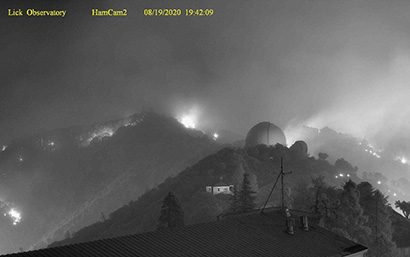
UC’s Lick Observatory threatened by fire
Residences on Mt. Hamilton sustained some damage, but fire crews have so far been able to protect the observatory’s telescope domes and visitor center.
-
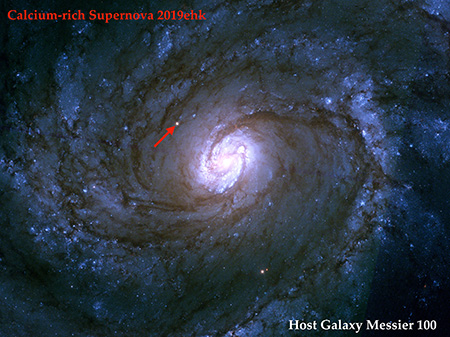
Calcium-rich supernova examined with x-rays for first time
An international team has obtained unprecedented observations of a rare calcium-rich supernova.
-
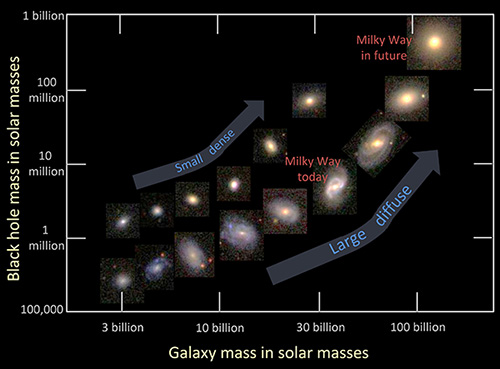
How galaxies die: New insights into the quenching of star formation
A simple model explains a wide range of observations by describing a contest between galaxy halos and their central black holes that eventually turns off star formation.
-

Astrophysics graduate student Diana Powell wins 2020 Ford Fellowship
Powell won a Ford Foundation Dissertation Fellowship to support her work as she completes her Ph.D. thesis on exoplanets.
-
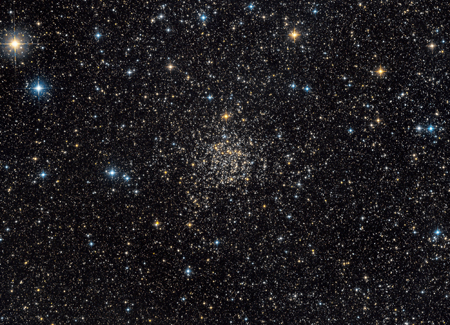
White dwarfs reveal new insights into the origin of carbon in the universe
A new analysis of white dwarf stars supports their role as a key source of carbon, an element crucial to all life, in the Milky Way and other galaxies.
-

Physicist Tesla Jeltema wins Mentorship Award from American Physical Society
An accomplished astrophysicist, Jeltema is also a champion for diversity and a dedicated supporter of students at all levels.
-
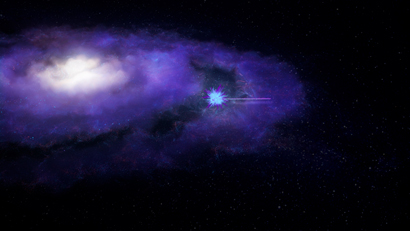
Universe’s ‘missing matter’ finally found in the space between galaxies
An international team of astronomers has solved the decades-old mystery of the ‘missing matter’ long predicted to exist in the universe but never before detected.
-

Astronomers create cloud atlas for hot, Jupiter-like exoplanets
Giant planets in our solar system and circling other stars have exotic clouds unlike anything on Earth, and the gas giants orbiting close to their stars—so called hot Jupiters—boast the most extreme.
-
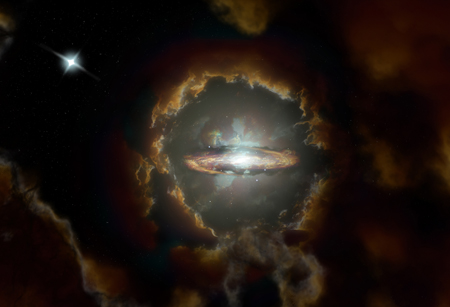
Astronomers discover a massive rotating disk galaxy in the early universe
The discovery by an international team of astronomers of a massive rotating disk galaxy, seen when the universe was only ten percent of its current age, challenges traditional models of galaxy formation.
-
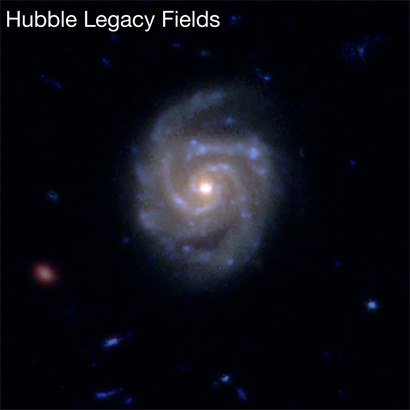
Powerful new AI technique detects and classifies galaxies in astronomy image data
UCSC researchers developed a deep-learning framework called Morpheus to perform pixel-level morphological classifications of objects in astronomical images.
-

Watch UCSC participants talk about hope during TEDx Santa Cruz
Last December, TEDx Santa Cruz hosted a day-long extravaganza of talks curated around the theme of “The Art of Hope.” Those talks, including ones by several UCSC affiliates, are now available for online viewing.
-
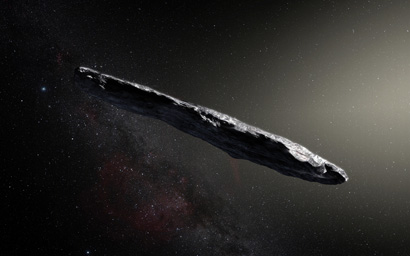
New formation theory explains the mysterious interstellar object ‘Oumuamua
A new scenario based on computer simulations accounts for all of the observed characteristics of the first known interstellar object to visit our solar system.