Earth & Space
Astrophysicist Stan Woosley awarded two of astronomy’s top prizes for seminal studies of supernovae
Longtime professor wins the 2026 Shaw Prize in Astronomy and the 2026 Gruber Cosmology Prize back to back
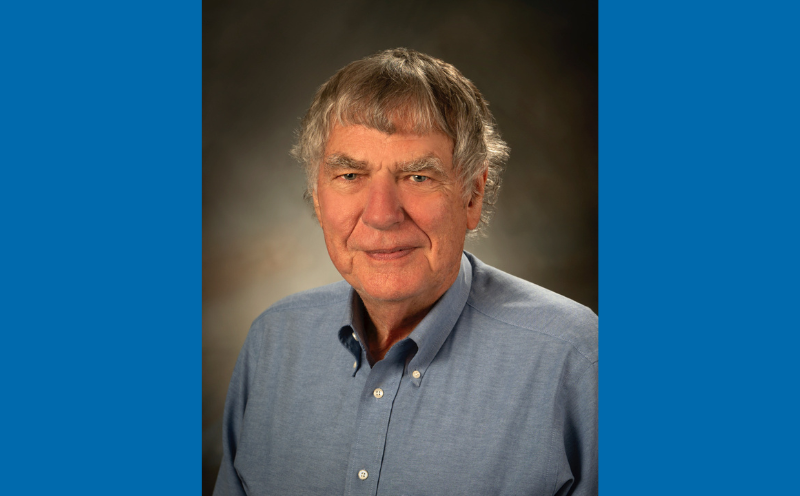
Stan Woosley has been a professor in the Department of Astronomy & Astrophysics at UC Santa Cruz since 1975 and chaired the department from 1989 to 2003.
Press Contact
UC Santa Cruz astrophysicist Stan Woosley has solidified his place as one of the world’s foremost experts in exploding stars, or supernovae. On May 27, the longtime professor of astronomy and astrophysics was named a co-recipient of the prestigious 2026 Shaw Prize in Astronomy. Just eight days earlier, he was awarded the 2026 Gruber Cosmology Prize, another honor that ranks among the highest in the field.
Woosley shares both prizes with Ken Nomoto, an emeritus professor at the University of Tokyo. Their work has been almost entirely independent and often complementary, according to the Shaw Prize Foundation, which recognized them for their studies of stellar explosions and the origin of the elements.
The foundation stated that Woosley, Nomoto, and their collaborators have played a central role in advancing our understanding of the end stages of stellar evolution, the observational signatures and diverse origins of supernovae and other stellar explosions, and their production of new chemical elements. Their models—especially of light curves (luminosity and spectra vs. time) and the formation of new elements (nucleosynthesis)—have guided increasingly sophisticated and extensive observational studies and anchored the interpretation of these research programs.
In addition, Woosley and Nomoto pioneered detailed calculations that track the evolution of massive stars from their birth to core collapse. Their calculations illuminated, and in some cases predicted, the large zoo of supernova types such as electron-capture supernovae, hypernovae, superluminous supernovae, stripped-envelope supernovae, and pair-instability supernovae.
Some core-collapse supernovae give rise to brief, intense bursts of gamma rays bright enough to be visible across the universe. Woosley is responsible for developing the “collapsar” model of such gamma-ray bursts, in which a supernova explosion leads to a black hole or neutron star surrounded by a rapidly rotating accretion disk.
Woosley and Nomoto shared the 2026 Gruber Cosmology Prize with UC Berkeley astrophysicist Alex Filippenko, a major user of Lick Observatory. The Gruber Foundation said the three professors deserved the prize because they “have transformed not just the science of exploding stars but astronomy itself.”
The Yale-based Gruber Foundation—which also honors and encourages educational excellence in the fields of genetics, neuroscience, and justice and women’s rights—began awarding its cosmology prize in 2000. The Hong Kong-based Shaw Prize Foundation presented its first awards in 2004 to recognize fundamental contributions in the fields of astronomy, computer science, life sciences and medicine, and mathematical sciences.