Earth & Space
Astronomers clarify exoplanet atmospheres with new cloud-detection technique
Discovery led by UC Santa Cruz Ph.D. of daily cloud cycle on a hot Jupiter exoplanet provides unique window into its make-up
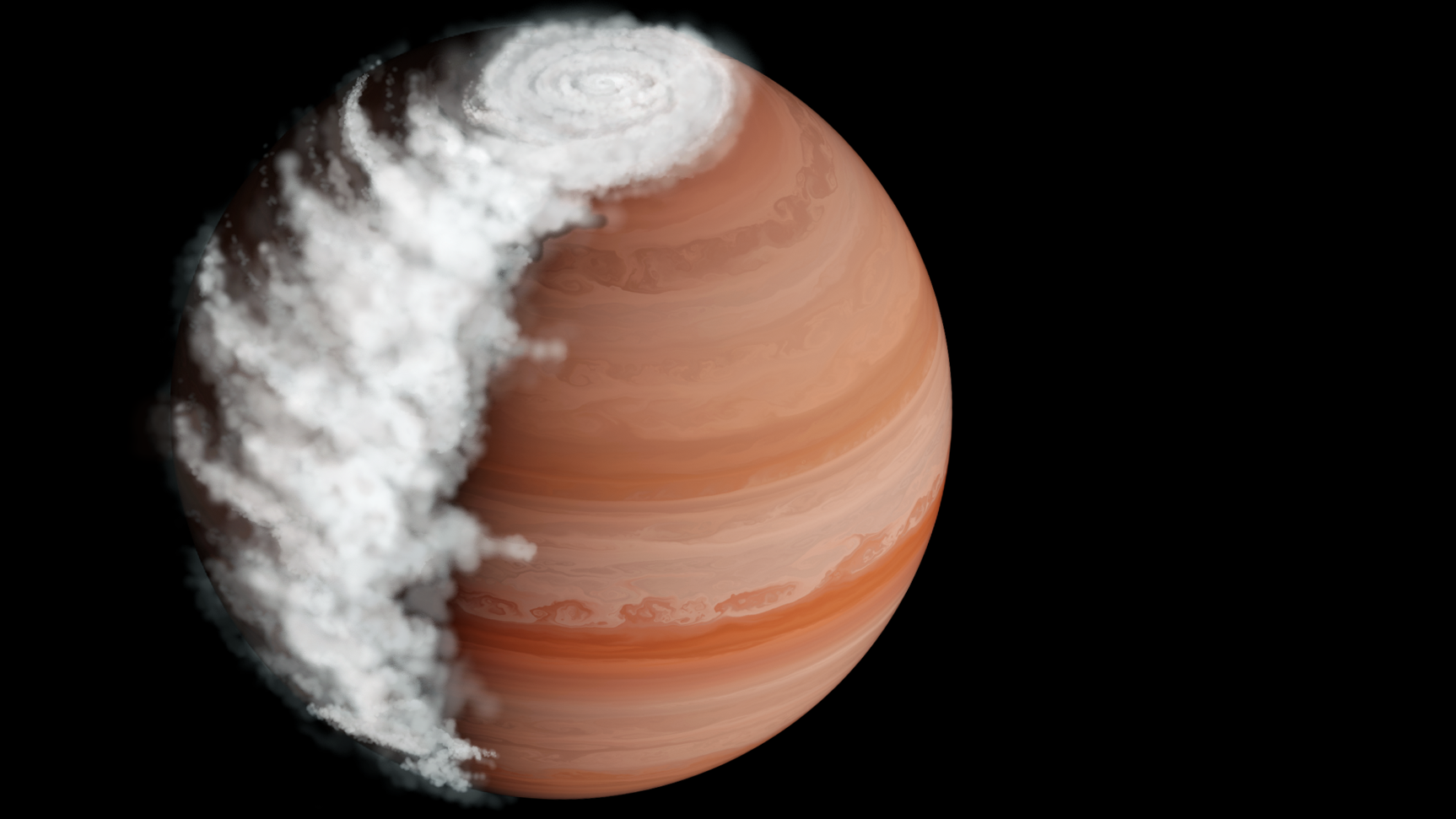
An artistic rendition of exoplanet WASP-94A b
Credit: Hannah Robbins, Johns Hopkins University
Press Contact
Key takeaways
- Using the James Webb Space Telescope, researchers found that a planet 700 light-years away has a daily cycle where mineral clouds form in the cool morning and completely evaporate by the scorching evening.
- Instead of blurring the cloudy and clear sides of the planet together like older telescopes did, this new technique allows scientists to look through the clear evening skies. This revealed that the planet’s chemical makeup is much closer to our own Jupiter than previously thought.
For students at the University of California, Santa Cruz, fog is an all-too-familiar dynamic that shrouds and ebbs from campus over the course of a day. But while working toward his Ph.D. in astronomy and astrophysics at UC Santa Cruz, Sagnick Mukherjee’s head was in the clouds of atmospheres hundreds of light years from Earth.
Mukherjee models planetary atmosphere-interior interactions to probe persistent mysteries about worlds beyond our solar system. And in his newest study, using data from the James Webb Space Telescope (JWST), he and a team of researchers are among the first to report the detection of cloud cycles on a Hot Jupiter exoplanet named WASP-94A b.
On this gas giant, nearly 700 light years away from Earth, sand clouds form every morning but clear up by nightfall. By isolating the clouds, researchers can more accurately measure the planet’s atmosphere and provide one of the clearest pictures to date of the planet’s composition—a significant advance in planetary science.
Their results were published on May 21 in the journal Science.

“Understanding this planet-wide cloud cycle is critical for determining how these distant exoplanets formed and evolved, and how they differ from solar system gas giants like Jupiter or Saturn,” said Mukherjee, now a postdoctoral fellow at Arizona State University supported by a prestigious 51 Pegasi b Fellowship awarded by the Heising-Simons Foundation.
A clearer view
By analyzing the light passing through WASP-94A b’s limbs as it crossed its star, the team found that the “morning” side is completely covered in thick clouds, while the “evening” side is much hotter and clear enough to show signs of water vapor. This distinct split helps solve a long-standing mystery: the clouds on these hot, giant planets are likely made of minerals like iron and silicates that cycle through the atmosphere, rather than being a permanent “smog” caused by chemical reactions driven by high-energy starlight.
On the cooler night side of the planet, these mineral vapors condense into droplets deep in the atmosphere. Intense winds then lift them high into the sky, creating a total whiteout on the morning side. As these clouds are blown toward the evening side, where temperatures are about 300 degrees hotter, they evaporate and vanish, leaving the sky clear, Mukherjee explained.
“I’ve been looking at exoplanets for 20 years, and general cloudiness has been a thorn in our side. We’ve known for quite a while that clouds are pervasive on Hot Jupiter planets, which is annoying because it’s like trying to look at the planet through a foggy window,” said study co-author David Sing, a professor of Earth and planetary sciences at Johns Hopkins University. “Not only have we been able to clear the view, but we can finally pin down what the clouds are made out of and how they’re condensing and evaporating as they move around the planet.”
Because the evenings are clear of clouds, the researchers could look to the trailing edge specifically to see what the atmosphere of the planet looked like—something the Hubble telescope could not provide.
“With the Hubble telescope, when we used to do this type of observation, we got an average view of the whole planet with data from the clouds and the atmosphere squished together and indistinguishable,” Mukherjee said. “This approach with the JWST lets us localize our observations, which helped us see the cloud cycle.”
A benchmark for broader exoplanet study
When the researchers looked at the clear evening sky, they found that WASP-94A b was much more like Jupiter than they thought. Previously, when the clouds were averaged in, the data suggested the planet was made of hundreds of times more oxygen and carbon than Jupiter—a finding that baffled researchers given it couldn’t be explained by planet formation theory. The new data, however, shows WASP-94A b has only five times the amount of oxygen and carbon.
Hot Jupiter planets orbit much closer to their stars—closer even than Mercury to the sun—and therefore are much hotter and are exposed to more radiation. Because of their extreme environments, these planets also make good laboratories to study the chemistry and physics of cloud dynamics.
Using WASP-94A b as a benchmark, the team looked at eight other hot gas giants and discovered the same distinctive cloud cycle on two other worlds: WASP-39 b and WASP-17 b. Next, Mukherjee, Sing and their team will study the cloud cycling across a wide variety of exoplanets using data from a new large JWST program, including an eccentric gas giant planet in the habitable zone.
“By observing the two sides of the planet separately, we show that we can get a much more accurate picture of what these distant worlds are made of and how their powerful winds and weather systems function,” Mukherjee said. “Our study shows that understanding such weather systems is also important for understanding a diverse variety of exoplanets other than gas giants, including smaller sub-Neptunes and Earth-like rocky planets as well.”