Technology
Ashesh Chattopadhyay named Schmidt Sciences AI2050 Early Career Fellow
Chattopadhyay will build steerable AI for science models with the prestigious fellowship
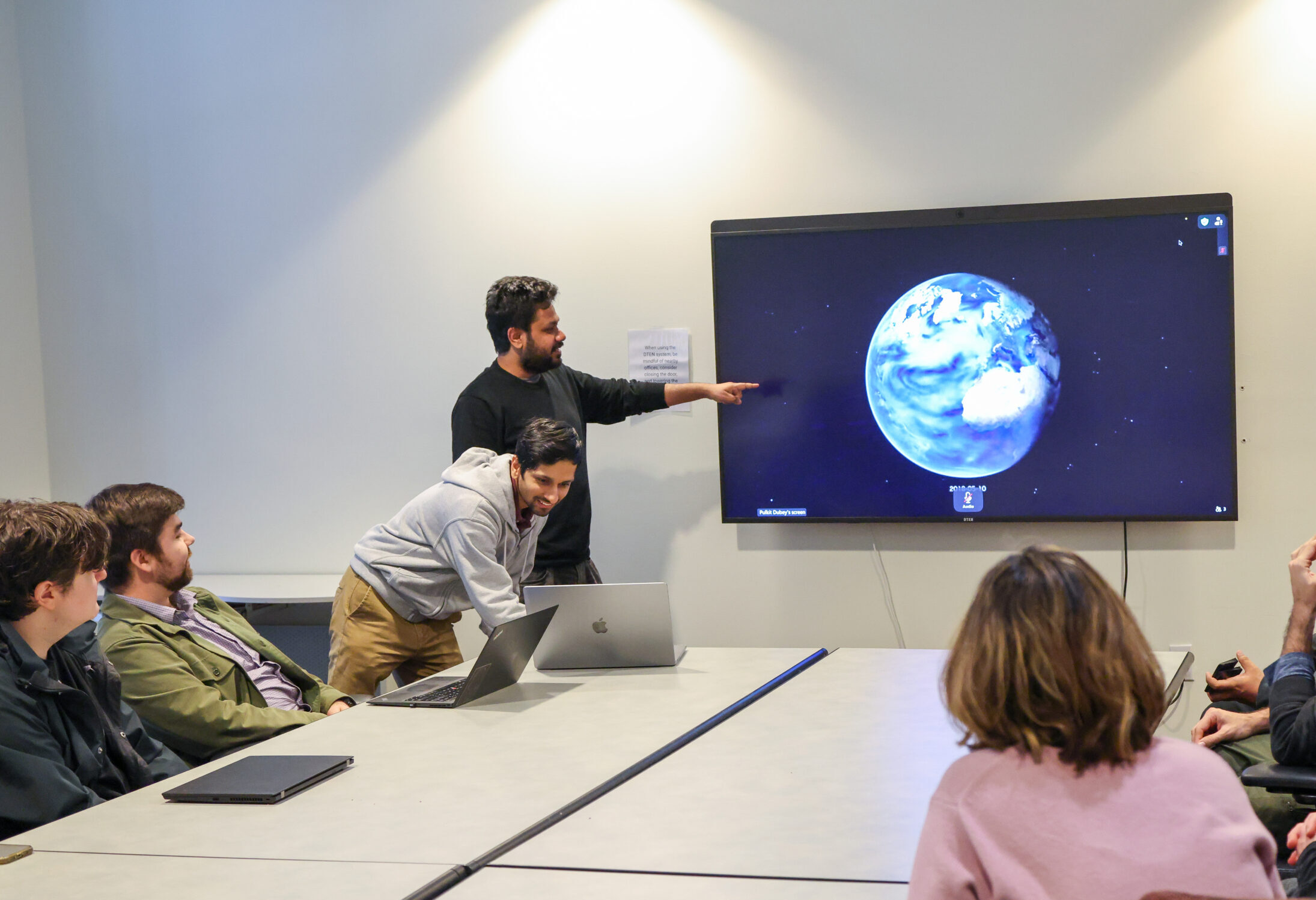
Ashesh Chattopadhyay's lab focuses on theoretical advancements in AI to improve Earth system modeling.
Carolyn Lagattuta
Press Contact
Ashesh Chattopadhyay, an assistant professor of applied mathematics at the University of California, Santa Cruz, has been named an AI2050 Early Career Fellow by Schmidt Sciences.
The AI2050 program supports researchers to pursue bold and ambitious work on hard problems in AI, which are often multidisciplinary and typically hard to fund. The 22 early-career fellows and six senior fellows will receive up to $16 million over three years to address critical long-term challenges in AI and help ensure the technology develops responsibly, expands human knowledge and benefits society.
Chattopadhyay’s research at the Baskin School of Engineering focuses on theoretical advancements in AI to improve Earth system modeling. With this fellowship, he will focus on methods to predict weather and climate “grey swan events,” which are events so rare they are not available in our short observational records even though they are physically possible.
AI models learn from past data, so they reproduce ordinary conditions well, but they tend to fail on exactly the extremes that matter most for public safety—an issue called the “out of distribution” problem.
To address this, Chattopadhyay will build novel machine learning methods, grounded in statistical physics approaches, to enable models to find realistic routes to extremes, rather than simply learning from history. Instead of asking an AI model only to forecast the atmosphere’s next state, his method treats a trained generative model as a full dynamical system and steers them to find the most physically plausible path that could lead to an extreme event.
Chattopadhyay’s work to enable AI to better predict rare events has implications beyond weather and climate. The same framework could help anticipate rare failures in other complex systems, from power grids to financial markets to disease outbreaks. By giving AI the ability to explore plausible futures that have never occurred, the project aims to strengthen how governments, industries, and communities prepare for high-impact events.