Climate & Sustainability
Clear skies ahead
A new measure to prevent bird window collisions on campus resulted from a team effort among UC Santa Cruz faculty, students, and staff
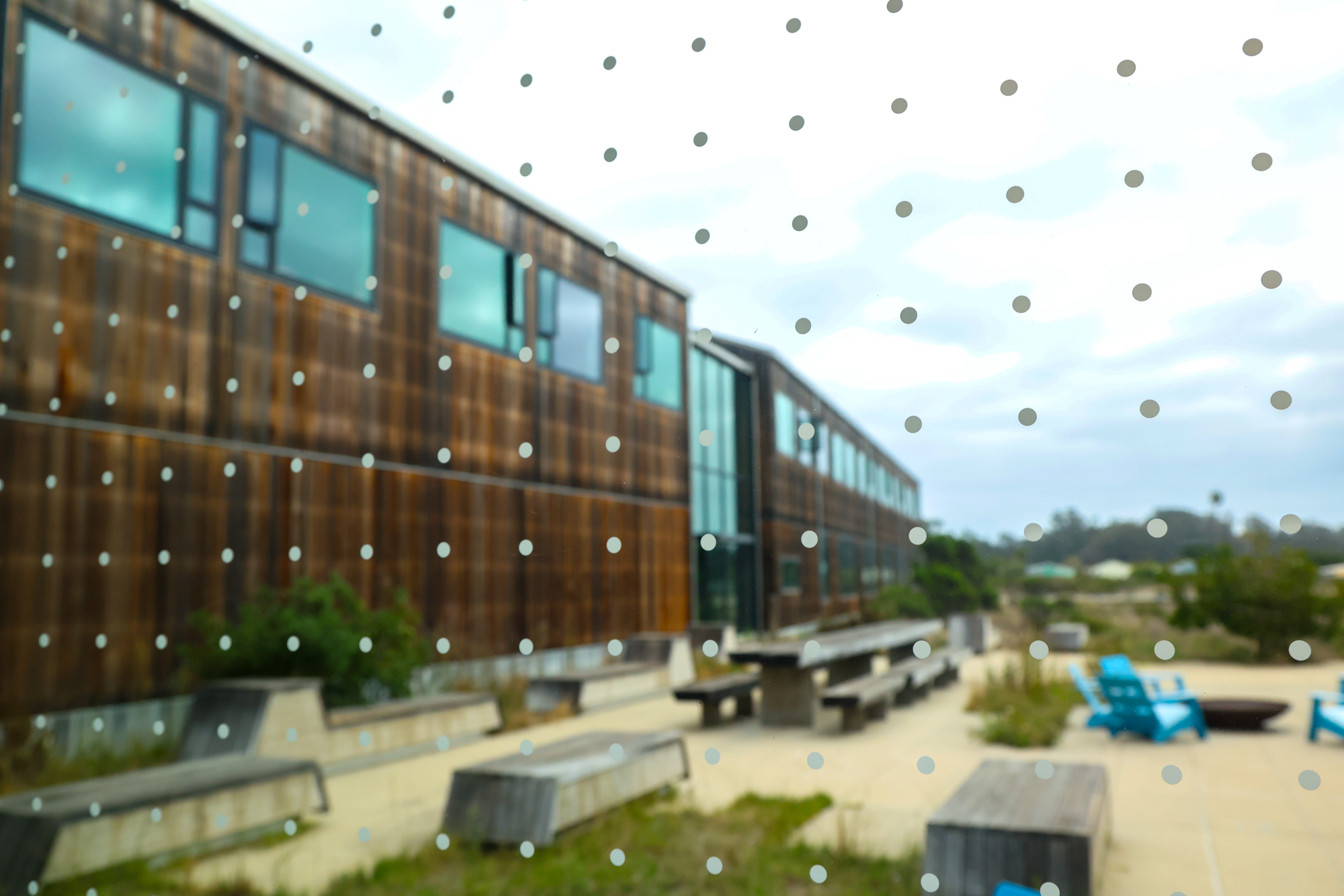
A new window film added to the Coastal Biology Building this past summer helps birds detect and avoid the windows, while also maintaining views from the inside. Photo: Carolyn Lagattuta
This collaboration was for the birds—but literally and in a positive way. Faculty, students, and staff came together to implement a solution to prevent birds from colliding with windows on campus.
Over the summer, the Coastal Biology Building on UC Santa Cruz’s Coastal Science Campus was retrofitted with a transparent film that has dots in a grid pattern, making it recognizable to a bird’s eye that it is not a fly-through space. The bird-friendly dotted film was installed just in time to prevent collisions during this year’s fall migration season, which peaked this month.
For birds, being able to see and avoid a window can mean the difference between life and death. Bird strikes against windows are a significant issue worldwide, causing over 1 billion bird deaths annually in the US alone.
“How sad to be a migratory bird, to be capable of these incredible migrations, and then die against a wall of glass,” says Environmental Studies Assistant Professor Natalia Ocampo-Peñuela.
Ocampo-Peñuela expects that the new mitigation measures will reduce collisions at the Coastal Biology Building by 90 percent or more. The effort to implement these changes started with undergraduate research.
Lauren Clor, currently a master’s student at CSUMB, previously supported the initiative as an undergraduate intern for Ocampo-Peñuela in 2023. Clor still walks by the Coastal Campus near-daily and expresses delight at seeing the project’s success “just in time for fall migration, when collision risk is highest.”
This year’s fall migration has been especially important. It’s what’s called an “irruption year,” meaning that food shortages elsewhere in North America have driven several species from northern regions and high elevation mountain areas to disperse to places they normally would not reach. As migration season wraps up, there might be many nomadic, and some unexpected birds in town at the moment because of this. Ocampo-Peñuela says it has been reassuring to know that, as a result of recent campus efforts, “none of them will die hitting the treated windows.”
Research takes flight
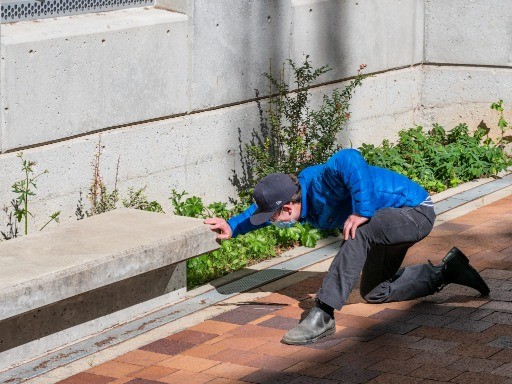
The window mitigation project first got its start In 2022, when Ocampo-Peñuela launched an internship within the distinctive internship program in the Environmental Studies Department, with support from the Norris Center. The goal of the over 20 interns who participated was to study bird strikes on windows across the UC Santa Cruz campus. For the next two years, an undergraduate cohort inspected areas around buildings each day for 21 consecutive days to see how many birds collided with windows during peak fall and spring migration.
Buildings around campus were selected based on different qualities—size, proximity to forests and meadows or surrounded by concrete—that led to an understanding of how and whether the surrounding environment affected which birds hit windows.
Ocampo-Peñuela’s history researching bird window collisions started during her own undergraduate years in her hometown of Bogotá, Colombia, in 2004. “People started identifying me and the group that I led in bird watching as ‘the people who received dead birds,’” she says. “I came to bird window collisions not as something I identified as a problem, but because people just started bringing us dead birds. Seeing the magnitude of the issue, I decided to take action”
In 2010, she and her team published the first paper studying bird window collisions anywhere in Latin America. Ocampo-Peñuela’s reputation as “the bird person” followed her to Duke, where she got her PhD. After a building her team identified as particularly prone to collisions was retrofitted, collisions were reduced by 87 percent. The results were published as a scientific article that is one of the most cited on campus-level bird window collisions.
When she arrived at UC Santa Cruz, Ocampo-Peñuela wondered whether bird window collisions might be an issue here, too.
The results of her UCSC student team’s research ultimately revealed very few collisions overall. But after two years of assessing bird strikes all over campus, they found, perhaps ironically, that the Coastal Biology Building was responsible for most. In 2023, the team presented their findings to the Facilities Department via a policy memo written by one of the undergraduate students as her senior thesis. From there, the conversation quickly turned to solutions.
A good (retro)fit: from care to action
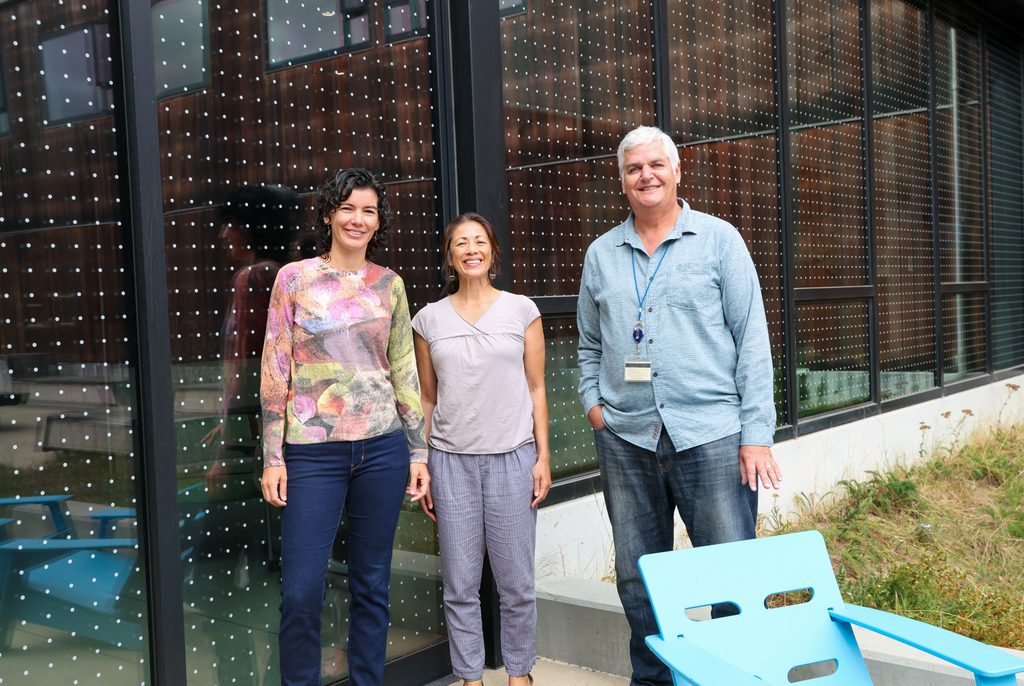
Ocampo-Peñuela’s team recommended retrofitting the Coastal Biology Building with transparent film in a grid pattern that specifically prevents birds from colliding with windows, a solution based on Ocampo-Peñuela previous research. In order for patterns on glass to be effective, they must be applied on the outside of the window, separated by no more than a few inches, and cover the entire surface.
There was strong enthusiasm to implement the solution from the Physical and Biological Sciences facilities team. When Ocampo-Peñuela reached out to Facilities Manager Chris Parker to request the bird-friendly retrofit of the Coastal Biology Building, he was onboard right away.
“I thought, ‘This is something we could really accomplish,’” Parker recalled. “I care deeply about the environment and birds, and I was part of the Coastal Biology construction. So I started building a stakeholder coalition, basically, to make our case to campus and pursue it.”
Parker explained that the Coastal Biology Building is situated on reserves that the campus is restoring to native grassland from agricultural use 70 years ago. Preventing birds from colliding with windows on the property seemed like an important way to help make the habitat as beneficial for wildlife as possible.
The Coastal Biology Building is also home to the Ecology and Evolutionary Biology Department, where many faculty and students are deeply engaged in the study of biodiversity. Members of the department, especially Department Chair Rita Mehta, naturally became important allies in supporting and advocating for the proposed mitigation measures.
“With student-led research, we were able to convince the administration that the bird collision film is an important investment and aligns with our climate and sustainability goals as a campus,” Mehta said. “I think it says a lot about the priorities of our campus leaders.”
When the window films were successfully installed this past summer, Ocampo-Peñuela visited to check them out.
“It was very emotional for me to see that work done by the undergrads that I advised actually was taken up by the university and converted into action,” she said.
The campus facilities team has also included a clause that all new buildings have to be bird-friendly. This will be incorporated from construction, so rather than retrofitting, the bird-window-collision issue will be taken into consideration before the building is erected, such as was done with recent construction at Kresge College.
The positive outcomes exemplify the best of campus collaboration, Parker says.
“We were successful in implementing something that is going to be meaningful for students, faculty, staff, and the animals,” he said.
To support continued efforts to identify and address bird-window collisions, join a community science project dedicated to this work through iNaturalist. You can contribute to a global effort or a UC Santa Cruz-specific project that is monitored by Ocampo-Peñuela’s team.