Climate & Sustainability
New cost-analysis tool allows coastal communities to see and estimate benefits of investing in storm-protection measures
CoSMos Adapts gives climate-resilience planners a way to compare the costs of inaction or long-term savings by adopting solutions such as restoring sand dunes or rocky reefs to guard against increasingly destructive storms.
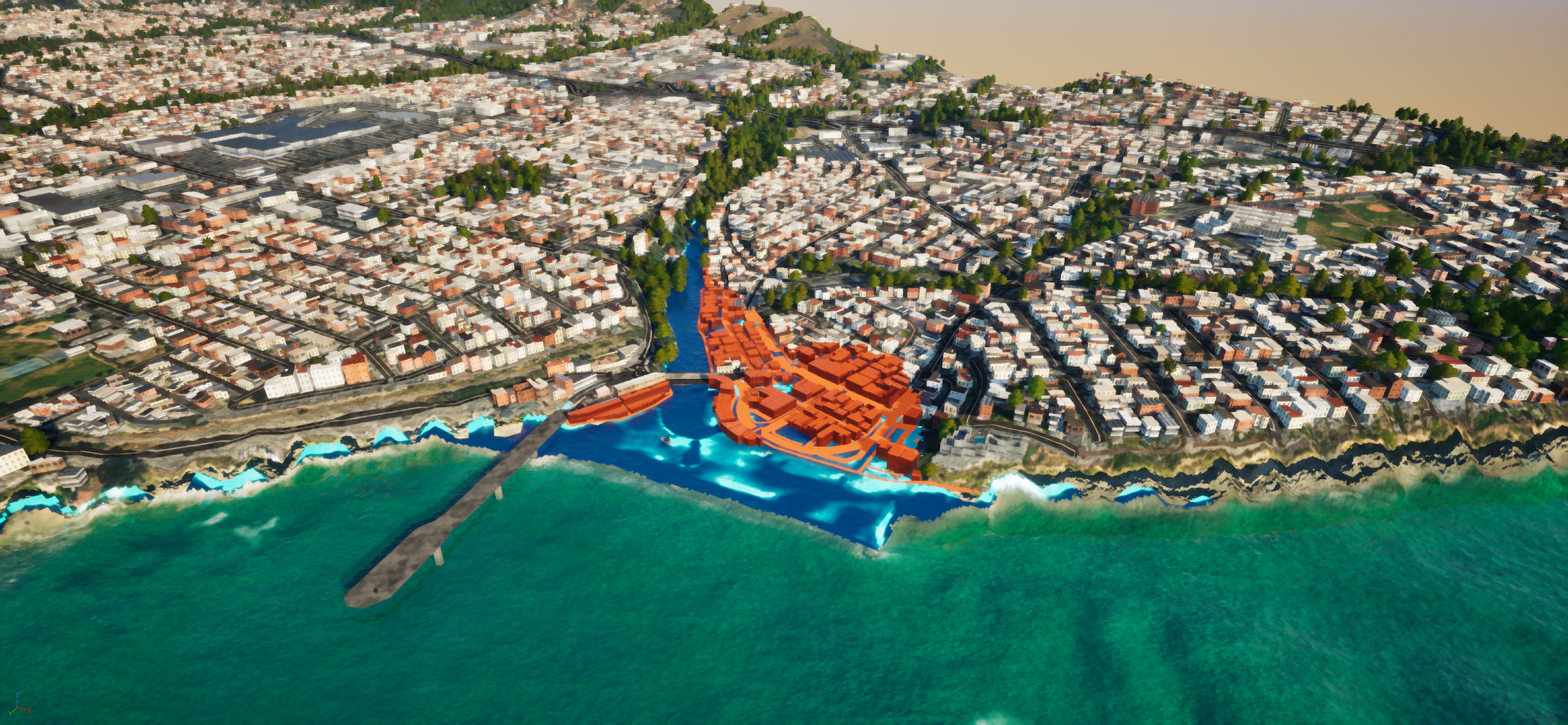
Coastal-flood model generated by CoSMos Adapts showing the impact of a representative El Niño storm event on the beach town of Capitola, Calif. Orange indicates buildings and streets affected by flooding, with blue indicating flood depth.
Credit: UC Santa Cruz Center for Coastal Climate Resilience
Press Contact
Key takeaways
- CoSMoS Adapts provides coastal communities with block-by-block visualizations to evaluate future flooding and erosion risks.
- The tool helps small local governments that lack the resources and site-specific science needed to create state-mandated plans for adapting to sea-level rise.
- It also assesses the cost of inaction, calculating potential multi-million-dollar increases in annual flood damages by 2085 if communities fail to protect their coastlines.
Today, as part of the official release of California’s Fifth Climate Change Assessment, researchers at the University of California, Santa Cruz, have launched a platform, data, and tools that community leaders can use to estimate the block-by-block climate risks and the cost-effectiveness of adaptation solutions for reducing coastal damages.
With a new tool called CoSMoS Adapts, California coastal communities can now see how much they could save—in dollars, properties, and infrastructure—by using nature-based solutions such as restoring dunes and offshore reefs to protect coastlines.
Evaluating risks down to the block
This year’s El Niño threatens to wallop the California coast with historic floods, huge waves, and erosion. Investing in adaptation measures such as restoring sand dunes or wetlands could provide communities with millions of dollars in net savings. But thus far, decisionmakers have had no way to see or estimate the return on investing in various climate-resilience solutions.
The project, led by the UC Santa Cruz Center for Coastal Climate Resilience (CCCR) in partnership with the U. S. Geological Survey (USGS), presents analyses and the CoSMoS Adapts framework to evaluate risks and adaptation investments with unprecedented resolution. The team published this research on October 19 in conjunction with the state’s climate assessment, a periodic report to study and help people prepare for the impacts of climate change.
The team has also released an interactive online decision-support tool to help policymakers and communities use the research to make local climate-adaptation plans.
“Coastal risks are growing rapidly in California, and El Niño events are the tip of that spear,” said CCCR Director Michael W. Beck. “Communities are asking for our help in managing these climate damages now, and the goal of the CoSMoS Adapts project is to quickly assess risks and solutions and to get that information to communities and state decision makers.”
Comparing the costs of inaction
CoSMoS Adapts brings together complex information about ecology, economics, geology, and hydrology to predict flooding and erosion, their impacts at the building level, and how much money adaptation projects could save taxpayers.
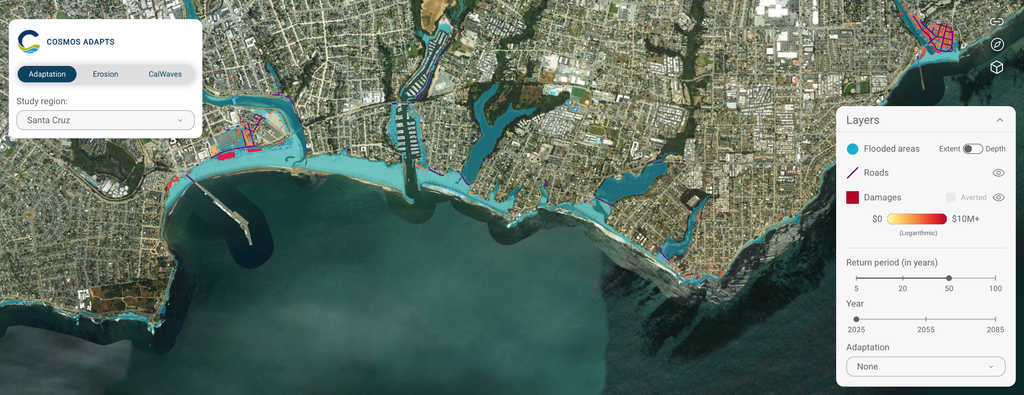
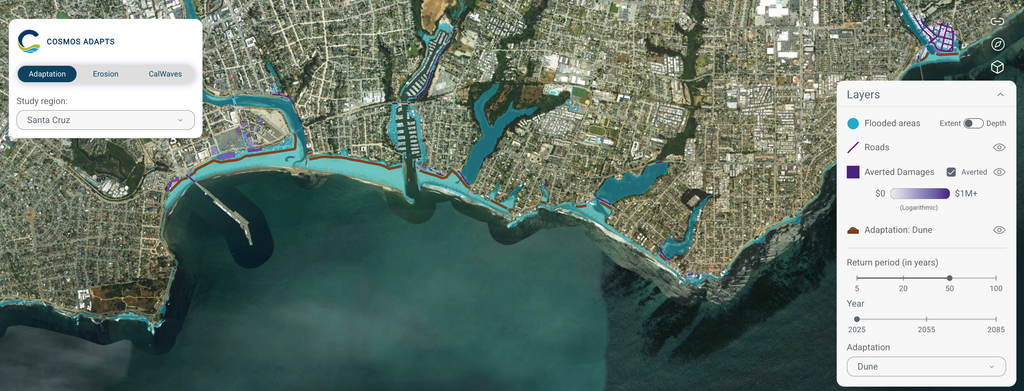
“These tools are a major advance in characterizing the effectiveness of nature-based infrastructure for coastal protection,” said the project’s lead researcher, Borja Reguero, associate professor in the Coastal Science and Policy Program at UC Santa Cruz. “We are helping communities adapt in a variety of ecosystems, including dunes, marshes, rocky reefs in the state, but also other solutions like coral reefs, mangrove forests, and hybrid infrastructure in other regions.”
CoSMoS Adapts builds on the previously created USGS Coastal Storm Modeling System (CoSMoS), which predicts the risks of coastal storm damage. The new model includes near-real-time information like recently released datasets on coastal climate across the state.
Using CoSMoS Adapts, the team determined that restoring beach dunes could save Santa Cruz more than $40 million per year and Ventura $20 million annually.
CCCR has used CoSMoS Adapts to study how climate change will shape coastlines in the future, and how these outcomes will impact people and property in coastal communities. The center then analyzed how different climate adaptations, including nature-based and human-built adaptations, might help or worsen damage due to future floods and erosion—along with estimated price tags for each to compare costs.
“Coastal-protection decisions have historically been made with incomplete information,” said CCCR Research Director Patrick Barnard. “This tool puts rigorous, site-specific science directly in the hands of the people who need it most—the officials and residents who must make these adaptation choices.”
Piloted across California
Planners in Santa Cruz, Half Moon Bay, and Ventura can now use CoSMoS Adapts to study which coastal adaptations might work best in their specific communities, with more on the way. On September 17, the State Coastal Conservancy approved a grant to expand this work to Los Angeles and Orange counties.
The CoSMoS Adapts team has already shared its findings with the City of Santa Cruz coastal-resilience team to support planning for projected coastal-climate impacts. “These new modeling results enhance our understanding and communication of changing risks and the costs of inaction as we collaboratively prepare the city’s 30-Year Shoreline Adaptation and Management Plan with our community,” said Tiffany Wise-West, Santa Cruz’s sustainability and resiliency officer.
The CoSMoS Adapts team has also studied climate adaptation in six other communities in Santa Cruz, San Mateo, and Ventura counties. The researchers found that if these communities don’t act to protect their coastlines, their annual flood damages could rise sharply: from $154 million to $229.5 million in Santa Cruz County, from $68 million to $196.4 million in Ventura, and from $2 million to $15.5 million in Half Moon Bay by 2085.
Nature-based solutions vs. seawalls
Using CoSMoS Adapts, the team determined that restoring beach dunes could save Santa Cruz more than $40 million per year and Ventura $20 million annually. In contrast, while some human-built adaptations, such as raising seawalls, could lessen flooding, they cost more than nature-based solutions such as dunes.
As part of the project, CCCR also created CalWaves, a statewide online database with comprehensive site-specific information for municipal planners on past and future waves. These data show that while there has been minor changes in average daily waves over the past five decades, high wave energy events have been increasing in many places by up to 7 percent per decade. Continued increases in extreme waves are expected in coming decades, especially in parts of Central and Southern California.
All coastal California municipalities are required to develop plans to adapt to sea-level rise by 2034 under a 2023 law called SB 272. But it’s expensive for small cities and governments to hire the experts needed to create those plans, and most simply don’t have adequate staff or resources.
CoSMoS Adapts is just one of UC Santa Cruz’s contributions to the fifth statewide climate report. Overall, 28 faculty, staff and students from campus worked on the assessment. UC Santa Cruz environmental researcher Ruth Langridge led the Central Coast section of the report.