Climate & Sustainability
Central Coast will face more extremes, regional report of California’s Fifth Climate Assessment finds
UC Santa Cruz researchers are leaders on the regional report, which is part of a larger statewide effort to understand climate vulnerabilities
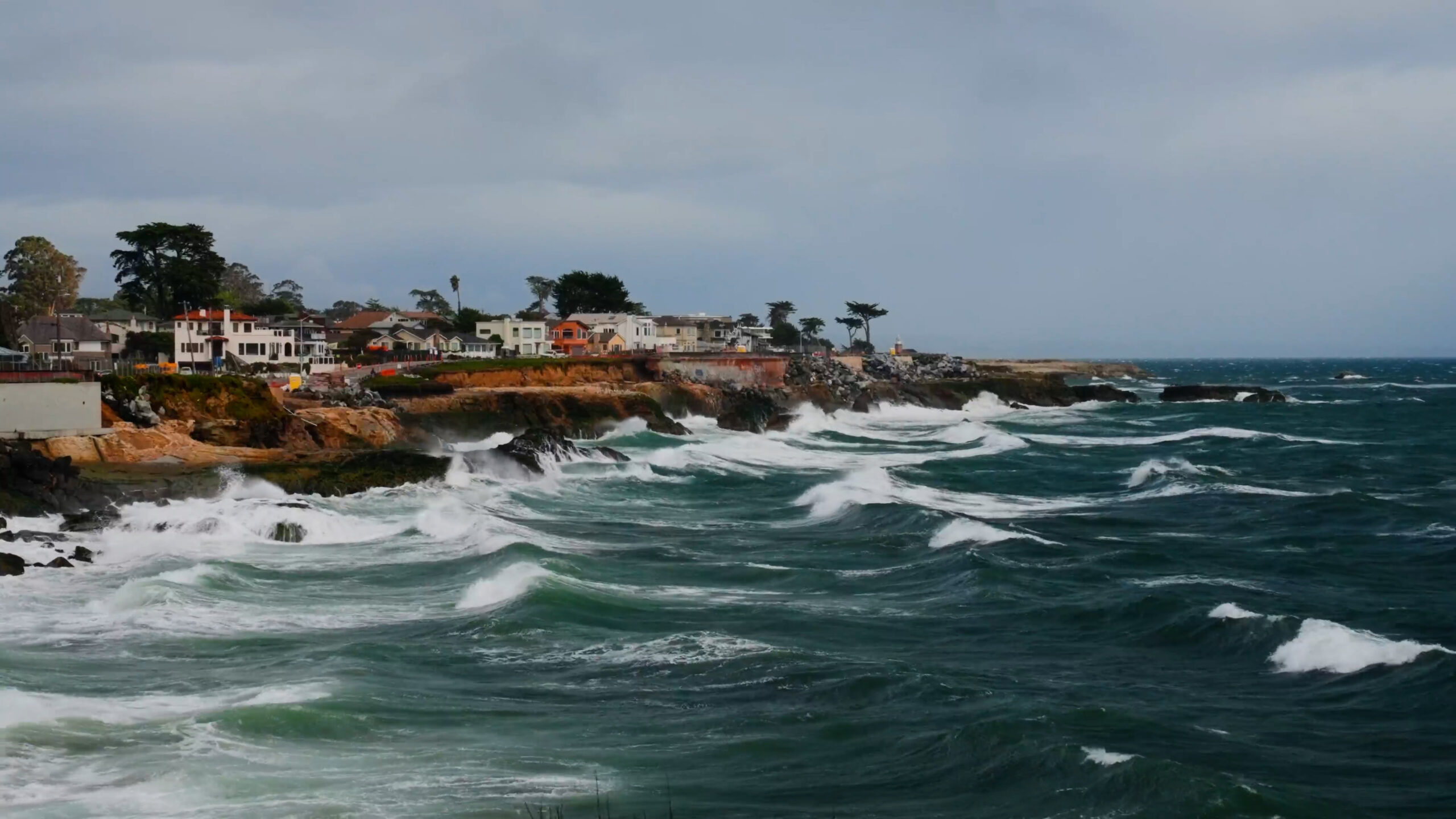
Waves crash into West Cliff in Santa Cruz during a storm in 2024.
Nick Gonzales
Press Contact
California’s Central Coast is headed toward more climate extremes, with hotter days, stronger storms, and more intense droughts.
That’s a major finding of the Central Coast report of California’s Fifth Climate Assessment, led in part by researchers at the University of California, Santa Cruz and part of a statewide effort to build a scientific foundation for understanding climate-related vulnerability.
The report brings together the best climate science projections for the mid-21st century and examines how they may impact the region’s natural, built, and social systems, and may serve as a tool for future resource management and climate planning. This is particularly important in the Central Coast, which is an overall under-studied region of the state, and the most heavily dependent on groundwater.
Despite projections for alarming climate trends, this report also highlights the increase in climate change mitigation and adaptation measures since the last state-wide climate report in 2018. It covers four main areas: climate, natural and working lands, built environments, and social science.
“There is a lot of adaptation going on,” said Ruth Langridge, the report’s coordinating lead author and a researcher in politics and legal studies at UC Santa Cruz. “We’re seeing a lot of nature-based solutions to try to figure out what to do about the coastal storms, and we’re seeing a lot of new water conservation, recycling, and recharge. There is a lot of positive action, and the report is very focused on what’s happening right here, on the ground, and how we can better adapt to those impacts.”
Langridge led the Central Coast report alongside Nathan Von Schmidt, the director of regional strategies at the San Francisco Bay Bird Observatory and Eloy Ortiz, Special Projects Manager at the Watsonville-based climate equity nonprofit Regeneración. They brought together the large group of interdisciplinary scientists that participated in this report, and engaged with Indigenous tribes, local communities, and non-profits throughout the region. A total of 20 UC Santa Cruz researchers from the Sciences and Social Sciences divisions contributed to this report.
As part of the larger statewide report, UC Santa Cruz researchers also led the development of CoSMoS Adapts, a tool that provides coastal communities with block-by-block visualizations to evaluate future flooding and erosion risks.
Hotter days, stronger storms
The assessment highlights a shift in the Central Coast’s weather patterns: hot months are projected to get hotter, while the rainy season gets increasingly shorter. Summer and early fall will see most of the temperature spikes, while spring and fall get drier.
“Temperatures have increased and are projected to increase even more. That’s a really big deal, because precipitation hasn’t changed that much,” Langridge said. “But with a lot of heat, you get a lot of evaporation, and so that’s gonna create a much drier situation—that’s what the real impact is,”
Rain is projected to come in more intense bursts, with January and February as the wettest months. The region’s largest storms will continue to intensify, with the wettest days delivering up to 30% more precipitation than historically observed.
Inland, heatwaves are expected to increase to unprecedented temperatures. By the end of the century, temperatures exceeding 80°F are projected to occur for up to half the year across all inland regions.
Peak temperatures are projected to be far more severe. Many areas face weeks of temperatures topping 100°F, while parts of the upper Salinas Valley could see conditions exceeding 110°F. These sustained spikes create acute public health risks, including heat stroke for outdoor workers, as well as ecological and agricultural threats like widespread vineyard die-offs.
Together, the periods of drought and heavy rain are expected to create a hydroclimate “whiplash.” This is likely to increase the risk of flash floods, wildfires, and disease outbreaks.
Water security and agriculture
Water reliability stands out as one of the region’s most critical vulnerabilities. The Central Coast is California’s most groundwater-dependent region, with the agriculture industry as the largest water user.
Overpumping has already caused water tables to decline significantly in some areas, with some wells at risk of drying completely. Accelerated by heavy groundwater pumping and sea-level rise, saltwater intrusion is migrating further inland, degrading water supplies.
Water utility costs are rising in response to these trends, with households the feeling direct impact. Monterey County now ranks highest in the state for water affordability burdens, while Santa Barbara County falls within the top ten. Local adaptation efforts are ramping up to counter these pressures, focusing on recycled water expansion, stormwater capture, managed aquifer recharge, and aggressive demand management.
Agriculture, a primary economic engine in the region, faces challenges. Less water threatens to reduce crop yields, increase pest and disease pressures, and degrade soil. During regional outreach meetings in Davenport, local farmers consistently cited drought as the single greatest threat to their livelihoods. In response, growers are adopting water-limited farming strategies, smart irrigation technology, and cover cropping to rebuild soil carbon reserves.
Public health and climate justice
Climate impacts fall disproportionately on vulnerable populations. Agricultural field workers face high risks from combined heat exposure, pesticide drift, and degraded air quality from wildfire smoke. Public health threats like vector-borne illnesses and fungal infections are also on the rise due to climate pressures.
The report highlights an expanding “financial protection gap:” the difference between emergency financial resources and the actual costs of disaster recovery, like temporary lodging, vehicle loss, and lost working hours.
Low-income households often bear the heaviest post-disaster economic burdens, and a case study in the report on the Pajaro River levee breach exemplifies this. To address these systemic inequities, a large number of regional grassroots organizations and community groups are building justice-focused coalitions, establishing resilience hubs, opening cooling centers, and coordinating local adaptation strategies to protect frontline communities.
The region’s built environment faces compounding strains. Sea-level rise and storm surges threaten key transportation corridors and low-lying coastal highways. To manage increased wildfire risks, utilities are relying more heavily on Public Safety Power Shutoffs, which disrupt power during extreme weather events, but also increase local cooling needs.
Coastal changes
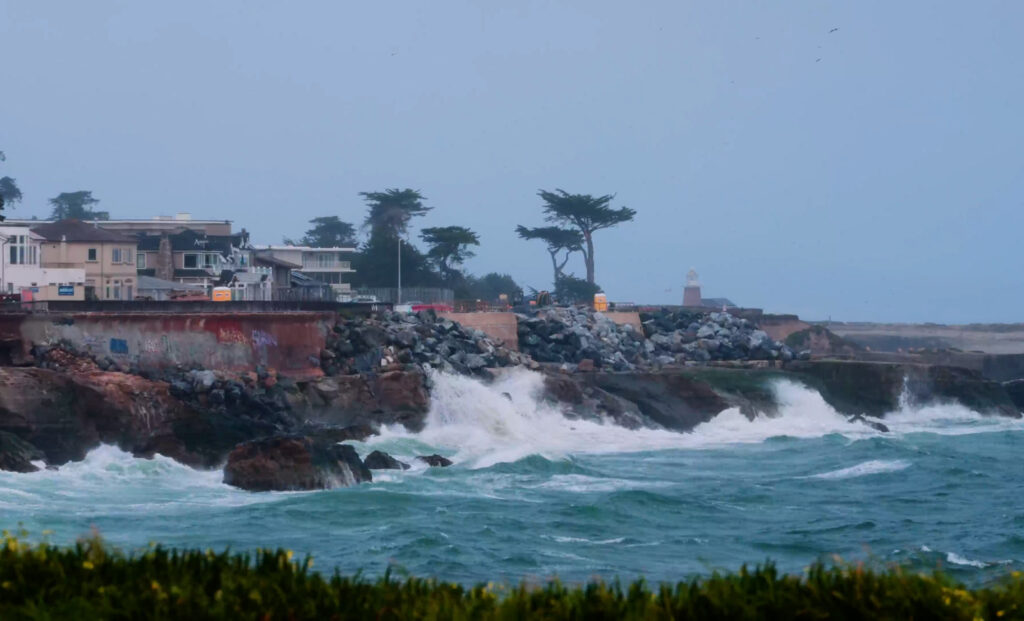
Coastal areas are also facing pressure. Sea levels are rising, reaching a 24% increase in Monterey. This threatens to submerge beaches, intertidal zones, and wetlands. Recurring marine heatwaves have driven kelp forest die-off.
Coastal communities are responding with natural infrastructure projects, like tidal marsh restoration in the Elkhorn Slough for storm surge protection and carbon capture. There have also been efforts to restore coastal dunes and build oyster reeds that can protect against coastal erosion.
UC Santa Cruz researchers involved in the Central Coast report for California Fifth Climate Assessment include: Ruth Langridge, Patrick Barnard (sea level rise and storm events), Mark Carr (kelp forests), Galina Hale (economics), Peter Raimondi (rocky coasts), Mark Snyder (climate: temperature and precipitation), Hannah Waterhouse (agriculture), Mercedes Pozo Buil (ocean conditions), Morgan Abbott (woodlands and forests), Peter Weiss-Penzias (coastal low clouds and fog), Laurel Fox (coastal shrubs), Crissy Picket (sea level rise and storm events)
Borja Gonzalez Reguero (sea level rise and storm events), Christina Richardson (water), Jerome Fiechter (fisheries), Eric Palkovacs (riparian areas and freshwater wetlands), Anjana Parandhaman (riparian areas and freshwater wetlands), Suzanne Lipton (woodlands and forests), Blair McLaughlin (woodlands and forests), and Patrick Chuang (low clouds and fog).