Astronomy & Astrophysics
-

Astronomers get a sizzling weather report from a distant planet
Astronomers have observed the intense heating of a distant planet as it swung close to its parent star, providing important clues to the atmospheric properties of the planet.
-
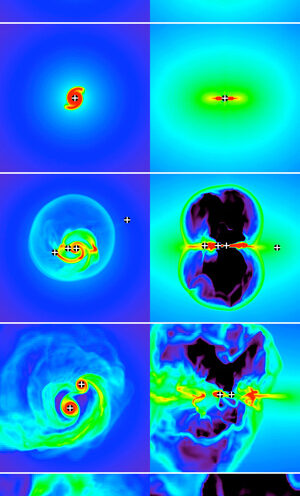
New study resolves mystery of how massive stars form
A study led by astrophysicist Mark Krumholz shows how massive stars can form without blowing away the clouds of gas and dust that feed their growth.
-
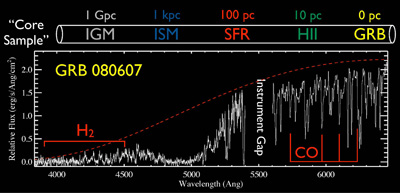
Astronomers use gamma-ray burst to probe star formation in the early universe
The brilliant afterglow of a powerful gamma-ray burst (GRB) has enabled astronomers to probe the star-forming environment of a distant galaxy, resulting in the first detection of molecular gas in a GRB host galaxy.
-

Astronomy professor Douglas Lin receives Outstanding Faculty Award
The Division of Physical and Biological Sciences has given its 2007-08 Outstanding Faculty Award to Douglas Lin, professor of astronomy and astrophysics.
-

UCSC earns top ranking for scientific impact of astronomy research
UCSC is the top-ranking university in the country for the quality of its research in astronomy and astrophysics, according to a new analysis of papers published in scientific journals and how often those papers are cited by other scientists.
-

Princeton awards Madison Medal to astronomer Claire Max
Princeton University will present the James Madison Medal, one of its top honors for alumni, to Claire Max, a professor of astronomy and astrophysics at UC Santa Cruz who has developed techniques to enable astronomers to more clearly observe the universe.
-
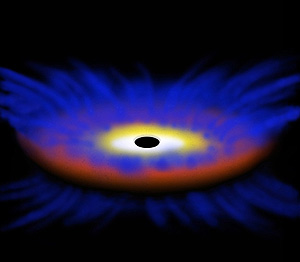
Serendipitous observations reveal rare event in life of distant quasar
Thanks to the sharp eyes of a UCSC undergraduate, astronomers have obtained a surprise view of a never-before-observed event in the birth of a galaxy.
-
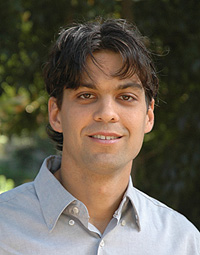
Astrophysicist Enrico Ramirez-Ruiz wins prestigious Packard Fellowship
Enrico Ramirez-Ruiz, an assistant professor of astronomy and astrophysics, is the ninth young scientist at UCSC to receive a prestigious Packard Fellowship for Science and Engineering.
-
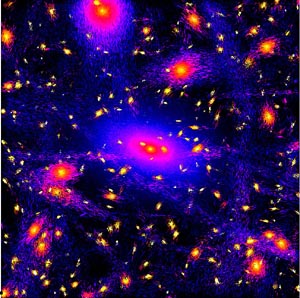
Study shows clumps and streams of dark matter in inner regions of the Milky Way
Using one of the most powerful supercomputers in the world to simulate the halo of dark matter that envelopes our galaxy, researchers found dense clumps and streams of the mysterious stuff lurking in the inner regions of the halo, in the same neighborhood
-
Study by UCSC undergrad shows a solar system gone wild
Research by a UCSC undergraduate has shown how the regular orbits of the planets could go haywire at some point in the far distant future.
-
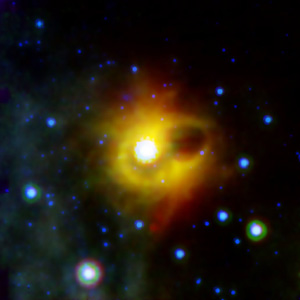
Strange ring found circling dead star
NASA’s Spitzer Space Telescope has found a bizarre ring of material around the magnetic remains of a star that blasted to smithereens.
-

Thirty-Meter Telescope focuses on two candidate sites
After completing a worldwide survey of astronomical sites for the Thirty-Meter Telescope (TMT), the TMT Observatory Corporation board of directors has selected two outstanding sites, one in each hemisphere, for further consideration.