Astronomy & Astrophysics
-

Compact galaxies in early universe pack a big punch
A team of astronomers looking at galaxies in the universe’s distant past have discovered nine young, compact galaxies, each weighing in at 200 billion times the mass of the Sun.
-
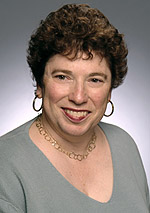
Astronomer Claire Max elected to National Academy of Sciences
Claire Max, professor of astronomy and astrophysics at UCSC, has been elected to the National Academy of Sciences in recognition of her distinguished and continuing achievements in original research.
-
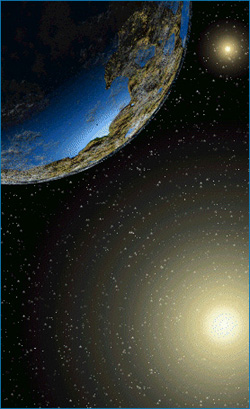
Nearby star should harbor detectable, Earth-like planets
A rocky planet similar to Earth may be orbiting one of our nearest stellar neighbors and could be detected using existing techniques, according to a new study led by UCSC astronomers.
-
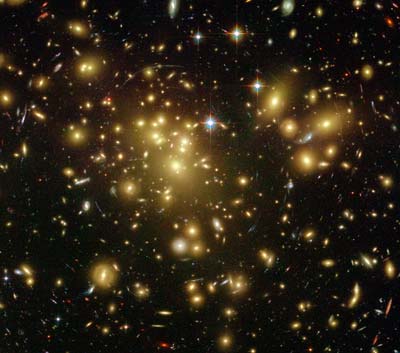
Astronomers find one of the youngest and brightest galaxies in the early universe
NASA’s Hubble and Spitzer space telescopes have uncovered what may be one of the youngest and brightest galaxies ever seen in the middle of the cosmic “dark ages,” just 700 million years after the beginning of our universe.
-

Unusual supernovae may reveal intermediate-mass black holes in globular clusters
A strange and violent fate awaits a white dwarf star that wanders too close to a moderately massive black hole.
-
Gordon and Betty Moore Foundation commits $200 million support for Thirty-Meter Telescope
The University of California and the California Institute of Technology have received a $200 million commitment over nine years from the Gordon and Betty Moore Foundation toward the further development and construction of the Thirty-Meter Telescope (TMT).
-

How to make the brightest supernova ever: explode, collapse, repeat
UCSC astrophysicist Stan Woosley provided an explanation for a supernova so bright–about 100 times as luminous as a typical supernova–that it challenged the theoretical understanding of what causes supernovae.
-

Scientists discover record-breaking fifth planet orbiting a star beyond our solar system
A team of American astronomers announced the discovery of a fifth planet around a star called 55 Cancri.
-
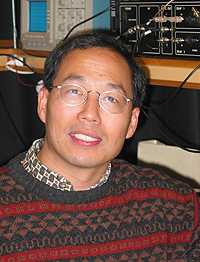
UCSC astronomer Sandra Faber and chemist Jin Zhang elected 2007 AAAS Fellows
Two UCSC scientists–Sandra Faber, University Professor and chair of astronomy and astrophysics, and Jin Zhang, professor of chemistry and biochemistry–have been honored as 2007 fellows of the American Association for the Advancement of Science (AAAS).
-

Scientists study tiny galaxy halfway across the universe
A tiny galaxy nearly halfway across the universe, the smallest in size and mass known to exist at that distance, has been identified and studied by an international team of over a dozen scientists, including four at UCSC.
-
Multiwavelength images of distant universe now available on Google Sky
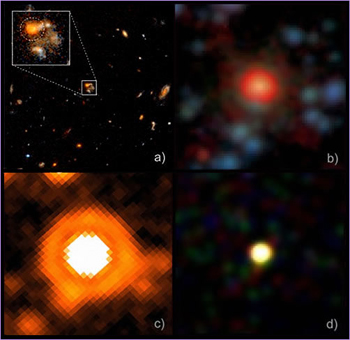
A massive project to map a distant region of the Universe in multiple wavelengths–from x-rays through ultraviolet, visible, infrared, and radio waves–is releasing its data this week to both fellow scientists and the general public.
-
Major gift supports crucial piece of Automated Planet Finder
The Gloria and Kenneth Levy Foundation has donated $600,000 to fund an innovative spectrometer for the Automated Planet Finder at UC’s Lick Observatory.