Earth & Space
Team builds best-performing detection system for next-generation accelerators
At the high beam-repetition rates of advanced accelerators, eventually reaching beyond one billion times per second, existing detection systems that are critical for ensuring precise measurements fail
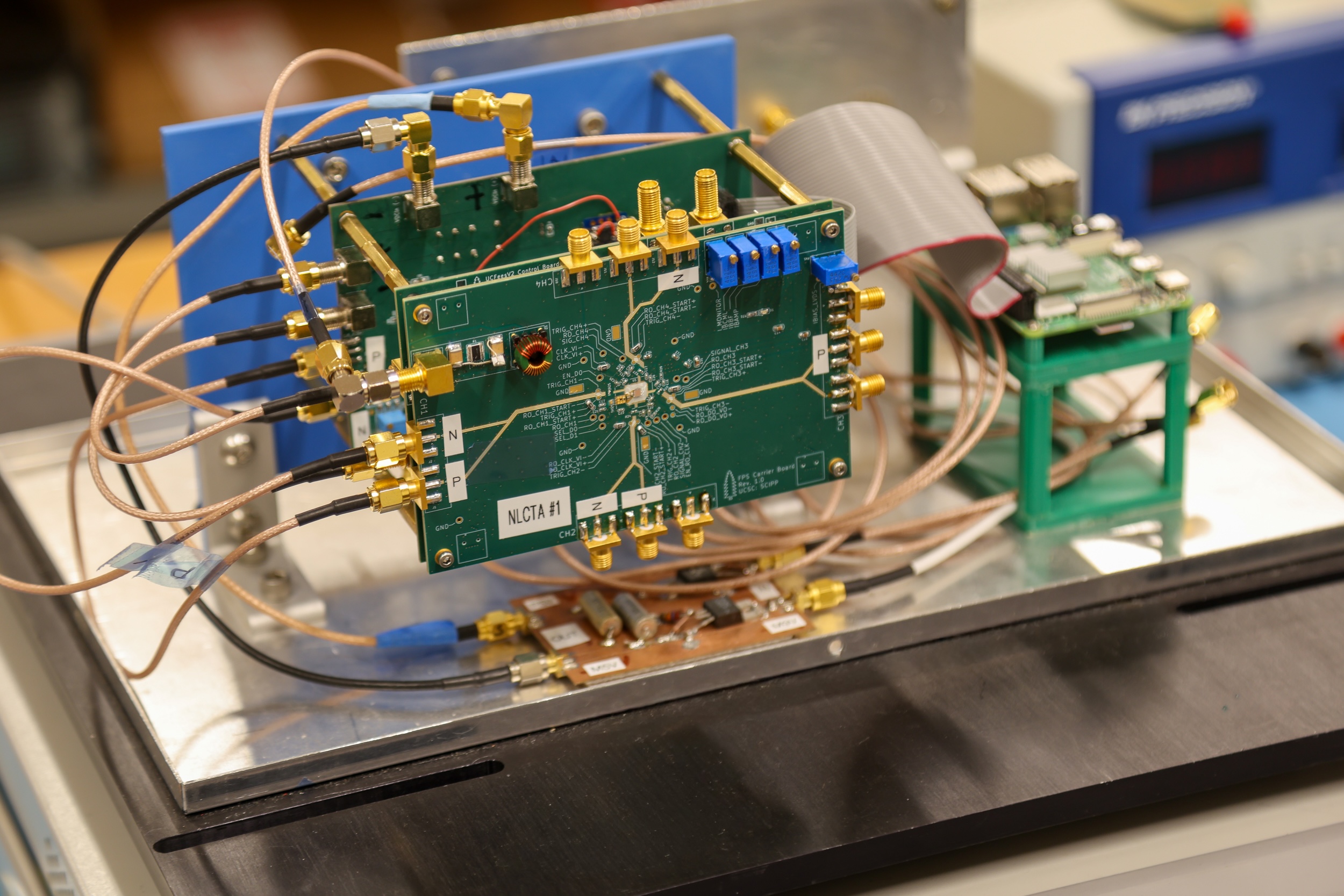
The detection system along with associated hardware for electronic conditioning and control (core system depicted below).
Photo by Carolyn Lagattuta
Press Contact
Key takeaways
- This system is crucial for enabling next-generation particle accelerators to better reveal fundamental biological and chemical processes, as well as advance materials science and energy research.
- The compact detector is a technological breakthrough, combining artificial diamonds, custom microchips, and cutting-edge assembly techniques into one unit.
- A collaboration spanning two UC campuses and three U.S. Energy Department laboratories was led by UC Santa Cruz. The project aims to solve a critical need for high-rate beam diagnostics, as the pulse rates of new accelerators dramatically increase.
Physicists at the University of California, Santa Cruz, and other institutes across the state and in New Mexico have developed a detection system that will allow next-generation particle accelerators to perform better at revealing fundamental biological and chemical processes, as well as advance critical areas such as materials science and energy research.
The Advanced Accelerator Diagnostics Collaboration, a group of two UC campuses and three U.S. national laboratories came together to solve a growing need for high-rate beam diagnostics. These accelerators will now jump from 120 pulses a second to a million pulses a second, straining current beam diagnostic systems.
The results are now published in the journal Physical Review Accelerators and Beams.
“It really highlights the power of collaboration between universities and national laboratories,” said Bruce Schumm, the Long Family Professor of Experimental Physics at UC Santa Cruz. “If you took away Lawrence Berkeley Lab, if you took away Los Alamos, if you took away UC Davis, any of those, the whole thing would have fallen apart.”
The fruits of this years-long collaboration are nothing less than the best-performing high-bandwidth particle detection system built to date. The system combines artificial diamonds, custom microchips, and cutting-edge assembly techniques into a compact detector designed for measuring the properties of the beams shot by advanced accelerators like the Linac Coherent Light Source II at SLAC National Accelerator Laboratory in Menlo Park.
Need for speed
As next-generation particle accelerators continue to develop, they will have faster and faster bursts of charged particles that are close to each other in time. This means the researchers using them will need to create new, faster ways to measure these beams and control their properties. “Nobody was building things that can measure, diagnose the beams and help control the accelerator, and also help the experimenters to unravel the data,” said Schumm.
At these high rates of beam repetition—eventually reaching beyond one billion times per second—existing detection systems fail. To overcome that barrier, the Advanced Accelerator Diagnostics Collaboration set out to redesign the entire detection chain from the sensor material itself, to the electronics used to read out the signal.
“It required developing a new approach to processing the signal, and also a new integrated circuit chip that we designed ourselves and then characterized,” said Schumm. “This is the first time we put it all together and put it into a beam.”
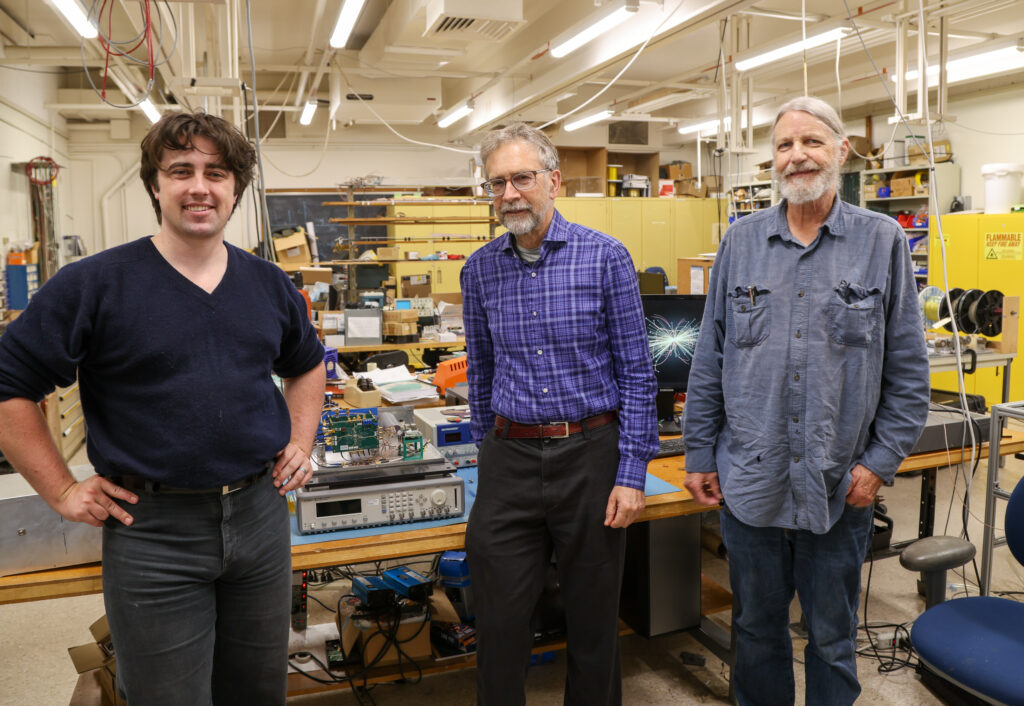
The detector’s first full accelerator test took place last July at SLAC, where researchers exposed their system to bursts of electrons lasting approximately one picosecond.
The team collected thousands of beam pulses under varying operating conditions and found that the detector consistently produced clean, sharply defined signals about one-eight of a nanosecond long, across a wide dynamic range.
“It performed extremely well, better than we expected,” said Schumm. “And not only that, but if we compare the performance to our pure calculation expectations, they agree with stunning accuracy.”
Looking ahead

These first tests are just the beginning, with the second version of the detection system currently in testing and development for fall 2026. These tests will use a new version of the integrated circuit chip that has been specifically designed to read out the tiny diamond sensor, and is expected to provide an even faster signal response than the version tested last summer.
In the near future, the team also hopes to make the detector easier for non-specialist laboratories to operate as a “plug-and-play” diagnostic system. And beyond next-generation accelerators, this new system could potentially be applicable in high-energy physics, advanced laser-control systems, and fusion-energy development.
“The more and more that we look at things, the more and more we need to understand things at the atomic scale,” said Schumm. “We need to understand how things evolve—how things change over very, very fast time scales.”
This work was supported in part by the U.S. Department of Energy (DOE) Office of Basic Energy Sciences, Office of High Energy Physics, and UC National Laboratory Fees Research Program. This work was performed, in part, at the Center for Integrated Nanotechnologies, a DOE user facility operated by Los Alamos and Sandia national labs.