Arts & Culture
Long days, snacks, and scan-a-thons: student archivists stepped up to save a treasure trove of Okinawan-American memories
In a cramped conference room, a small group of students spent countless hours digitizing the photos, slides and artworks of the Okinawan American community in Los Angeles County. These students work for the Okinawa Memories Initiative.
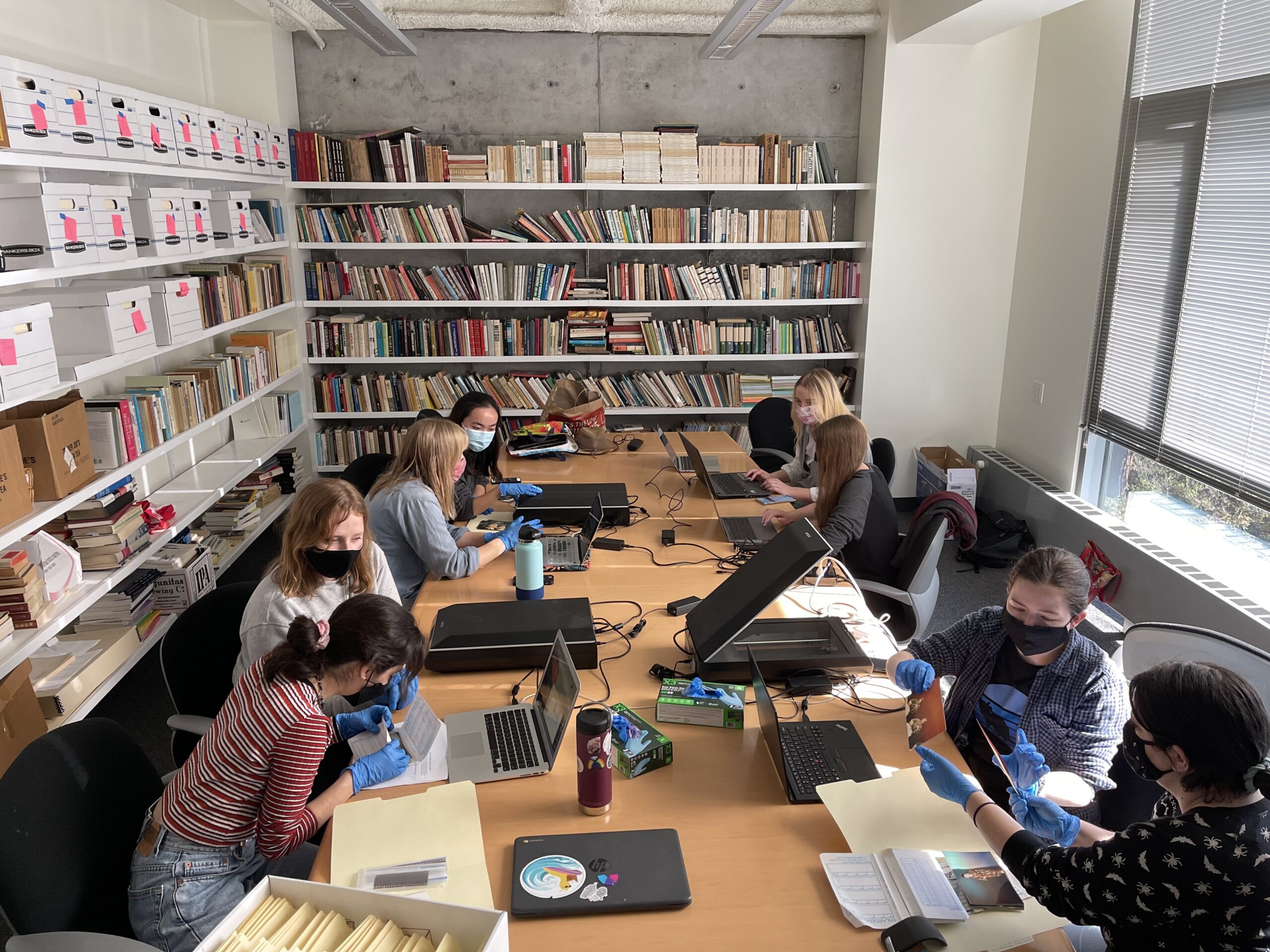
Undergraduates working for OMI had long "scan-a-thons" in a small conference room in the Humanities building.
In a cramped conference room in the Humanities building at UC Santa Cruz, a small group of students spent countless hours digitizing and preserving the photos, slides and artworks of the Okinawan American community in Los Angeles County.
These undergraduates are working for the Okinawa Memories Initiative (OMI), a public history research project that is housed in and sponsored by The Humanities Institute. The Humanities EXPLORE Program funds seven undergraduate fellows who oversee operations and run the archives and exhibits, oral history, communications, and media production teams.
OMI focuses on preserving and sharing Okinawan history and culture—especially after World War II—through oral histories, archival work, exhibitions, and community partnerships.
In a unique partnership, OMI agreed to preserve the Yamashiro Family Collection, a photo archive belonging to The Okinawa Association of America, a diasporic community organization in Gardena, a city in the South Bay of Los Angeles County. Some of the images will end up in an online visual exhibit.
The four-year, student-driven project was urgent because the OAA, which has an elderly membership, had large amounts of unorganized historical material including photos, films, and artwork, which had accumulated over decades and had been sitting around in boxes.
When History Professor Alan Christy, the director of OMI, first began discussions with the OAA about digital preservation in 2020, he was sitting in their office and had a realization: “I looked around, and there were piles of stuff everywhere,” Christy said. “As members of the community pass on, their kids often don’t know what to do with their things so they donate prints, paintings, and film to the OAA.”
The OAA told Christy that they lacked the money, equipment and labor to turn these materials into an archive. “I said I could supply all three,” Christy said.
Christy was eager to get the project started – but then the pandemic hit. After the worst of COVID, the community agreed to lend OMI some large banker boxes full of photos.
This project turned out to be much more daunting than anyone predicted. When they started scanning, the OAA believed there were roughly 3,000 photos. The actual amount turned out to be 35,000.
“This was a huge undertaking, starting in the beginning of 2020 before any of us were even around,” said Geneva Samuelson (Cowell, history, ’25). “Our team had a lot of enthusiasm and motivation for this project. We were all cooped up by ourselves in a Humanities conference room but it was fun to work on the project collectively. Our scan-a-thons were social events. We brought snacks.”
The students spent so many hours in that room that they found creative ways to pass the time. They gave nicknames to their five hard-working scanners, including “Scan-Elder,” “Sir Scans A Lot,” and “Cameron Scan-der-Scoff,” in tribute to OMI’s co-founder Cameron Vanderscoff.
The images documented decades of Okinawan American life—from the 1980s through the 2010s. Many showed major community events: New Year celebrations, picnics, bazaars, and the Okinawan Taikai, a global gathering held every five years where Okinawan diaspora communities from around the world reunite in Okinawa.
Other photos were more intimate: baby showers, weddings, and small gatherings of friends.
Because of this deeply personal content, the archive raises important questions about access. While some images will be publicly available through exhibitions and digital platforms, others may remain in a controlled archive accessible only There were so many images, over long periods of time, that the students could watch time unfolding.
“These photos span from the 1980s to the 2010s so you can see how people grow up and the continuity in different events throughout the years,” said Aivan Bach (Oakes, anthropology and environmental science, ’26.)
Bach is a 2025-26 Humanities EXPLORE fellow, working as one of two lead interns at OMI.
Bach was recruited to join OMI at Cornucopia in their first year at UC Santa Cruz, when they did not know much about the history of Okinawa. “But I had taken Japanese language classes in high school and OMI was looking for new members that knew Japanese,” Bach said.
They joined the archival team to get invaluable volunteer experience.
For the students, the process of sifting through those boxes, and scanning the materials, was not just enjoyable; they were great preparation for future careers.
“I knew that archiving is something I really want to do,” said oral history team lead Peyton White (Porter, history, ’28). “I knew I would be passionate about it. I was pretty bad at technology beforehand so learning to work with the scanners was very helpful. I can’t wait to see how this project continues.”
Nixie Young, (Merrill, history, ’25), who has Okinawan ancestry, said the archive preservation gave her invaluable experience as she began to apply for public history programs in graduate school. The experience also taught her something about continuity and patience.
“Every year, we’d be like, ‘we’re going to finish this!’ and then we’d say ‘oh, maybe next year”’, Young said. “Now, we’ve reached the point where we can see the finish line.”
Christy praised the hard work of the student archivists.
“The process took so long that there was turnover in student leadership; project team members kept graduating,” he said. “But the students as a collective were able to keep the project going, passing it on from one set of students to the next and maintaining it. It makes me very proud.”
While the project may be coming to an end soon, for Christy, it is only the beginning.
“I have a ridiculously ambitious dream for this project to be a model for other Okinawan diasporic organizations all around the world,” Christy said. “If they built their own (digital) archives, we would have linkages of archives all across the globe.”
The Humanities EXPLORE program is led by the Humanities Division with strategic support from the Humanities Institute and is funded by the Mellon Foundation, The Helen and Will Webster Foundation, the Humanities Division, The Humanities Institute, and private donors.