Arts & Culture
Humanities students are rethinking incarceration through VAST and EXCEL programs
Humanities students at UC Santa Cruz are finding new ways to think about incarceration through art, literature, journalism, and community internships.

Gina Dent, Professor of Humanities and Faculty Director of the Institute of the Arts & Sciences, speaks to students at an exhibit at the IAS.
Humanities students at UC Santa Cruz are finding new ways to think about incarceration through art, literature, journalism, and community internships.
The Humanities Division’s Visualizing Abolition Studies certificate program, known as VAST, offers an interdisciplinary, cross-departmental framework for examining the carceral state.
Making use of art and visual culture, VAST prepares students to challenge the existing criminal legal system, developing critical thinking about social and cultural systems and learning how to advocate for social justice.
Meanwhile, one of the Humanities Division’s flagship programs, Humanities EXCEL, is creating internships with organizations working directly with incarcerated or formerly incarcerated people.
VAST: visualizing alternatives to prisons
Founded two years ago by Professor of Humanities and Faculty Director of the Institute of the Arts & Sciences Gina Dent, VAST brings together courses from the humanities, arts, and social sciences to examine incarceration, abolition, and visual culture.
Dent is PI and co-director, with Rachel Nelson, of Visualizing Abolition, a large-scale initiative designed to shift society’s attachment to prisons through art and education.
In the VAST course, students complete 15 credits, including the Introduction to Visualizing Abolition course, as well as electives from across campus. The program encourages students to think critically about the role that images, media, and art play in shaping public understanding of the criminal legal system.
The program was designed to be flexible and interdisciplinary. Rather than focusing only on the study of prisons and policing, VAST asks students to imagine alternatives and think creatively about social change.
“We didn’t want students to be only learning about the carceral state,” Dent said. “We want them to think about abolition and all the things that would have to shift in how we think, plan, and imagine the future.”
Since its inception, 45 students have completed the certificate program.
Dent said students from many different majors have joined the program, often discovering new connections between their academic interests and questions of justice, art, and community engagement.
Some students continue into gallery work, community programs, or public humanities projects, Dent said. Others rethink their career paths entirely.
“These experiences could influence career choices for many of these students,” Dent said. “It creates a whole different world of potential art professionals or people who use art practice more responsibly in the other work they do.”
Dent said VAST places art and imagination at the center of conversations about incarceration.
“A lot of anti-carceral work has been based on data and statistics,” she said. “But artists can drive the imagining of something different, not just illustrate it.”
That focus has attracted strong student interest. The program now includes faculty from multiple disciplines, including literature, philosophy, critical race and ethnic studies, and the arts.
For Dent, one of the most important aspects of the program is helping students believe they can help create change.
“Young people are deeply aware of the situation we are living in,” she said. “What is unusual is feeling you can do something about it — that you can take a position and help create an alternative.”
Humanities EXCEL program: hands-on experience about criminal justice
Undergraduate interns in the Humanities EXCEL program are also gaining hands-on experience learning about criminal justice and incarceration while working with community organizations.
One of the partnerships connects students with the Santa Cruz Poetry Project, which offers creative writing workshops inside Santa Cruz County correctional facilities.
Interns Maddie Frealy (literature and legal studies, ‘28) and Michael Griffith (literature, ‘26) work as educational programs assistants, co-teaching poetry workshops in the Main Jail and Blaine Street Women’s Facility.
The workshops encourage incarcerated participants to explore creative writing as a form of self-expression and emotional healing.
“Although we are bringing poetry in to ‘teach,’ it really is a collaborative environment where we are equals,” Frealy said. “We are all learning and teaching. I think there is a pretentious stigma around poetry, and yes, sometimes it is overly metaphorical and difficult to understand. However, there are a lot of really accessible poems/poets that are extremely meaningful and profound. Honestly, some of the most deep and insightful poems I have read are the ones created by incarcerated people.”
Through this internship, Frealy has grown as a writer, learning from other teachers as well as incarcerated people.

“It is one thing to learn about the carceral system in class, but it is something else entirely to build relationships and trust with people inside the system,” Frealy said.
The organization also hosts public poetry readings and publishes anthologies featuring participants’ work.
Other students work with the Santa Cruz Public Libraries through the People & Stories program, which brings literature discussion groups into county jails. Interns Isa Anderson (literature and education, democracy and justice, ‘27) and Daniel Mair (literature, ‘27) help create educational materials and select stories that encourage reflection, discussion, and empathy among incarcerated readers.
The students are mentored by Jesse Silva, outreach librarian for Santa Cruz Public Libraries’ Jail Reach program. Silva has worked with EXCEL fellows for the past three years. These interns research and review stories for the library’s People & Stories program, a short story discussion group offered inside county jails.
“This year, two students are doing work similar to last year’s, but the focus is on stories featuring women, LGBTQ+ communities, and stories written in Spanish,” Silva said. “I find that working with the fellows brings a new perspective to the work and strengthens our collection of stories for the program.”
Silva said her mentorship draws on more than a decade of facilitating literature discussions inside the Santa Cruz County jails.
Auditing a VAST course in the winter of 2024 helped reshape her own understanding of jail outreach work and influenced how she mentors students.
“Honestly, it influenced my work in the jails and Juvenile Hall more than anything else,” Silva said. “It reminded me how the language we use to discuss our work in jails impacts people’s perception of carceral systems and those caught up in the legal system.”
While auditing Rachel Nelson’s course, Introduction to Visualizing Abolition Studies, Silva said she began to reconsider the language used by the library’s jail outreach program. Nelson is the director and chief curator of the Institute of the Arts and Sciences. Through the course, Silva said, she started thinking more critically about how language shapes perceptions of incarceration and the people inside the system.
“I changed the name of the program to Jail Reach to focus less on the ‘corrections’ and more on the outreach to the folks inside,” Silva said. “I now approach the work from a prison abolitionist perspective.”
The VAST program also helped Silva identify students who would be strong candidates for the internship program.
Another internship partner is Open Campus Media, where student fellow Vee Santoscoy (literature, ‘26) works as an editorial intern with national reporter Charlotte West.
Their work with Open Campus Media and the College Inside newsletter focused on prison education and communication with incarcerated readers.
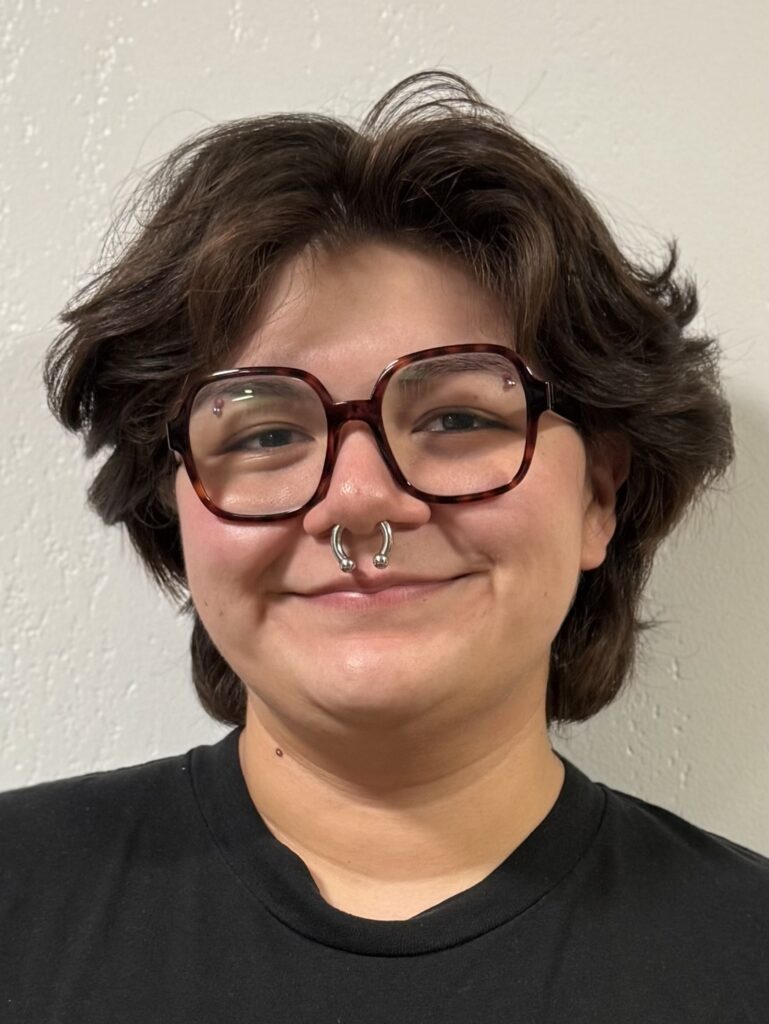
As part of the internship, Santoscoy helped distribute newsletters to incarcerated individuals, prison education programs, and prison libraries while also assisting with editorial work for the Open Campus website.
One of the most meaningful aspects of the internship involved reading and responding to letters from incarcerated people.
“This correspondence varied from requests to subscribe to the College Inside print newsletter, to seeking advice on how to manage defaulted student loans, how a Pell Grant works for incarcerated scholars, or just expressing gratitude and admiration for the work Charlotte West and Open Campus does,” Santoscoy said.
Reading and responding to these letters was a transformative experience.
“Letter-writing acts as a form of harm reduction, rejecting the isolation, erasure and vulnerability to violence incarcerated individuals face within prison,” Santoscoy said.
To learn more about the VAST certificate and how to get involved, visit the Institute of Arts and Sciences. For any community organizations doing work related to incarceration interested in partnering with the Humanities EXCEL program, check out our Partner with Us page.
The Humanities EXCEL program is led by the Humanities Division with strategic support from the Humanities Institute and is funded by the Mellon Foundation, The Helen and Will Webster Foundation, the Humanities Division, The Humanities Institute, and private donors.