Campus News
Ancient DNA reveals Ice Age mammals thrived after volcanic eruption
UC Santa Cruz researchers were able to collect ancient DNA preserved in permafrost for insight into how a natural disaster impacted genetic diversity.
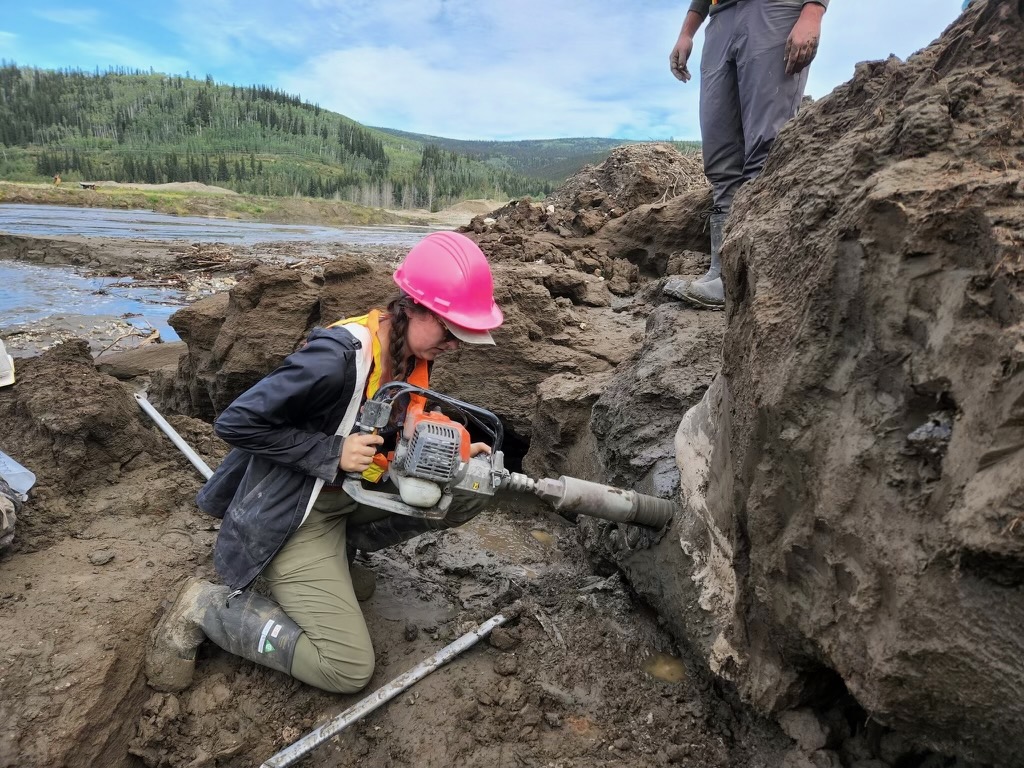
Ciara Wanket drilling for sedaDNA samples in Canada’s Yukon territory. This ash layer from the volcano eruption she studied is visible as a pale stripe in the dark permafrost sediment.
For the first time, scientists have used DNA preserved in ancient sediments to examine how a major natural disaster affected animal populations. A new study of a catastrophic volcanic eruption during the Ice Age has found that mammoths, bison, and other large grazers in the region were remarkably resilient and thrived even after their entire world had been covered in a thick layer of ash.
The study was led by researchers in the UC Santa Cruz Paleogenomics Lab, which is affiliated with the university’s Genomics Institute and specializes in techniques to analyze ancient and degraded DNA. They extracted genetic material from permafrost cores in Canada’s Yukon territory to reconstruct both the ecological community and the population genetics of large mammals before and after a massive ashfall event roughly 29,000 years ago.
The approach opens a new window into understanding how current ecosystems dominated by large grazing animals might respond to catastrophic disturbances, and could be particularly relevant as large wildfires become more common globally.
“This is the first time anyone has used DNA extracted from sediment to examine the genetic and ecological impact of a natural disaster,” said Ciara Wanket, a graduate student in ecology and evolutionary biology at UC Santa Cruz and lead author of the study. “Long-term recovery after such events is impossible to observe on human time scales, which is why it’s so important that we can use ancient records.”
An ancient ashfall preserved in permafrost
The volcanic eruption Wanket and her colleagues looked at occurred in what is now the Aleutian archipelago of Alaska. The eruption deposited ash across much of the eastern portion of an ancient land bridge that connected Asia and North America, leaving a layer up to 2.5 feet thick in some areas. This ash layer is still visible today in frozen ground across Alaska and Yukon, appearing as a pale stripe in the dark permafrost sediment.
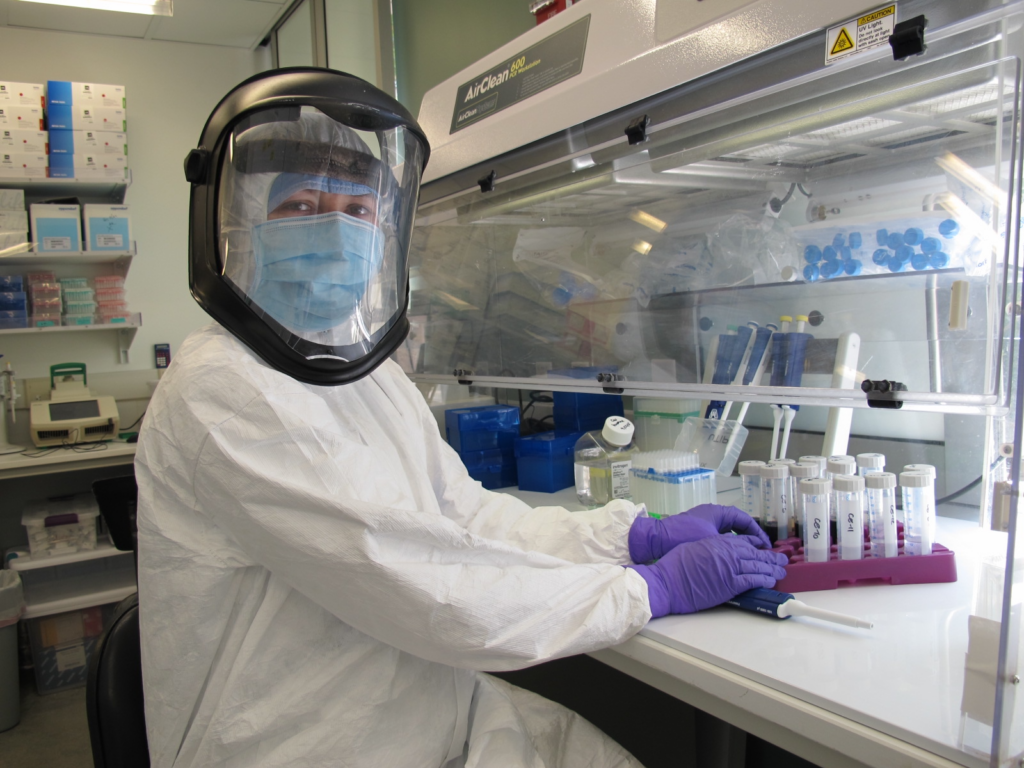
The researchers collected permafrost cores from three sites in the Klondike region of Yukon Territory, drilling through layers of frozen soil that spanned the time before, during, and after the eruption. Previous studies had used pollen preserved in the permafrost to reconstruct the plant communities in the region, but pollen can’t reveal what animal species were present or how their populations fared. The UCSC Paleogenomics team used specialized techniques to extract genetic material that had leached into the sediment from decomposing organisms, known as sedimentary ancient DNA or sedaDNA, which allowed them to identify both plants and animals and to track genetic changes within animal populations across the disaster.
“Sedimentary ancient DNA gives us a way to look at entire ecosystems at different points in time,” said Beth Shapiro, professor of ecology and evolutionary biology at UC Santa Cruz and senior author on the study. “From a single set of samples, we can see what the whole community looked like through time, and track whether individual species experienced population declines or genetic bottlenecks. It’s an incredibly powerful tool.”
Ancient DNA reveals no lasting damage
The team found that plant and animal communities at all three sites showed no significant changes before and after the ashfall. Woolly mammoths, horses, bison, and caribou were the most common large animals, with predators and smaller species also detected. Somewhat surprisingly, caribou appeared in relatively high numbers, even though they are not a species that is typically associated with the arid mammoth steppe. The finding highlights sedaDNA’s ability to uncover species interactions that aren’t obvious from the fossil record.
When the researchers examined the mitochondrial DNA of the large grazing animals to look for signs of population decline, migration, or genetic turnover, they found none. The populations maintained their genetic diversity across the event. Several factors may have contributed to this resilience. Evidence suggests the eruption occurred in late winter or early spring, and if snow was still on the ground it would have washed the ash off the hillsides as it melted, quickly re-exposing grazing areas. The plants of the cold steppe also have deep root systems that allowed rapid regrowth, and the vast ranges of large grazers provided a buffer against localized impacts.
Implications for modern ecosystems
While the ice age ecosystem weathered the volcanic eruption, it ultimately collapsed during the dramatic climate shifts at the end of the Pleistocene, around 10,000 years ago. The contrast highlights that resilience to one kind of disturbance does not guarantee survival of another.
The findings carry particular relevance for understanding how modern ecosystems dominated by large grazing animals might respond to major disturbances. The researchers found that the species they studied maintained high genetic diversity across the landscape, indicating that populations were well-connected and able to interbreed freely.
“Genetic diversity is important for resilience because it facilitates adaptation,” explained Wanket. “Both now and in the past, habitat connection is essential for maintaining healthy populations. Today, human activities are fragmenting habitats and threatening animal populations around the world. Our findings emphasize the importance of connection for weathering disturbance.”
A collaborative effort
The research was conducted on the traditional territories of the Tr’ondëk Hwëch’in First Nation and was made possible through collaboration with the Klondike placer mining community and the Yukon Geological Survey. Researchers at the University of Alberta contributed expertise in permafrost science, radiocarbon dating, and tephrochronology—the use of volcanic ash layers to establish the age of geological deposits.
The study was supported by the National Science Foundation, the National Institutes of Health, and the University of Alberta Northern Research Award Grants.