BE-healthwellbeing
-
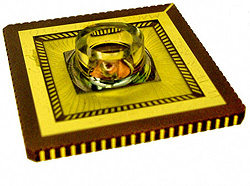
Magnetic nanotags allow sensitive detection of cancer biomarkers
A team led by researchers at UCSC and Stanford has developed a compact prototype detector that uses magnetic nanotechnology to spot cancer-associated proteins in a human blood serum sample with much higher sensitivity than current detectors.
-
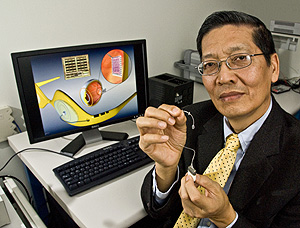
Microchip developed by UCSC engineer is helping restore vision to the blind
Last year, Wentai Liu watched as surgeons implanted a microchip he had designed into the eye of a blind patient. For Liu, a professor of electrical engineering at UCSC, it was a major milestone in two decades of work on an artificial retina to restore vis
-
New HIV browser gives researchers access to valuable data from vaccine trials
A new HIV data browser developed by UCSC and the nonprofit organization Global Solutions for Infectious Diseases (GSID) will give researchers access to a wealth of data collected during clinical trials of an AIDS vaccine.
-
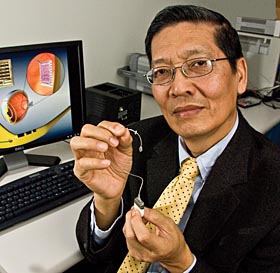
Engineering Hope: UCSC bioelectronics engineer designs prostheses that promise to change lives
Wentai Liu is an electronics wizard whose work is enabling the development of devices once found only in the realm of science fiction–miniaturized electronic implants to restore vision, movement, and other biological functions lost to disease or injury.
-

UCSC project aims to provide a virtual speech therapist via cell phone
UCSC researchers have received funding from Microsoft Research to develop a virtual speech therapist, accessible on a cell phone, to aid stroke survivors in Malaysia.
-
Silicon chip beams light through a liquid-core waveguide to detect one particle at a time
By guiding light through liquid-filled channels smaller than a human hair, researchers at UCSC and Brigham Young University have succeeded in building a silicon chip that can detect tiny particles one at a time.
-
New statistical approach could improve hospital care for sick newborns
The movement to computerize patient records in a growing number of hospitals is paving the way for the use of sophisticated statistical methods to assist doctors’ decision making. The National Institutes of Health has provided $1.35 million to a team of researchers working to develop new statistical approaches that could dramatically improve the care for…
-
NIH award supports research on nanopore DNA sequencer
William Dunbar, an assistant professor of computer engineering at UC Santa Cruz, has received a career development award from the National Institutes of Health. The Mentored Quantitative Research Career Development Award is designed to encourage researchers with backgrounds in quantitative science and engineering to focus on questions relating to health and disease. William Dunbar Dunbar,…
-
UCSC researchers receive $1.6 million grant for biosensor project
Researchers at the University of California, Santa Cruz, have received major funding from the National Institutes of Health to develop new sensor technology for biomedical applications. The project builds on earlier advances by UCSC researchers in optical and electrical sensing technologies and involves a broad interdisciplinary group of collaborators at UCSC and Brigham Young University.…
-
UC Santa Cruz researchers awarded grant to develop faster, cheaper DNA sequencing
A team including researchers at the University of California, Santa Cruz, has received a major grant from the National Human Genome Research Institute (NHGRI) to develop new technology for genome sequencing. The grant is part of a NHGRI program to develop “revolutionary genome sequencing technologies” that will enable a human-sized genome to be sequenced for…
-
Genome centers combine forces to validate a gene set for biomedical research
The advent of online databases to access the human genome has been a boon to biomedical research, and the usefulness of this information has just moved to a new level. Researchers at the University of California, Santa Cruz (UCSC), the European Bioinformatics Institute (EBI), the National Center for Biotechnology Information (NCBI), and the Wellcome Trust…
-
An unusual RNA structure in the SARS virus offers a promising target for antiviral drugs
Research on the genome of the virus that causes severe acute respiratory syndrome (SARS) has revealed an unusual molecular structure that looks like a promising target for antiviral drugs. A team of scientists at the University of California, Santa Cruz, has determined the three-dimensional shape of this structure, an intricately twisted and folded segment of…