BE-genomics
-

UCSC Genome Browser selected to first-ever Global Core Biodata Resource List
The UCSC Genome Browser is now part of the first list of Global Core Biodata Resources—a collection of 37 resources whose long-term funding and sustainability is critical to life science and biomedical research worldwide.
-

Long-standing genomic mystery about the origins of introns explained in new study
A new study led by scientists at UC Santa Cruz points to introners, one of several proposed mechanisms for the creation of introns, as an explanation for the origins of most introns across species.
-

Karen Miga discusses the future of equitable genomics research with Clinton, Bono
UC Santa Cruz Assistant Professor of Biomolecular Engineering and Associate Director for Human Pangenomics at the UCSC Genomics Institute Karen Miga joined former President Bill Clinton, U2 lead singer Bono, and Director-General of the World Health Organization (WHO) Tedros Ghebreyesus to talk about the greatest health challenges and opportunities the world is currently facing.
-

From concept to commercialization: how UCSC researchers revolutionized DNA sequencing
More than a quarter century since the first patents were filed, the UCSC researchers who pioneered nanopore sequencing reflect on the impact of their invention
-

UCSC scholars join researchers statewide on a massive genomic study of California’s biodiversity
The California Conservation Genomics Project (CCGP) is a state-funded initiative with a single goal: to produce the most comprehensive, multispecies genomic dataset ever assembled to help manage regional biodiversity.
-

The team behind a tree of 10 million Covid sequences
10 million sequences of COVID-19’s genomic code have now been organized into a phylogenetic tree in the UC Santa Cruz SARS-CoV-2 Browser, which is the largest tree of genomic sequences of a single species ever assembled.
-

UCSC and Amazon Web Services work to accelerate genomics research
The UC Santa Cruz Genomics Institute is collaborating with Amazon Web Services (AWS) to allow researchers to quickly and efficiently execute bioinformatics pipelines on AWS’s global cloud infrastructure.
-

Genomics Institute tool becomes primary method to identify lineages of COVID-19 worldwide
As COVID-19 continues to mutate, software developed and maintained at the University of California, Santa Cruz’s Genomics Institute will now be at the core of the primary tool used by health officials worldwide to track the spread of variants in their community.
-

First complete, gapless sequence of a human genome reveals hidden regions
Parts of the human genome now available to study for the first time are important for understanding genetic diseases, human diversity, and evolution.
-
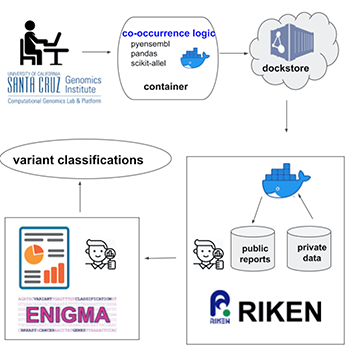
New responsible data sharing technique will enable better understanding of disease-causing genetic variants
Scientists may better understand and test for the genetic variations that cause cancer and other heritable diseases through the application of a novel strategy for securely sharing and analyzing genomic data developed at the UC Santa Cruz Genomics Institute.
-

A new way to find genetic variations removes bias from human genotyping
Researchers at the UC Santa Cruz Genomics Institute have demonstrated an effective new tool for mapping genetic variants in sequencing data using ‘pangenomics’ instead of a single reference genome .
-

NIH funds Center for Live Cell Genomics at UC Santa Cruz
The NIH Centers of Excellence in Genomic Science program has awarded $13.5 million over five years for a new center to advance genomics in biomedical research.