Earth & Planetary Sciences
-
Seismologist Thorne Lay elected to American Academy of Arts & Sciences
Thorne Lay, professor of Earth and planetary sciences at UCSC, has been elected a fellow of the American Academy of Arts & Sciences, one of the nation’s oldest and most prestigious honorary societies.
-
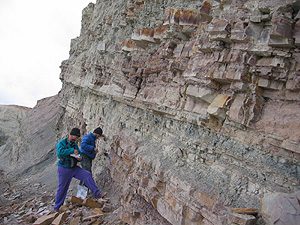
New findings from Tibetan Plateau suggest uplift occurred in stages
New evidence from an eight-year study by UCSC and Chinese researchers indicates that the Tibetan Plateau rose in stages, with uplift occurring first in the central plateau and later in regions to the north and south.
-

Past greenhouse warming events provide clues to what the future may hold
Scientists studying an episode of extreme global warming in Earth’s past are piecing together an increasingly detailed picture of its causes and consequences.
-

Earth scientist James Zachos elected fellow of the American Geophysical Union
James Zachos, professor of Earth and planetary sciences at UCSC, has been elected a fellow of the American Geophysical Union (AGU).
-
Geophysicist Robert Coe honored by American Geophysical Union
Robert Coe, professor of Earth and planetary sciences, was selected by the American Geophysical Union’s (AGU) Geomagnetism and Paleomagnetism section to receive the 2007 William Gilbert Award.
-
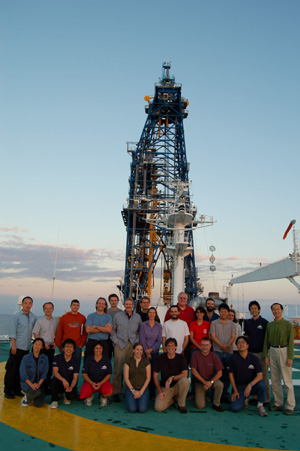
UCSC geologist probes undersea seismic zone as part of new deep-drilling experiment
The first effort to drill into an undersea zone where massive earthquakes and tsunamis are generated has yielded new data on the stresses that build up there, according to UCSC geologist Casey Moore.
-
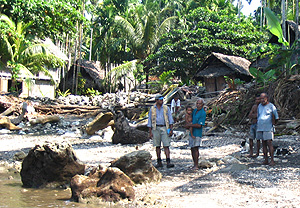
Study finds oral traditions effectively warn people about tsunamis and reduce mortality
Oral traditions are a very efficient means of tsunami education, according to a new study that researchers say shows the power of education to reduce mortality from tsunamis.
-
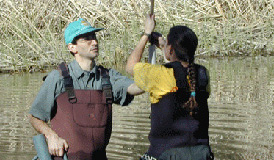
UCSC hydrogeologist provides expert advice on Pajaro Valley’s water supply
When a community forum was held in Watsonville on November 1 to discuss the future of the Pajaro Valley’s water supply, organizers turned to Andrew Fisher, professor of Earth and planetary sciences, to describe the state of the region’s ground water.
-
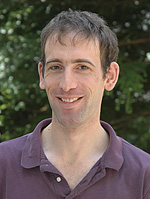
Francis Nimmo receives Urey Prize in Planetary Science
The Division for Planetary Sciences of the American Astronomical Society will award the 2007 Harold C. Urey Prize in Planetary Science this week to Francis Nimmo, associate professor of Earth and planetary sciences.
-

Scientists reconstruct prehistoric behavior and ecology of northern fur seals
A team of researchers has documented major changes in the behavior, ecology, and geographic range of the northern fur seal over the past 1,500 years using a combination of techniques from archaeology, biochemistry, and ecology.
-
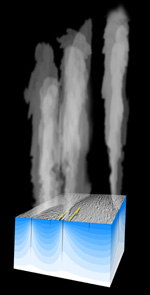
Frictional heating explains plumes on Saturn’s moon Enceladus
Rubbing your hands together on a cold day generates a bit of heat, and the same process of frictional heating may be what powers the geysers jetting out from the surface of Saturn’s moon Enceladus.
-

Seismologists discover complex structure in Tonga mantle wedge
The subduction zones where oceanic plates sink beneath the continents produce volcanic arcs such as those that make up the “rim of fire” around the Pacific Ocean. A new study finds that the structure of the mantle wedge above the subducting plate may be f