Earth & Planetary Sciences
-
UCSC hydrogeologist provides expert advice on Pajaro Valley’s water supply
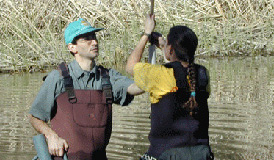
When a community forum was held in Watsonville on November 1 to discuss the future of the Pajaro Valley’s water supply, organizers turned to Andrew Fisher, professor of Earth and planetary sciences, to describe the state of the region’s ground water.
-
Francis Nimmo receives Urey Prize in Planetary Science
The Division for Planetary Sciences of the American Astronomical Society will award the 2007 Harold C. Urey Prize in Planetary Science this week to Francis Nimmo, associate professor of Earth and planetary sciences.
-

Scientists reconstruct prehistoric behavior and ecology of northern fur seals
A team of researchers has documented major changes in the behavior, ecology, and geographic range of the northern fur seal over the past 1,500 years using a combination of techniques from archaeology, biochemistry, and ecology.
-
Frictional heating explains plumes on Saturn’s moon Enceladus
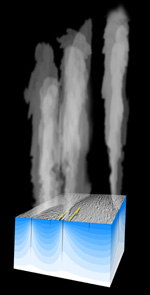
Rubbing your hands together on a cold day generates a bit of heat, and the same process of frictional heating may be what powers the geysers jetting out from the surface of Saturn’s moon Enceladus.
-

Seismologists discover complex structure in Tonga mantle wedge
The subduction zones where oceanic plates sink beneath the continents produce volcanic arcs such as those that make up the “rim of fire” around the Pacific Ocean. A new study finds that the structure of the mantle wedge above the subducting plate may be f
-
New technology shows old faults are smoother than young ones
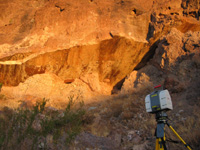
A new study by UCSC geologists finds old earthquake faults are smoother than young ones, worn smooth over time by friction like the brake pads of an old car.
-
New instrument reveals raindrop formation in warm clouds
How do raindrops form? It’s a simple question, but the answer is far from elementary. Tiny water droplets somehow merge to become full-sized raindrops, but the details remain a mystery. Now, scientists at the University of California, Santa Cruz, are closing in on an explanation with a new instrument they developed that measures the sizes…
-
Seismologists measure heat flow from Earth’s molten core into the lower mantle
For the first time, scientists have directly measured the amount of heat flowing from the molten metal of Earth’s core into a region at the base of the mantle, a process that helps drive both the movement of tectonic plates at the surface and the geodynamo in the core that generates Earth’s magnetic field. Seismologists…
-
Fall lecture series at the Seymour Center will focus on global climate change
The Fall Lecture Series at UC Santa Cruz’s Seymour Marine Discovery Center will focus on climate change and global warming, with six speakers providing a range of perspectives on climate science, the effects of global warming, and policy options. Lisa Sloan, professor of Earth and Planetary Sciences, will give the first lecture in the series.…
-

New book looks at Santa Cruz coast ‘then and now’
A new book by Gary Griggs, professor of Earth and planetary sciences at UC Santa Cruz, and local architect Deepika Shrestha Ross offers a unique look at the Santa Cruz coastline. The book juxtaposes historic photographs with photographs taken from the same locations today, showing how the coastline has evolved and changed, sometimes dramatically, over…
-
Increased flow of groundwater after earthquakes suggests oil extraction applications
The most obvious manifestation of an earthquake is the shaking from seismic waves that knocks down buildings and rattles people. Now researchers have established a more subtle effect of this shaking–it increases the permeability of rock to groundwater and other fluids. The enhanced permeability caused by seismic shaking could potentially be harnessed to help extract…