Astronomy & Astrophysics
-
Major gift supports crucial piece of Automated Planet Finder
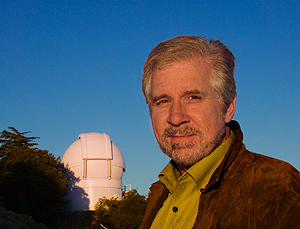
The Gloria and Kenneth Levy Foundation has donated $600,000 to fund an innovative spectrometer for the Automated Planet Finder at UC’s Lick Observatory.
-

Thirty-Meter Telescope Project Receives $15 Million from Moore Foundation
UC and Caltech have each received $7.5 million in additional funding from the Gordon and Betty Moore Foundation for the development of the Thirty-Meter Telescope.
-

Adaptive optics pinpoints two supermassive black holes in colliding galaxies
Astronomers have used powerful adaptive optics technology at the W. M. Keck Observatory in Hawaii to reveal the precise locations and environments of a pair of supermassive black holes at the center of an ongoing collision between two galaxies 300 million
-
UCSC astronomer Douglas Lin appointed director of Kavli Institute for Astronomy and Astrophysics in China
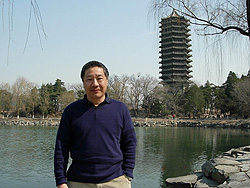
Douglas Lin, professor of astronomy and astrophysics at UCSC, has been named founding director of the Kavli Institute for Astronomy and Astrophysics (KIAA) at Peking University in Beijing, China.
-
Music and stargazing entice summer visitors to Mt. Hamilton’s Lick Observatory
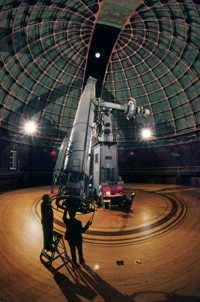
UC’s Lick Observatory offers its 27th season of evening programs for music lovers and astronomy buffs this summer, featuring concerts, lectures, and opportunities to view the night sky through the observatory’s history-making telescopes atop Mt. Hamilton.
-

Supernova Sage: Stan Woosley
Stan Woosley, one of the world’s leading theoretical astrophysicists, studies the evolution of massive stars–and their explosive demise.
-
AEGIS survey reveals new principle governing galaxy formation and evolution
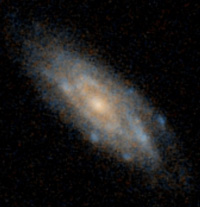
Faced with the bewildering array of galaxies in the universe, from orderly spirals to chaotic mergers, it is hard to imagine a unifying principle that describes them all with mathematical precision. But that is just what astronomers have now discovered.
-
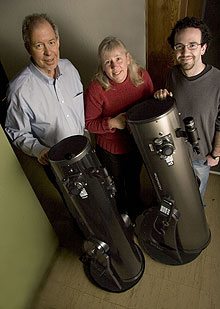
UC Santa Cruz students see stars, thanks to local company
UC Santa Cruz students will have more time with the stars, thanks to a generous donation from a local company. Watsonville-based Orion Telescopes has made a gift of 10 portable telescopes for field use by students, creating greatly enhanced opportunities for observing in introductory courses. “This gift means many more possibilities for students to have…
-
UCSC ranked first in nation for research impact in physics
In a new analysis of research publications from top U.S. universities, the University of California, Santa Cruz, ranked first for the impact of its faculty in the field of physics and fifth in the field of space sciences.
-
DOE awards support UCSC research on dark matter and supernovae
The Department of Energy (DOE) has awarded valuable computing time on one of the world’s most powerful supercomputers to two research projects led by scientists at UCSC.
-
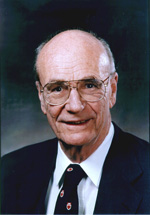
Donald Osterbrock, eminent astronomer and former director of Lick Observatory, dies at age 82
Donald Osterbrock, an eminent astronomer, a leading authority on the history of astronomy, and former director of UC’s Lick Observatory, died suddenly on Thursday, January 11. He was 82.
-
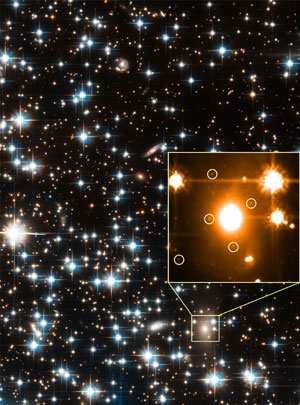
Astronomers find the most distant star clusters hidden behind a nearby cluster
Astronomers have discovered the most distant population of star clusters ever seen, hidden behind one of the nearest such clusters to Earth.