Social Justice & Community
CEJA at UC Santa Cruz: Preparing alumni for academic and community impact
Alumni Desiree Ryan (Ph.D. ’24, psychology), David Amaral (Ph.D. ’22, politics), Melina Singh (Ph.D. ‘23, psychology), and Rosalie Lansing (Rachel Carson ’24, sociology) share their experiences with the Center for Economic Justice and Action and how it prepared them to be successful in their careers.
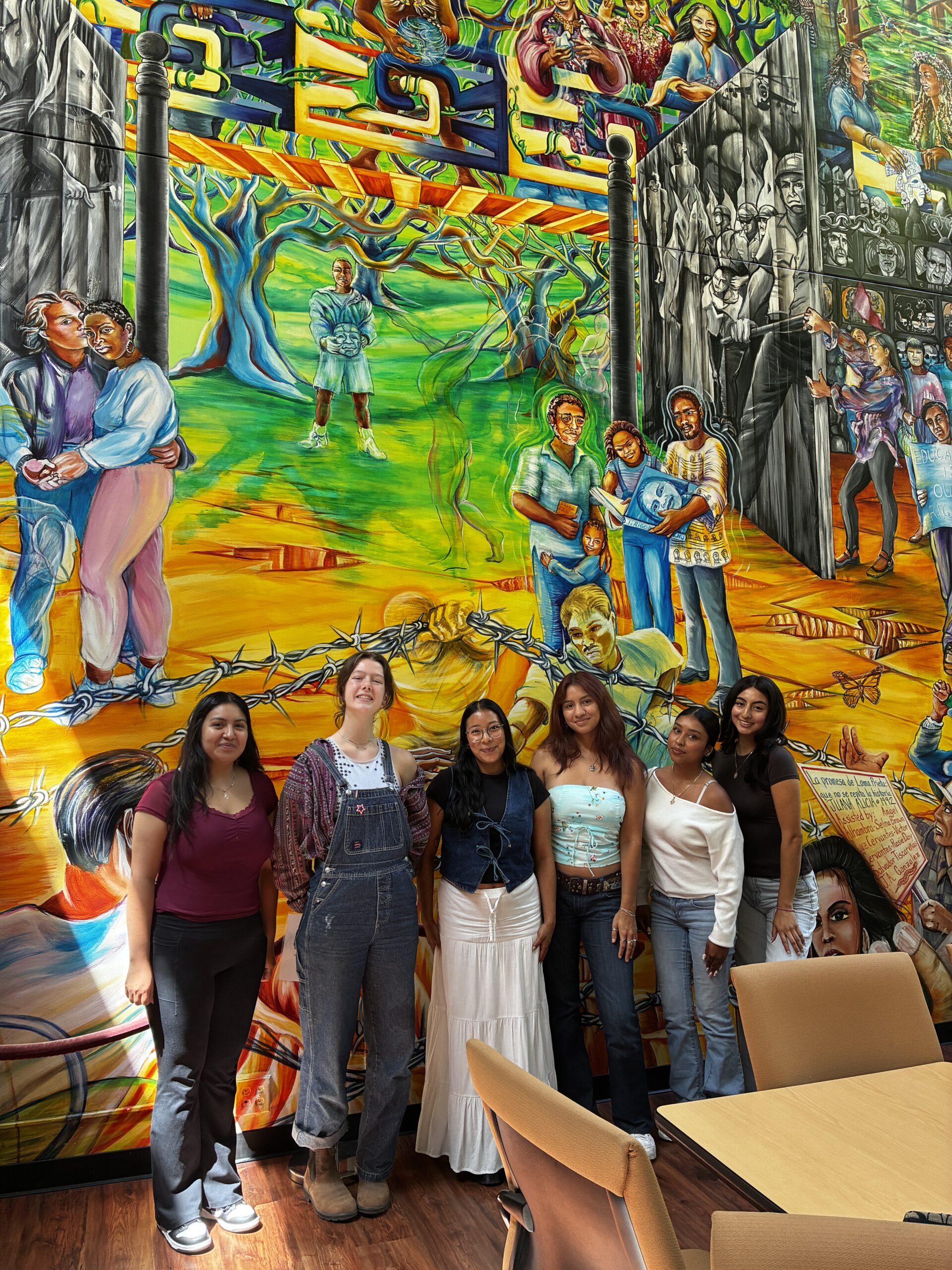
Center for Economic Justice and Action summer 2025 interns.
Key takeaways
- Founded by Richard C. Blum in 2014, the Center for Economic Justice and Action (CEJA) has grown into a leading hub for community-engaged, anti-poverty research focused on economic justice for underserved communities.
- CEJA equips students with hands-on research skills and real-world experience, launching alumni into impactful careers across academia and community development.
- Philanthropic support remains essential to CEJA’s mission, funding the internships, research assistantships, and programs that make student opportunity and community impact possible.
Founded in 2014 through a generous gift from UC alumnus and philanthropist Richard C. Blum, the Center for Economic Justice and Action (CEJA) at UC Santa Cruz has grown into a leading hub for community-engaged, anti-poverty research.
The center specializes in poverty alleviation, fiscal equity, and food and housing security, with a focus on women, families, communities of color, and UC students. Relaunched under its current name in Fall 2023, CEJA partners with students, faculty, and community organizations to develop real, actionable solutions to economic hardship, while also supporting the next generation of researchers through a variety of paid internships, research assistantships, and other community-engaged experiential programs.
In its 12 years, the Center for Economic Justice and Action has helped shape the paths of countless alumni, equipping them to drive change across academia, community development, government, and beyond.
“Watching our alumni go on to create meaningful change in their communities and through their careers is at the heart of what CEJA does,” said CEJA Faculty Director and Professor of Psychology Heather Bullock. “The skills, relationships, and sense of purpose they develop through hands-on research and community partnerships stay with them long after they leave.”

David Amaral (Ph.D. ’22, politics) is the director of research and evaluation at All Home, a regional non-profit focused on reducing homelessness, racial disparities, and promoting housing security and economic mobility for residents with extremely low incomes in the Bay Area. Amaral says that he frequently utilizes the skills he developed while at CEJA in his current role.
Amaral spent several years at CEJA working on a food security study in Santa Cruz County, helping develop a food insecurity index to measure the gap between community need and available food assistance.
The work involved close partnership with Second Harvest Food Bank and a network of local organizations, as well as community convenings to share findings and policy recommendations with service providers, advocates, and local officials. The project resulted in several annual reports tracking food insecurity trends, including a COVID-era report capturing how assistance providers adapted during the pandemic. As a result of the work, Amaral went on to serve on the Board of Second Harvest, an experience he describes as an additional opportunity for learning and service.
“My focus—then and now—has been on local politics, poverty, and public policy, and in the politics department especially, but also across the university, there is an amazing collection of thoughtful and passionate scholars working on these areas,” Armal said about his decision to attend UC Santa Cruz for his Ph.D. “The politics department’s collection of faculty focused on local and urban politics was a big draw, as was the opportunity to pursue really multidisciplinary work with faculty and students in other departments like sociology and psychology.”

Melina Singh (Ph.D. ‘23, psychology) is a teacher-scholar science fellow and visiting assistant professor of psychology at Kenyon College. In the Fall, she will start a new position as an assistant professor of diversity science at Macalester College.
As a graduate student researcher at CEJA from 2018 to 2021, Singh conducted research examining how housing insecurity impacts the academic success and well-being of low-income students, with a focus on underrepresented groups including student parents, transfer students, and students of color. Her work spanned the full research cycle, from developing protocols and training research assistants to conducting interviews and presenting findings at a UC systemwide basic needs conference.
“My experiences at CEJA were instrumental in preparing me for an academic career, especially one involving significant undergraduate mentorship, as well as shaping my identity as a qualitative researcher,” Singh said.
In addition to gaining practical research skills such as developing interview questions, recruiting participants, and using qualitative analysis software, working at CEJA gave Singh a unique opportunity to conduct collaborative, community-engaged scholarship on issues affecting marginalized students.
“Treating participants as experts in their own lives and working to amplify the perspectives of marginalized groups are values that I carry with me from my time at CEJA and UCSC more broadly.”
Desiree Ryan (Ph.D. ’24, psychology) made her way to UC Santa Cruz from Sonoma State University. In her third year at Sonoma State, she was introduced to social psychology research, and quickly developed a passion for social justice focused research.
Ryan was a graduate student researcher with CEJA for over four years. Ryan says her experiences at CEJA prepared her for her job as an assistant professor at San Jose State University in many ways. The experience deepened her understanding of the financial and basic-needs challenges students face—like food and housing insecurity—through direct research methods including focus groups, interviews, case note analysis, and statistical work. It also built her skills in community-engaged, student-centered research aimed at producing practical solutions to remove barriers to student success.

As a graduate student, Ryan conducted research in partnership with Slug Support, a program at UC Santa Cruz made up of non-clinical case managers who work one-on-one with students to help address and navigate difficult situations. Ryan’s project consisted of analyzing over a thousand case worker notes to better understand the catalysts to seeking housing assistance among students.
“I am deeply grateful for the opportunity to be a graduate student researcher at CEJA,” Ryan said. “The skills I learned are invaluable to me, but it was witnessing Heather and [CEJA Assistant Director] Lisa [Nishioka] work tirelessly to conduct this student-driven research that taught me change through research—the skillset I personally can bring to the table—is possible and very valuable.”
CEJA’s impact extends beyond graduate students, offering undergraduate students meaningful opportunities to engage in hands-on, community-focused research from early in their academic careers. Through paid research and internship opportunities, undergraduates work alongside faculty and community partners to address poverty and inequality in Santa Cruz County, gaining real-world skills and experience that prepare them for careers in economic justice and beyond.
Rosalie Lansing (Rachel Carson ’24, sociology) now works at the San Gabriel Valley Council of Governments, focusing on housing and homelessness programs across the 31 cities of the San Gabriel Valley. Her role spans both the planning and financing sides of affordable housing, from helping cities identify sites and improve zoning policies to reviewing developer applications for affordable housing funding.
She credits her CEJA experience as a critical stepping stone, noting that having hands-on, housing-related research experience on her resume was essential in landing her first job out of college in a field where early relevant experience is hard to come by.

Lansing joined CEJA in her junior year as a research assistant, working on two studies that aligned with her longstanding interest in affordable housing. The first, conducted in partnership with Habitat for Humanity, examined the generational wealth-building impacts of affordable home ownership for lower-income families. The second studied a guaranteed income pilot program in Santa Cruz County supporting farmworker families and survivors of intimate partner violence, tracking how monthly stipends enhanced financial and family stability. Across both projects, she contributed to interview design, data collection, transcription, and reporting.
“Majoring in sociology, I really liked working at the center because it was a very practical application of what I was learning,” Lansing said. “A lot of sociology can focus on wider institutions and studying problems from a more pulled back lens, but this was very focused on individual people and how our systems can better support individuals whether that be through more affordable housing options, affordable home ownership options, or through things like guaranteed income programs.”
Additional CEJA undergraduate alumni outcomes
- Serena Ramirez (Porter ’25) is a graduate student at Northeastern University and a development associate at PIVOTAL.
- Marlén Reyes (Oakes ’22) is a community organizer at Cradle to Career Santa Cruz County.
- Lisa Pham (Porter ’24) is a graduate student at the University of California, Irvine.
- Jennifer Aimee Martinez (Oakes ’22) is a LAUNCH family health navigator at Pacific Clinics.
A foundation of philanthropy
Philanthropy has supported CEJA since its founding, and remains essential to sustaining and expanding the center’s impact today. Richard C. Blum’s founding gift established the center’s vision of hands-on, community-engaged research, a legacy that continues to grow through the generosity of donors who share that commitment.
Additional philanthropic contributions have directly enabled two cornerstone programs: CEJA’s Community Engaged Internships, which places students in meaningful anti-poverty work throughout Santa Cruz County, and the Blum Scholars Grant Program, which funds student-led research. Another generous gift has grown into an endowment dedicated to alleviating poverty and advancing the well-being of low-income women and mothers in the local community.
More recently, Roberta Gordon (Rachel Carson ’81, chemistry/environmental studies) and the Ida and Robert Gordon Family Foundation have provided annual support for summer internships focused on women’s financial security, food, and health.
“I feel that it is important to think about the next generation and for donors to consider that they are helping the next generation come along,” Roberta Gordon said in a 2024 article. “We’ve got to think about what we’re doing to move them along and support their trajectories.”
These contributions do more than fund individual programs, they provide a stable financial foundation that allows CEJA to sustain its work even when grant funding falls short, ensuring continuity and growth for both students and community partners. For students, donor support translates directly into paid research and internship opportunities that might otherwise not exist, opening doors to real-world experience and professional development in the field of economic justice.
“Philanthropic support is what makes so much of what we do at CEJA possible,” said CEJA Faculty Director and Professor of Psychology Heather Bullock. “It allows us to offer students paid research and internship opportunities that are truly transformative, and ensures that our work in the community continues even when other funding is uncertain. We are deeply grateful to the donors who share our commitment to economic justice and invest in both our students and the communities we serve.”
Your support for the Center for Economic Justice and Action can amplify opportunities for degree-defining experiences.
Learn more about how we’re supporting Student Success through our Inspiring Change fundraising campaign.