Earth & Space
Professors Adina Paytan and Douglas Lin elected to National Academy of Sciences
Lin, emeritus distinguished professor of astronomy and astrophysics, also elected to the UK’s Fellowship of the Royal Society
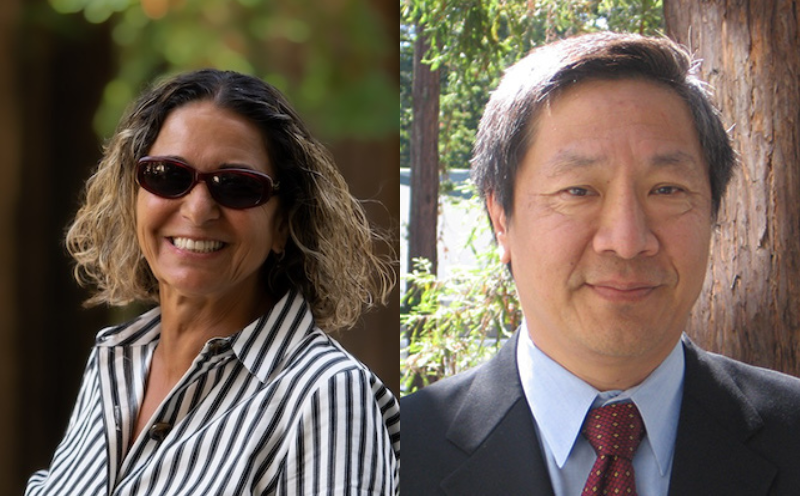
UC Santa Cruz distinguished professors Adina Paytan and Douglas Lin
Two more faculty members from the University of Calfornia, Santa Cruz, have been elected to the National Academy of Sciences (NAS): Adina Paytan, distinguished professor of Earth and planetary sciences, and Douglas Lin, emeritus distinguished professor of astronomy and astrophysics.
Every year, NAS elects new members in recognition of their distinguished and continuing achievements in original research. Paytan’s research focuses on global biogeochemical cycles and how human activity alters these cycles. She has played a key role in efforts to restore wetlands and understand their role in climate resilience. Her lab is dedicated to exploring the intricate web of interactions between living organisms and the chemical elements that shape our planet at present and over geological time.
Paytan, recently named a new fellow of the American Association for the Advancement of Science, has also been honored for her involvement in STEM education and public outreach to provide professional development opportunities to students of all ages and expand science literacy. Paytan is a fellow of the American Geophysical Union (AGU), Association of the Sciences of Limnology and Oceanography (ASLO), Geochemical Society, and European Association of Geochemistry.
Lin, a world-renowned theoretical astrophysicist, focused on the origin of the solar system, planet formation, and astrophysical fluid dynamics. He is best known for his pioneering work on the evolution of planetary systems and his development of fundamental models used in modern astrophysics. For his outstanding contributions, the UK’s national academy of sciences has also elected Lin to its Fellowship of the Royal Society.
He was one of the first scientists to realize that protoplanetary disks—the gas and dust surrounding young stars—are subject to turbulent angular momentum transport. In addition, he postulated the theory of planetary migration, which accounts for the origin of the subsequently discovered close-in planets around their host stars. Beyond planets, he also researched the rings of Saturn, the dynamics of spiral galaxies, and the accretion disks surrounding black holes.
Lin was the founding director of the Kavli Institute for Astronomy and Astrophysics (KIAA) at Peking University, where he worked to elevate the profile of Chinese astronomy. He is a Legacy Fellow of the American Astronomical Society, Honorary Fellow of the Royal Astronomical Society, member of the American Academy of Arts and Sciences, and has been honored with visiting professorships at top universities and institutes around the world.
Paytan and Lin’s election to NAS brings the current number of members from UC Santa Cruz to 27. The total active NAS membership is 2,705, plus an additional 557 international members, according to an April 28 NAS announcement.