Campus News
National award recognizes UCSC’s student-centered housing strategy
Where students live shapes their success. UC Santa Cruz built a housing plan around that premise—and it earned a national award.

The Colleges, Housing and Educational Services (CHES) Long Range Business Plan has been selected to receive the 2026 Outstanding Innovation in Housing and Residential Life Award from the Association of College Personnel Administrators (ACPA). The award, presented by ACPA’s Commission for Housing and Residential Life, positions UCSC’s approach as a replicable model for how universities can grow under significant resource constraints.
The plan addresses a clear challenge: how to expand housing capacity in one of the nation’s most expensive rental markets, on terrain that makes construction complex, while meeting ambitious sustainability and safety standards.
For CHES leadership, the answer started with the three divisional priorities that guide all work within UC Santa Cruz’s Division of Student Affairs and Success: student-centered decision-making, equity and inclusion, and innovation. Those values weren’t just framing—they were the lens through which the plan was developed.
Student-centered decision-making: Housing as a student success issue
The connection between housing and academic success is well documented. “The Case for Campus Housing”, a multi-year research report from the Association of College and University Housing Officers-International, conducted with Indiana University found that commutes exceeding 10 minutes can lead to decreased persistence, a phenomenon they call the “Friction of Distance.” When students live farther from campus, they’re less likely to return for evening study groups, office hours, or co-curricular programming.
Housing stability plays a critical role in retention. A 2021 study by Dr. Broton of the University of Iowa found that housing instability is a statistically significant predictor of college attrition, with affected students seeing an 8–12 percentage-point drop in their chances of staying enrolled or graduating. University housing helps provide that stability. Students living on campus benefit from residential life staff trained to offer support, while proximity to campus keeps them connected to faculty, peers, and opportunities—including deadlines and opportunities that students living farther away may miss.
Equity and innovation: Sustainable growth with financial stewardship
Expanding access to on-campus housing is essential, but that growth must also be financially sustainable and protect students from sharp rate increases—a direct expression of the plan’s equity commitments.
Facing a significant deficit and rising construction costs, CHES leadership developed the “toggle” strategy, an approach that alternates between periods of new construction and major renovations. Backed by a 10 percent budget realignment and strategic cost reductions, the approach transformed a projected deficit into a positive financial outlook through 2040. The campus can now fund growth while reinvesting in the housing communities students already rely on.
Putting the plan into action
The plan projects a significant increase in UCSC’s total housing capacity by 2035, and work is already underway. Major projects advancing under the framework include:
- Kresge College renewal and expansion, adding 587 new beds with award-winning design by Studio Gang.
- Hagar Drive Family Student Housing and Early Education Center, providing 120 two-bedroom units and childcare for students, faculty, and staff.
- Delaware Apartments, a mixed-use development with the City of Santa Cruz adding 350 beds.
- Cabrillo College partnership, the first UC–community college housing collaboration, creating more than 600 new beds.
- Heller Phase I, projected to bring over 1,200 new upper-division beds to campus.
Together, these efforts connect housing growth to the campus’s broader Long Range Development Plan for sustainable physical development through 2035.
The team behind the work
The plan was developed through collaborative effort across CHES leadership:
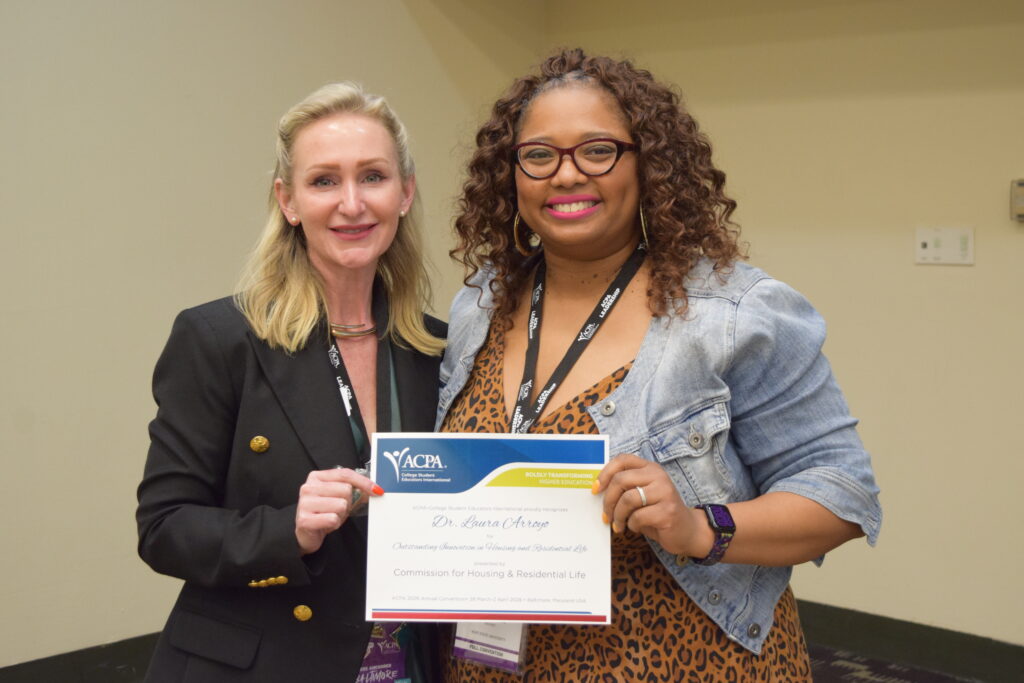
- Laura Arroyo, Associate Vice Chancellor of CHES
- Steve Houser, Executive Director of Capital Planning
- Angela Cline, Assistant Vice Chancellor for Budget and Financial Management
- Amy Chavez, Director of Financial Planning and Analysis
“Centering student success in every housing decision is what guided this work,” said Laura Arroyo. “For our first-generation and diverse student population especially, stable housing isn’t separate from academic success—it’s the foundation. We’re honored that this recognition might inspire other institutions facing similar pressures to prioritize both expansion and long-term financial responsibility. This achievement belongs to the entire team.”
The award was presented at ACPA’s national conference in April 2026.
Division of Student Affairs and Success (DSAS) advances holistic student development by providing programs, services, and resources that support students’ academic achievement, personal growth, and sense of belonging. Grounded in equity and student success, the division partners across campus to create inclusive environments where all students can thrive. To learn more, visit the DSAS website and follow @ucsc.dsas on Instagram.
Colleges, Housing and Educational Services (CHES) provides leadership across college student life, residential services, housing, dining, capital planning, conference services, and early education. Through these areas, CHES delivers programs and services that support students, faculty, staff, and the broader Santa Cruz community. Learn more about CHES.
Budget and Financial Management (BFM) supports the Division of Student Affairs and Success departments by providing financial planning, oversight, and reporting across operating and capital budgets—including major maintenance, capital projects, and debt service. The department advises division leadership on budgeting, accounting, staffing, and personnel matters. Learn more about BFM.