Student Experience
Immersion in childhood cancer research transforms undergrads into scientists—and advocates
The Treehouse Childhood Cancer Initiative is giving 80 students the opportunity to become cancer researchers for a quarter, thanks in part to generous funding from the UCSC Degree-Defining Experiences Program and the Dragon Master Initiative.
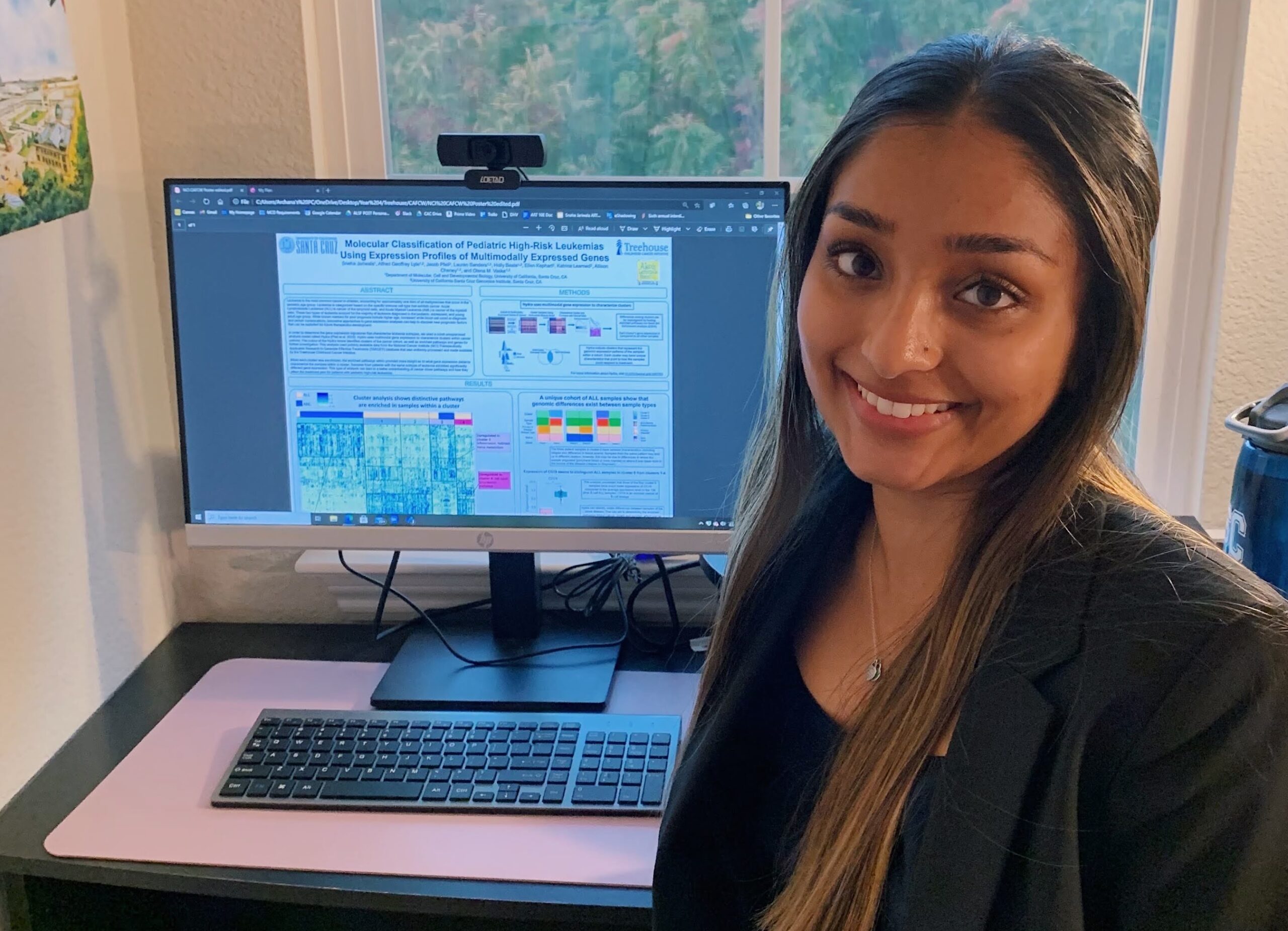
Sneha Jariwala presenting a poster of her undergraduate research project with the Treehouse Childhood Cancer Initiative at a virtual conference for the American Association for Cancer Research (AACR) during the Covid pandemic.
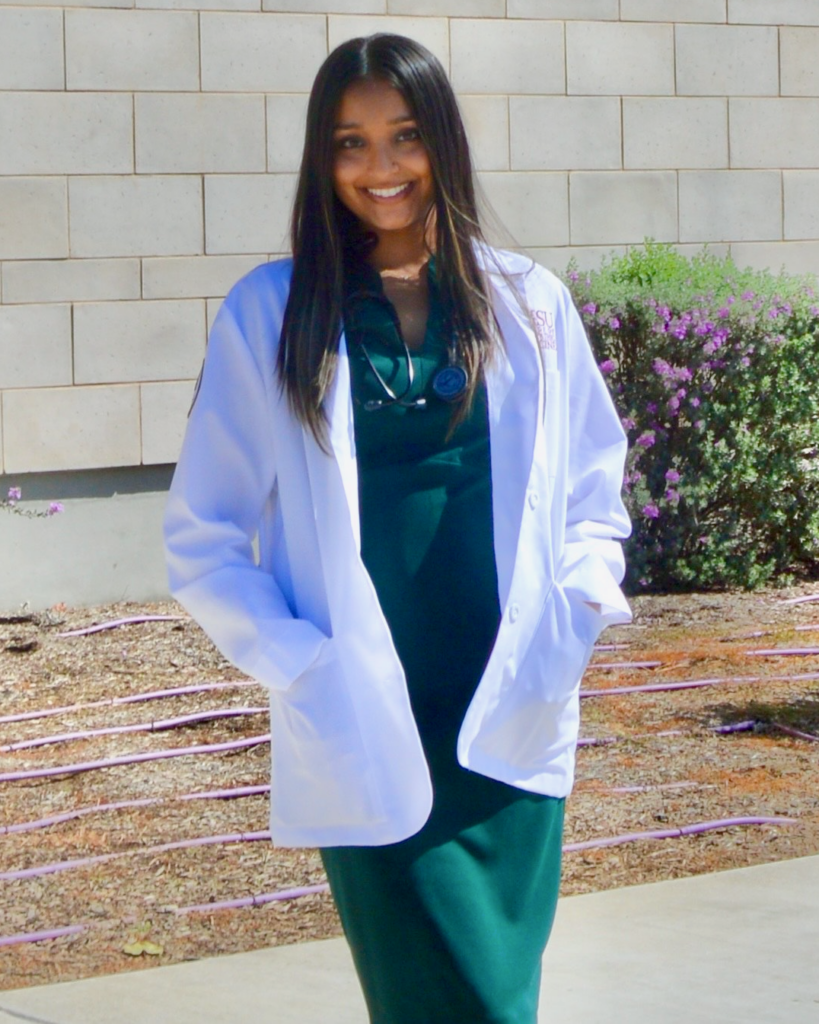
When Sneha Jariwala applied to the Treehouse Undergraduate Bioinformatics Immersion (TUBI) in her first year at UC Santa Cruz, she had an idea that she eventually wanted to go into a career in medicine, but she had no experience with bioinformatics, coding, or research.
“TUBI gave me a whole new perspective on oncology and highlighted how research can impact clinical decisions years later,” Jariwala said. “It helped show me that biology and bioinformatics can open the door to so many opportunities.”
After TUBI, Jariwala became an undergraduate researcher in the Vaske lab, and Alex’s Lemonade Stand Foundation awarded her a prestigious Pediatric Oncology Student Training grant to continue her research. She also became involved in advocacy, co-leading the UC Santa Cruz chapter of Colleges Against Cancer.
Today, Jariwala is a medical student at California Health Sciences University with the goal of specializing in pediatric hematology and oncology. She says early exposure to research through TUBI opened doors for her and shaped her journey.
“As a first-generation medical student, I had to pave my own path,” Jariwala said. “TUBI gave me the confidence to talk about something that I’m passionate about—childhood cancer—in medical school interviews and career-related conversations.”
Retention through research
Stories like Jariwala’s are not unique. In seven years, TUBI—which operates out of the UC Santa Cruz Genomics Institute’s Treehouse Childhood Cancer Initiative—has fostered many budding scientists, engineers, PhDs, medical students, and advocates for cancer research.
The program emerged from conversations between Treehouse’s lead computational biologist, Holly Beale, and its co-founder, Professor of Molecular, Cell, and Developmental Biology (MCDB) Olena Vaske, about how many undergraduates came into college excited about careers in STEM but then ended up leaving those majors by the end of their second year. Beale believed more students might stick with science if scientists were people they knew—regular people like them.
“Knowing scientists and being known by scientists—I think that is something really powerful for undergraduates,” Beale said.
Research confirms this intuition. Multiple studies have shown that early undergraduate research experiences improve graduation rates, encourage the pursuit of advanced degrees, and increase students’ confidence. The problem is that labs can usually only take on a couple of trainees at a time, a majority of which tend to go to students who are more advanced in their studies.
Beale’s answer to this problem was to create TUBI, a quarter-long program that immerses students in the cutting-edge RNA variant calling work that Treehouse is known for. This research compares individual tumor data to thousands of other tumors to find patterns that might suggest targeted treatments. Students learn to follow computational protocols, use the UCSC Genome Browser, and communicate about their work, even when it isn’t going well.
“Being able to say, ‘I tried to work on this, but I’m actually kind of lost’—I think that’s a specific skill that is critical for science,” Beale said.
The approach is helping many students to gain confidence and persevere in STEM fields. Of the 43 students surveyed after the 2025 session, 84% said they had experienced imposter syndrome—and 97% of those said TUBI helped them manage it.
Scaling through alumni leadership

From the beginning, Beale’s dream for TUBI has been to offer a research experience to as many students as possible. She started with 20 students, but when she first attempted to scale up, she felt that it didn’t work—her surveys showed that students weren’t coming out with the sense of belonging and connection that made the smaller program so effective.
The breakthrough came when new funding allowed Beale and her team to take a new approach, creating paid mentorship programs for TUBI alumni to help lead smaller breakout sessions. The first gift, from the Degree Defining Experience (DDE) program, allowed TUBI to expand to 60 students last year. This year, the program received a second DDE gift, but it wasn’t enough to cover the cost of alumni mentors—which meant TUBI was going to have to scale back down to 20.
That’s when the Dragon Master Initiative stepped in. The nonprofit, dedicated to accelerating cures for cancer and rare diseases, offered a transformative gift that not only preserved the program but enabled it to expand to 80 students. Eight section leaders and three floaters now lead small-group discussions and one-on-ones, while Beale handles technical instruction for the full cohort.
“It’s honestly all about the TUBI alumni coming back and being leaders,” Beale said. “If you had 10 of me, it would not be as good as it is to have 10 of them.”
Jackie Roger, one of TUBI’s first mentors, said that mentoring helped her build confidence in her own abilities as a young researcher. She went on to earn her Ph.D. in bioinformatics at UC San Francisco and is now a postdoctoral scholar at Kaiser Permanente’s Division of Research. Of all the labs she has worked in over the years, she says that there was something very unique about Treehouse.
“The whole Treehouse ecosystem was and is such an inspiration,” Roger said. “Olena and Holly have this really genuine drive to do something that can help people.”
Real people, not just data

One thing Roger appreciated about Treehouse was that even with their intense focus on research, the members of the lab never forgot the real people impacted by pediatric cancer.
“It’s never just data on a screen,” she said. “You’re always aware that these are real people who are affected.”
Beale encourages students who are cancer survivors to apply to TUBI, and over the years several have shared their experiences with the group. One is Samantha Garcia, who beat cancer twice—once as a toddler and again as a teenager. There were of course difficult parts of this experience, but Garcia likes to defy people’s expectations of what a cancer patient should be, presenting them with a girl who loved having her blood pressure taken by nurses dressed as princesses, and also engaged in daring athletic feats in the hospital that led to sprained wrists on two separate occasions, and a near concussion.
TUBI gave Garcia a chance to process her story by sharing it with peers, and to see their reactions. Many students told her they were amazed at how she could be so funny and positive when talking about cancer, which Garcia took as validation that they were seeing her as the person she wanted to be.
“For the longest time, I was just labeled as a sick little girl,” Garcia said. “Hearing people respond—it was like, all right, I’m becoming someone I want to be. I’m able to take my story and still not make it this Debbie Downer sob story. Because it’s not.”
Garcia is now pursuing a double major in education and global community health, and plans to pursue a Ph.D. in public health education so she can teach medical students how to better communicate with patients where they are.
The path forward for TUBI
The timing of the Dragon Master Initiative’s gift is significant. Federal funding cuts have impacted mentorship programs across the country, and TUBI has expanded to fill a critical gap at a moment when students need these programs more than ever.
For students like Jariwala, Roger, and Garcia, TUBI offers something invaluable: the chance to explore their interests, see themselves as scientists, build community, and gain the confidence they need to persevere in whatever path they choose. The program is also building a much-needed pipeline of scientists, physicians, and advocates who will tackle some of our biggest health challenges.
“TUBI and Treehouse provide a very unique scientific environment, and it’s very inspirational,” Roger said. “It’s interdisciplinary, it’s connected with clinical motivation, it’s led by women, and there’s an emphasis on diversity and inclusivity. TUBI is more than just the technical material that the students learn—it’s a window where really young students can see, ‘Oh, this could be me. I could be a scientist. I could do this.’ I think that’s really wonderful.”
If you would like to support the Treehouse Childhood Cancer Initiative or TUBI, please visit https://treehousegenomics.ucsc.edu/donate/
Your support for the Treehouse Childhood Cancer Initiative and Degree-Defining Experiences Program will create transformational learning opportunities for undergraduates outside the classroom.
Learn more about how we’re supporting Student Success through our Inspiring Change fundraising campaign.