Climate & Sustainability
The business case for insuring forests in urban areas
New report examines how insurance policies covering urban forests could be structured and whether it’s feasible
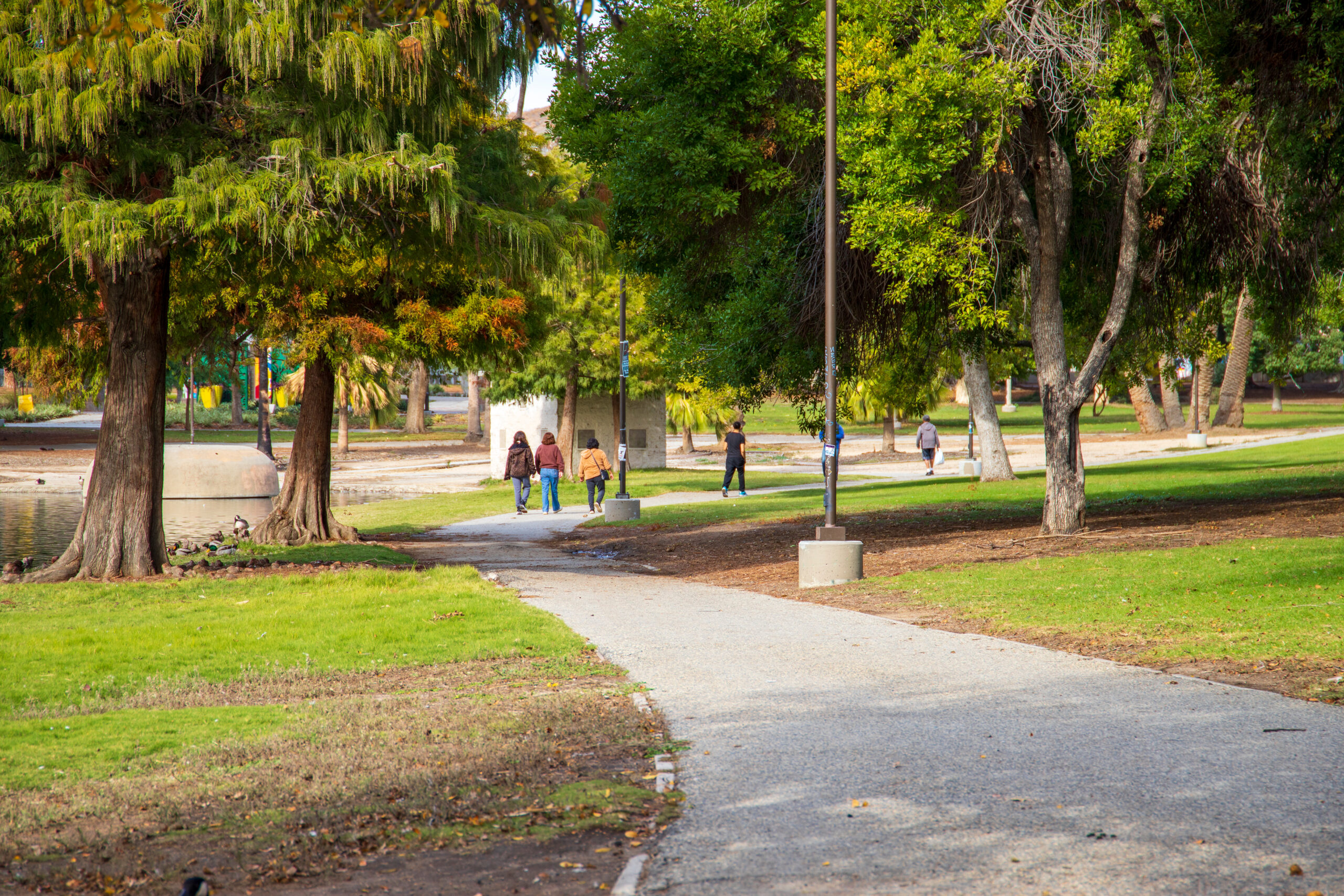
Urban forests in parks and mixed-use spaces are typically not insured to cover the replacement cost of trees downed by storms and other high-risk events.
Press Contact
From offsetting higher temperatures as cities heat up and cultivating healthier communities, to contributing to local economies and delivering other critical services, the range of benefits of trees in urban settings are detailed in a new report co-authored by scientist Heather Tallis at UC Santa Cruz’s Center for Coastal Climate Resilience (CCCR).
The publication, “California Urban Forest Insurance,” is a feasibility report that translates these benefits into monetary terms in order to make the business case for insuring these resources. The report identifies storms as a primary insurable risk and outlines stakeholders who might have an incentive to purchase insurance that helps protect and restore urban trees and green spaces.
“The reality of climate impacts is becoming completely unavoidable for a lot of communities in the state right now,” said CCCR Senior Fellow Heather Tallis. “We need novel approaches. We need different ways to respond to climate impacts as they happen, and we need different ways to fund responses.”
The economic value of urban trees
The financial benefits identified in the study are significant:
- California’s 173.2 million urban trees represent a $181 billion asset, generating $8 billion in services per year. For comparison, the combined financial value of California’s highway infrastructure, buildings and other depreciable property in 2023 totaled $143.4 billion.
- A study of 5 million Northern California residents found that those living in the greenest areas paid $374 less per year in adjusted health care costs, compared to those living in areas with fewer trees.
- Planting, caring for and maintaining urban and community forests contributed $12.9 billion to California’s economy in 2021, supporting 78,560 jobs.
According to Tallis, these numbers likely underestimate the true value of urban forests.
“(These estimations) only capture a small subset of the things we have the methodologies to account for in current economics,” Tallis noted. “It’s very important to translate what’s going on in the natural environment into benefits someone is responsible for providing, whether that’s in healthcare costs or in stormwater-treatment terms, or in dollar savings, whatever the metrics are that people make decisions around.”
Aligned with state insurance office
Tallis, whose career focuses on conservation policy and innovative nature-based solutions, has worked on efforts to quantify how natural systems affect human well-being and how those contributions can influence investments.
“I have worked on mechanisms that quantify how nature’s affecting things that people care about in ways that can help us design investments that provide those benefits,” Tallis said.
That focus aligned closely with the work of California Department of Insurance (CDI) Special Advisor Deborah Halberstadt, who has been examining how insurance tools can help protect natural assets. Their partnership helped drive the development of the report, which highlights the ecological, social, and economic value of urban forests and frames them as long-term investments.
Previous research by Tallis has also shown that access to green space can improve educational outcomes for elementary students in California. Other studies indicate that even views of greenery from a window can accelerate patient recovery times.
Those health-related benefits are one reason the report identifies healthcare providers and insurers as key stakeholders who have financial gains from healthier, greener environments.
“The health insurance industry is definitely a beneficiary of urban green space of urban forests, and so they’re really important in this conversation. They will see savings, both in health care costs and in claims, if people are living in a healthier, greener environment,” Tallis said.
A proven model
Storms—including atmospheric rivers and high-wind events—pose the most immediate threat to urban forests in California. A single storm in 2023, for example, felled more than 1,000 trees in Sacramento. The report explores how tiered parametric insurance could be structured to provide different payout levels based on sustained wind speeds, precipitation intensity, or soil saturation.
To build out the model, the research team convened a workshop with potential stakeholders, including state and local urban foresters, nonprofit and community-based organizations, academic researchers, and healthcare professionals. Their perspectives helped shape how an insurance policy could operate in practice.
As Tallis explained, a forest insurance model would rely on stakeholders purchasing policies that would contribute to a pooled fund. When a qualifying storm event occurs, the policy would pay out funds that cities could use to restore and recover their urban forest systems.
The concept draws inspiration from the Mesoamerican Barrier Reef insurance model. In 2019, CCCR Director Michael W. Beck and co-leads from The Nature Conservancy worked with Swiss Re to develop a parametric insurance policy for a stretch of reef along Mexico’s Yucatán Peninsula. This policy was triggered and paid out when winds during Hurricane Delta surpassed 100 knots (115 mph). This approach has been expanded to reefs in other Mesoamerican countries and Hawai’i.
“That definitely was a basis for this idea and that model is a very useful example to learn from,” Tallis said. “There’s just no question that we need new ways to act and new ways to respond and new ways to move money in a timely fashion so that people can respond and build more resilience in order to protect themselves.”
Looking ahead
As for what’s next, Tallis said that conversations with stakeholders and potential insurers are needed to refine the design of a potential policy, followed by partnerships with pilot cities to implement the policies. The researchers emphasize the need to better understand the costs counties face after climate-related disasters and determine what forms of coverage and payout thresholds would be most effective.
Success, Tallis noted, would mean cities, counties, and stakeholders recognizing the benefits of nature and building the financial and governance structures needed to protect those assets. She envisions a world where policies insuring natural assets is commonplace, offered by big insurers to cover different kinds of natural assets.
But beyond the mechanics of insurance, she hopes for a broader shift in mindset.
“I hope that beyond insurance as a tool, the report adds to people’s recognition that nature really matters to our daily lives,” Tallis said. “We have a lot of tools across our entire economy to use differently and make nature a much more present and important part of our reality.”