Campus News
California Arts Council fellowship supports faculty member’s musical innovation, from opera to hip-hop
Assistant Professor akua naru will receive unrestricted funding for her work, which centers Black music, culture, and experience.
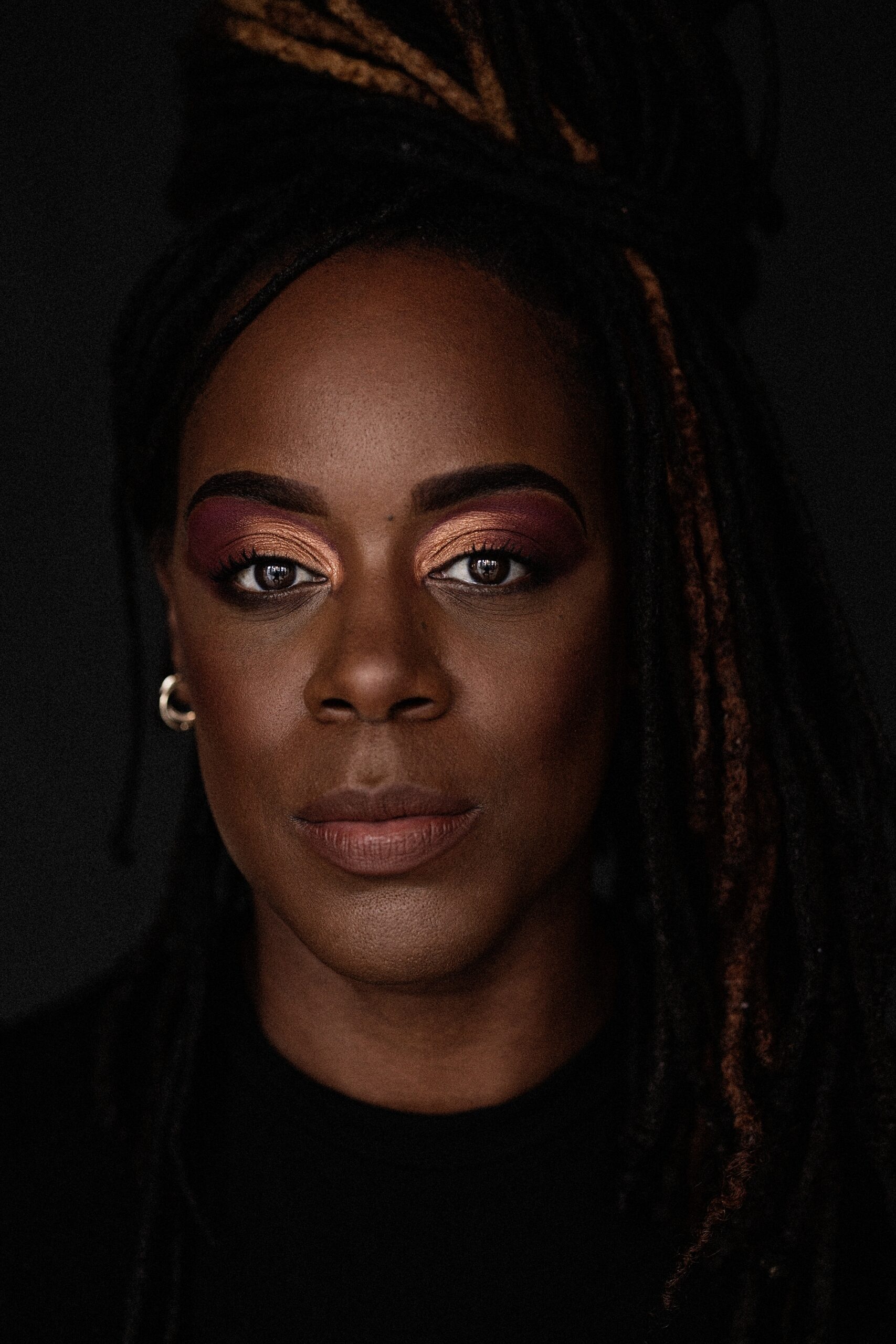
Assistant Professor of Music akua naru has been named as one of 14 artists and culture bearers selected to receive a 2026 California Arts Council Individual Artists Fellowship through Arts Council Santa Cruz County. naru’s scholarship focuses on the history and study of hip-hop and the experiences and accomplishments of Black women.
Her office in the Music Department is an inviting environment showcasing historical equipment from the hip-hop world, such as a 1988 MPC 60 from France. The walls are decorated with album covers of women in hip-hop she admires, alongside those from her own prolific oeuvre. On a recent sunny fall morning, she sat in this space reflecting on her recent fellowship win.
“It felt like a wonderful embrace,” said naru, who relocated to Santa Cruz for her faculty position in 2024.
The fellowship funding is bestowed in recognition of artistic practice, professional accomplishments, and artists’ contributions to their communities. Divided into three categories for established, emerging, and legacy fellows, naru is one of seven Established Artist Fellows for the region.
Sally Green, Deputy Director of the Arts Council Santa Cruz County, said the fellowship “recognizes that artists deserve investment and trust.”
With unrestricted funding, artists can “respond to what their practice actually needs, whether that’s time, materials, research, professional development, or simply space to keep making the work,” says Tamara Liu, Grants Manager at Arts Council Santa Cruz County.
Bringing Black women’s stories to the forefront of opera
naru plans to use her $10,000 fellowship award to complete and bring to the local and national stage her project called Longing to Tell: A Blues Opera, which she has been working on since 2019. To describe Longing to Tell, naru invokes a favorite quote from Dr. Cornel West: “What does courage do in the face of insult? What does honor do in the face of brute force?—that is the blues.”
Longing to Tell is adapted from the eponymous book by sociologist and scholar of African American culture, racial inequality, and gender Dr. Tricia Rose. The book tells stories of Black women on love and loss, tenderness and violence, intimacy and community. For the adaptation, naru focuses on one particular woman: Linda Ray.
“I take elements of Linda Ray’s life as it’s told in the book, fictionalize her life, and stage it,” naru explains. “It’s the story of a woman whose protectors failed to protect her as a child, and it asks what that does to a person. It’s about resilience, survival, self-making, and power. It’s not an easy story. There are twists and turns and some very difficult moments. It was hard to write.”
naru performs as Linda Ray in the opera. The music is composed by Pulitzer Prize winner Tyshawn Sorey, with acclaimed German chamber orchestra Ensemble Resonanz. The show originally premiered in Hamburg, Germany, in August 2025. Despite the already positive initial reception in Europe, naru feels there is work yet to be done on it.
“I want to resolve that spirit of meticulousness and tinkering,” naru said. “I can always feel when a work is finished. With my song ‘Poetry, How Does It Feel?’ I wake up knowing that the choices made were exactly the choices that needed to be made—yesterday, tomorrow, next week, next lifetime. I don’t yet feel that way about Longing to Tell, and I need to get there. It’s important to me.”
Celebrating hip-hop through teaching and research
Besides her blues opera, naru is most proud of continuing efforts in the vein of her prior work as a developer of theKEEPER, a digital and subsequently physical archive dedicated to preserving and documenting the contributions of women and girls to hip-hop culture. At UCSC, she’s furthering the concept with The Hip-Hop LAB, an interdisciplinary initiative joining hip-hop scholarship, performance, and community engagement.
“We’re very excited about it,” she says of the lab. “The students are ecstatic, we have support, and the faculty are excited about it, too. This is so important.”
Academic work on hip-hop remains limited, compared with other fields, and naru is deeply involved with changing that, including through her teaching. In the classroom, naru aims to “carve out space to surprise myself,” she says.
“What we call it in hip-hop is freestyling,” she explained. “You don’t want to be too fixed, thinking, ‘This is what I’m going to do.’ Of course, you have goals and a vision for what something is supposed to be. I have lesson plans. I do research. But I also want to shift based on what my students reveal to me, what I’m hearing, and what the content requires.”
She loves experiential learning, bringing in “rap battles” and “double Dutch to demonstrate the complexity of Black girls’ hand-clapping games,” along with guest speakers and field trips.
“Teaching and education have to be collaborative,” she says. “There’s so much power in improvisation. There’s so much power in making myself available to what life reveals.”