Arts & Culture
The deadly poison that changed medicine; History Professor Matt O’Hara will read from The Flying Death at Bookshop Santa Cruz on November 9
In The Flying Death: Poison, Plunder, And The Quest For A Miracle Medicine In The Amazon, UC Santa Cruz History Professor and Cowell/Stevenson Provost Matt O’Hara tells a complex but fast-moving story, in which scientific breakthroughs emerged alongside questionable medical experiments, commercial rivalries, and the exploitation of the Indigenous communities whose knowledge made the discoveries possible.
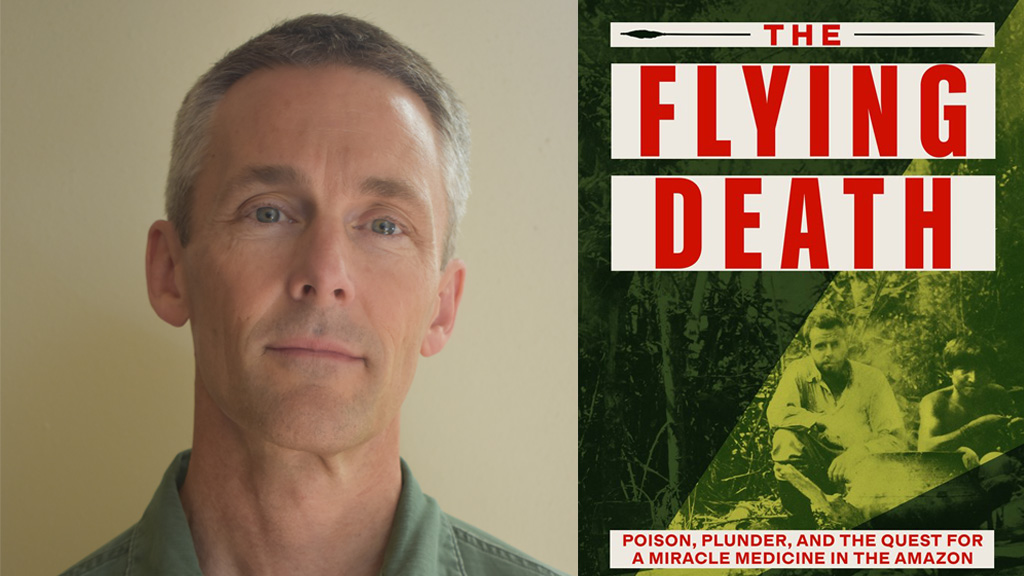
Professor of HIstory Matt O'Hara
In the fall of 1938, American explorer Richard Gill ventured into the western Amazon in search of curare, a plant-derived poison used on blowdarts to kill animals.
Gill, who had been diagnosed with multiple sclerosis, believed the substance, nicknamed the Flying Death, might offer relief. He also saw a chance to make money by connecting Indigenous knowledge with the resources of Western pharmaceutical companies.
He had competition. Boris Krukoff, a Russian-born botanist, was on the hunt too, setting off a fierce competition that stretched from the Amazon rainforest to American corporate boardrooms and medical laboratories.
The story sounds like an adventure novel. In The Flying Death: Poison, Plunder, And The Quest For A Miracle Medicine In The Amazon, UC Santa Cruz History Professor and Cowell/Stevenson Provost Matt O’Hara tells a complex but fast-moving story, in which scientific breakthroughs emerged alongside questionable medical experiments, commercial rivalries, and the exploitation of the Indigenous communities whose knowledge made the discoveries possible.
O’Hara will discuss his new book at a reading and signing at Bookshop Santa Cruz on Monday, Nov. 9, at 7 p.m. The event is cosponsored by The Humanities Institute at UC Santa Cruz. He will be in conversation with Distinguished Professor of History Nathaniel Deutsch.
“An interesting thing about the journey of curare from poison to drug, and its use in medicine, is that even outsiders had known about this poison for a long time, in some cases back into the 16th and 17th centuries, and they were captivated by it,” O’Hara said.
Those outsiders were fascinated by its power to kill silently, but they didn’t know what it was good for beyond hunting. Hundreds of years later, the poison remained a puzzle.
“As one of the people involved in the pharmaceutical industry put it, curare was a drug looking for a disease,” O’Hara said. “It kind of flips the script in terms of the way we think of medicine being developed: people were trying to figure out how this powerful substance might be used in medicine, and also how it worked.”
O’Hara is an award-winning historian whose previous books include The History of the Future in Colonial Mexico and A Flock Divided: Race, Religion, and Politics in Mexico, 1749–1857.
He found the curare story while doing research at the UC San Francisco Medical School for a different project. In the archives, he came across Gill’s papers and others relating to curare.
“Instantly I was fascinated,” O’Hara said. “I am a Latin American historian, and I’d heard about curare, but I was scratching my head: why didn’t I know more about this story? Why wasn’t there more written about this? As soon as I started digging into some of the boxes of papers, the stories just got more wild, filled with really stranger-than-fiction characters and events, and it just hooked me.”
Drawing on the lives of Gill and Krukoff, O’Hara reconstructs the race to identify, obtain and commercialize curare. The poison eventually became an important tool in modern medicine. Because it relaxes muscles, it helped transform surgical anesthesia when used alongside general anesthesia and respiratory support, making operations that had been far more difficult possible.
But finding those uses required experimentation, and the drive to find them sometimes outpaced ethical safeguards.
“One parallel today is that in the 1930s and 1940s the pace of innovation in medical discoveries in the pharmaceutical industry was really breakneck,” O’Hara said. “In the same way that we are experiencing this kind of unsettlingly fast rate of technological change today, that was something people in the ’30s would have been able to identify with. There was also an uneasy balance between patient safety and innovation, because things we take for granted now, like informed consent, weren’t operative in this period.”
Indigenous peoples had developed sophisticated methods of preparing and using curare long before Western explorers arrived. Their knowledge was indispensable to the science that followed, yet the benefits of commercialization flowed unevenly. Gill and Krukoff negotiated with Indigenous poison makers and courted pharmaceutical companies eager for new products, helping build a commercial pipeline from the rainforest to laboratories and hospitals. The book asks questions that remain relevant today: who owns traditional knowledge, and who benefits when it becomes a commodity?
The Flying Death is written for a general audience and published as a trade book by Farrar, Straus and Giroux. “That was a deliberate choice,” said O’Hara, whose previous publishers were academic presses. “I was motivated by recognizing the amazing work that many historians were doing but it wasn’t reaching most people. It was sort of staying within the community of other historians and indirectly influencing what people know about the past, but there is an opportunity to go directly to the public and get what I think is a very important story out to a bigger group of people.”
Aside from his book tour, O’Hara has been speaking to anesthesia departments at medical schools across the country. He has given talks at the University of Texas, Stanford, Emory University, and UC San Diego, and, will also speak, among other events, at Harvard, the Baylor College of Medicine, the University of Pittsburgh, the University of Miami, and UC San Francisco.
“It’s great to see what the humanities can do to communicate the history of medicine for people in the field,” O’Hara said.