Earth & Space
The best pollinators can drive evolutionary changes in flowers, new study finds
Researchers find hummingbirds to be better pollinators of mountain flowers than bees, prompting the plants to adopt traits that favor the fast, feathered carriers over the fuzzy, buzzy ones
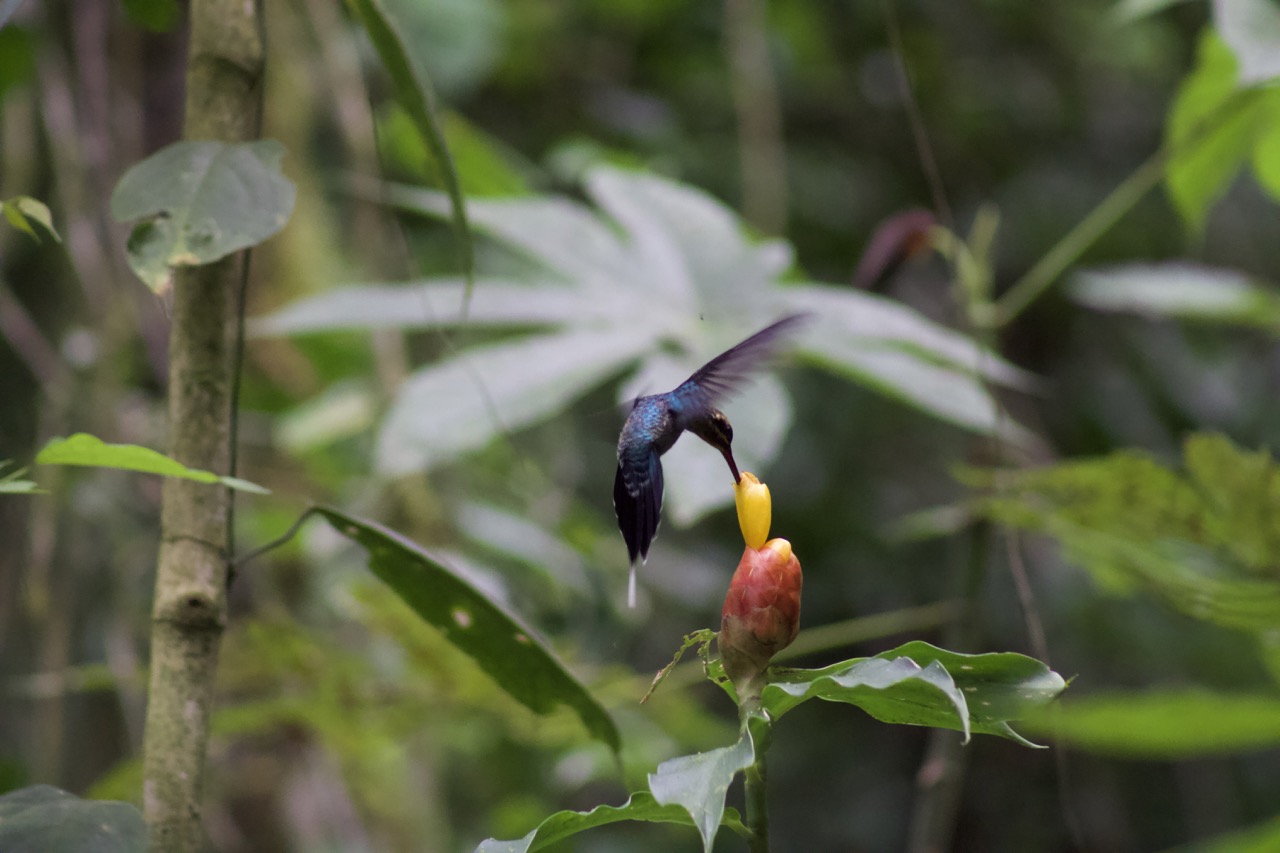
A female green hermit hummingbird hovers over a tropical species of spiral ginger in Las Alturas, Costa Rica.
Photos by Pedro Juárez
Press Contact
Key takeaways
- This study debunks a decades-old myth that tropical mountain flowers evolved to attract hummingbirds because high altitudes are too cold and wet for bees, and finds that hummingbirds are simply much better at moving pollen.
- Hummingbirds are superior pollinators because they just drink the nectar and move on to the next flower, while bees constantly groom pollen from themselves to feed their offspring.
- Over generations, flowers will change shapes, colors, and scents to favor hummingbirds over bees. These tiny adaptations can result in entirely new plant species without requiring any major climate or environmental changes.
A new study by plant biologists at the University of California, Santa Cruz, challenges a longstanding idea that stems from the large number of flowers in the mountains of Central and South America that have evolved to be pollinated by hummingbirds instead of bees. According to the research team, flowers make this switch—not because bees avoid cool, wet cloud forest conditions at higher elevations—but because hummingbirds are simply more effective pollinators.
Studying two closely related tropical plant species in Costa Rica, the team found that hummingbirds deliver more pollen per visit than bees—even when bees visit flowers more often. “We’ve assumed for decades that plants switch to hummingbirds because bees drop out at higher elevations in the tropics,” said senior author Kathleen Kay, professor of ecology and evolutionary biology at UC Santa Cruz. “But our results show that’s not necessary. Hummingbirds can drive this transition because they’re better at moving pollen.”
As described in their new study in New Phytologist, the researchers focused on two species of spiral ginger: one pollinated by bees in lowland forests, and a closely related species pollinated by hummingbirds in mountainous cloud forests. To understand what drives this evolutionary shift, the team measured both how often pollinators visit flowers and how much pollen they transfer with each visit.
They also conducted a large field experiment, moving plants across an elevational gradient—from lowland rainforest to cloud forest—to observe how well plants are pollinated outside their usual environments.
Efficiency beats frequency
The results were striking. Bee-pollinated plants received more visits overall, but hummingbird-pollinated plants received more pollen per visit. When the researchers combined these two factors, hummingbirds emerged as the more effective pollinators overall.
Even more surprising, bee visitation did not decline at higher elevations, contradicting the decades-old hypothesis. Instead, hummingbird visits increased with elevation, further boosting their effectiveness in mountain habitats.
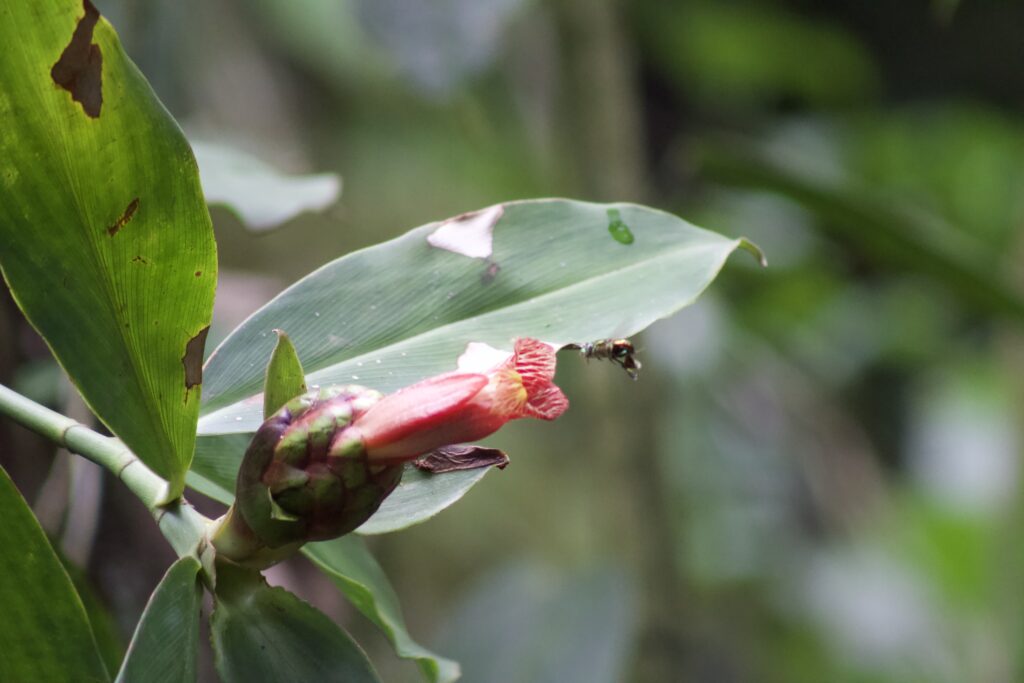
“Bees were still there and visiting flowers, even in the cloud forest,” Kay explained. “What changed was that hummingbirds became even more important—not because bees disappeared, but because hummingbirds were both efficient and more active at higher elevations.”
When a plant shifts from bee to hummingbird pollination, its flowers essentially undergo a redesign, explained lead author Pedro Juárez, a postdoctoral research fellow at Lund University. A bee-pollinated flower often has a broad landing platform, nectar guides, and scent that help bees find and handle the flower. In contrast, a hummingbird-adapted flower may become smaller, more tubular, and less scented, reflecting a different way of attracting and interacting with pollinators.
“Pollination shifts can help generate new species because flowers adapted to different pollinators may become reproductively isolated from one another,” said Juárez, a Costa Rican who led the field team while he was a Ph.D. student at UC Santa Cruz. “These evolutionary transitions have occurred many times in flowering plants and help explain the remarkable diversity of flowers. However, they are difficult to study directly because we usually discover them only after the shift has already happened.”
The findings of this study suggest that evolutionary shifts may not require the loss of one pollinator group. Instead, even small advantages in efficiency can push plants toward a new evolutionary strategy. Kay added, “Unlike bees, which groom pollen from their bodies to feed their offspring, hummingbirds are focused on nectar and end up transporting more pollen from flower to flower.”
Rethinking evolution
This has broader implications for how scientists understand the evolution of complex traits. Pollination systems involve suites of coordinated characteristics—such as flower shape, color, and scent—that evolve together. The study shows that transitions between these complex trait combinations can occur without dramatic ecological change.
The researchers say their work highlights the importance of looking beyond how often pollinators visit flowers and focusing instead on how effectively they transfer pollen. This perspective could reshape how scientists study plant–pollinator interactions and the origins of new plant species, since adaptation to a new pollinator isolates plants from relatives reliant on the original pollinator.
The study also underscores the ecological importance of hummingbirds in tropical ecosystems, where they may play a key role in shaping plant evolution.
The research was conducted in Costa Rica across multiple field sites spanning lowland rainforest to high-elevation cloud forest and involved years of observation and experimentation. The field team included four UC Santa Cruz undergraduates, highlighting the role of student-led fieldwork in advancing evolutionary biology.
Kathryn Gerhardt was one of them. She graduated in 2023 with a B.S. in ecology and evolutionary biology and said this project was an incredible opportunity to collect ecological data and to experience the beautiful country of Costa Rica and all of its biodiversity in a meaningful way. “Though the field work was the most exciting part,” she said, “it was also rewarding to extract usable data from camera traps and see the paper published.”