Campus News
Campus celebrates 40 years of Banana Slug mascot
An exhibit at McHenry Library chronicles the student-led effort to pick the Banana Slug as the mascot, while the Go Bananas! Carnival on the East Field event provides a chance to gather in community.
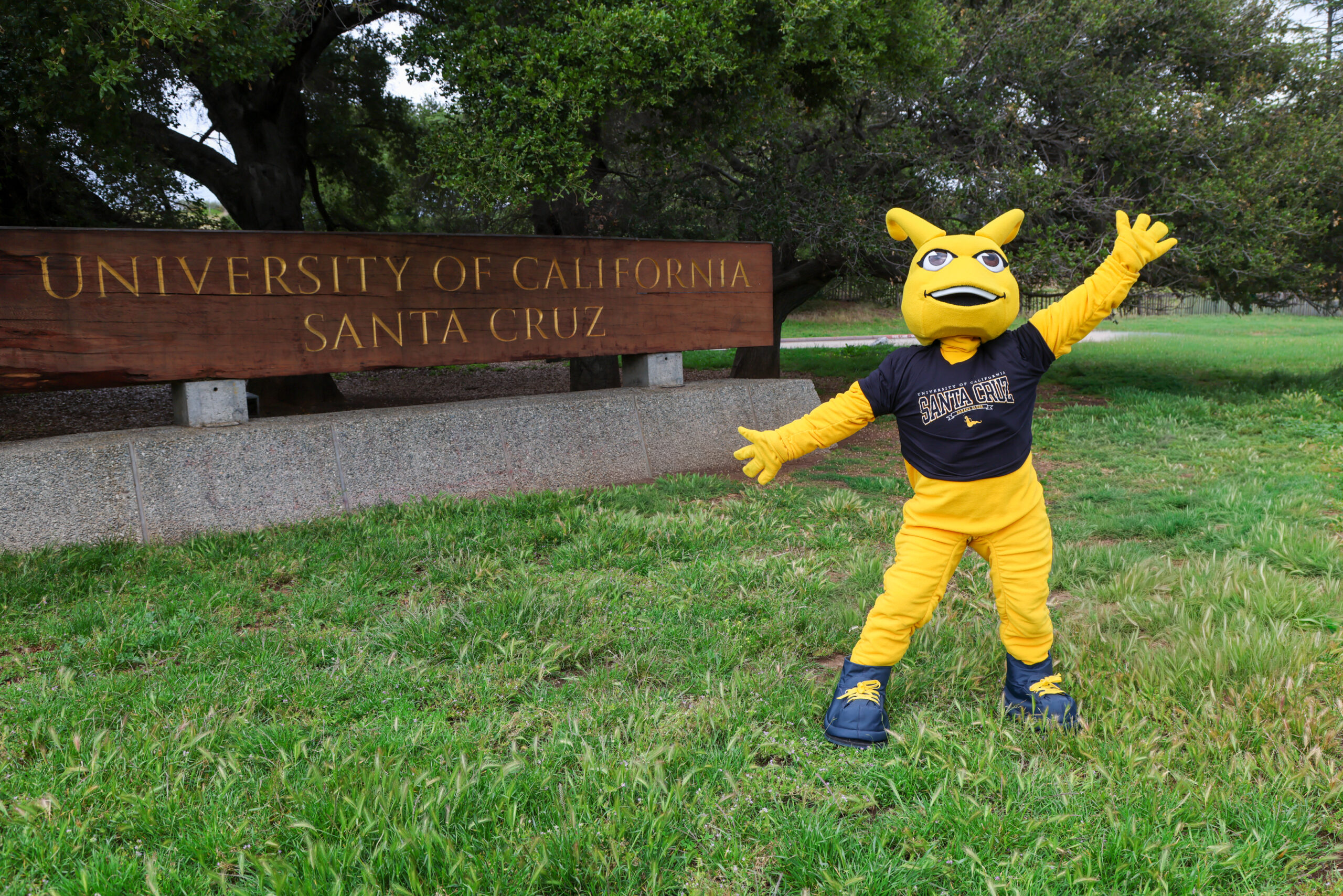
The first-ever Go Bananas! Carnival will take place Saturday, May 30 on East Field from 2 – 6 p.m. Staff and faculty can join in the fun by volunteering to support the event.
The UC Santa Cruz Sea Lions? The UCSC Monarchs? … The Pelicans?
After 40 years of fame, adoration and no known predators, it’s difficult to imagine UC Santa Cruz with any mascot but the Banana Slug.
The gastropod, most often spotted adding a yellow pop to the forest floor on damp days, has topped the lists of unusual collegiate mascots, made a cameo in Pulp Fiction on a shirt worn by John Travolta, and continues to bring smiles to students, faculty, and staff.
This year marks the iconic slug’s 40th anniversary, offering the community a chance to celebrate a mascot that reflects a campuswide ethos just as much as the NCAA III athletics program.
“Slime is on their Side,” a new exhibit at McHenry Library curated by University Archivist Kelsey Knox, explores the six-year saga that culminated with nationwide attention on the student effort to make the slug as the official mascot. With internal memos, newspaper clippings, and university press releases, the exhibit shows an administration at odds with the student body. Knox also recorded a podcast with Daniel Story, UCSC’s Digital Scholarship Librarian, about the tale.
“As a proud UCSC alumnus and now University Archivist, I’ve always loved our Banana Slug mascot,” Knox said. “I’ve enjoyed getting to dive into research on the whole mascot saga and now I’m loving getting to share all of the interesting pieces of the story that I’ve discovered.”
Go Bananas! Festival
The first-ever Go Bananas! Carnival will take place Saturday, May 30 on East Field from 2–6 p.m. The campus is celebrating the end of the academic year and 40 years of the Banana Slug as our mascot with an afternoon of fun, connection, and campus tradition. Sign up to volunteer.
Slime is on their Side
“Slime is on their Side,” a new exhibit at McHenry Library curated by University Archivist Kelsey Knox, explores the six-year saga that culminated with nationwide attention on the student effort to make the slug as the official mascot. The exhibit is on the third floor and runs through the end of summer.
As early as 1970, a student improvisational troupe named itself The Original Banana Slug Theatre, according to Knox’s research. By the end of the decade, the moniker was widely used by club sports teams.
In 1980, Chancellor Robert Sinsheimer announced the campus would be joining NCAA Division III. The first UC Santa Cruz chancellor from outside the UC system, Sinsheimer was appointed in 1977 to lead a campus that many saw as needing direction and a vision for the future. His tenure was marked with major changes—a campus reorganization—and a sustained effort to move the campus forward.
Athletics teams in the NCAA must have a mascot, and the campus conducted a survey to understand the preferences of students, teams, and alumni. The Banana Slug, according to an internal memo, emerged as the the clear favorite, well above the Sea Lions (“a distant second”), Monarchs (“an even more distant third”), and Coyotes, Dolphins, Pelicans, and Redwoods (“scattered support”).

Nevertheless, Sinsheimer picked the Sea Lions in June 1981, and in his memo suggested the Slug love “may in fact reflect the attitude of many UCSC students toward athletics.”
“I will not ask them to participate under a demeaning name that will subject them to taunts and sneers,” he wrote to Provost John Dizikes, who was chair of the Council of Provosts. “The skills of opponents and the ‘slings and arrows of outrageous fortune’ are foe enough.”
The campus, in a press release, touted the survey’s rigor—“worthy of a major research project” — while also ignoring the findings. The announcement characterized Sinsheimer’s choice as a “Solomon-like selection.”
The backlash was swift. City on a Hill Press refused to use Sea Lions in its athletics coverage, while the Porter Senate passed a resolution opposing the decision. Kresge College adopted the Banana Slug as a college mascot.
But for five years, the athletics teams played as the Sea Lions with uniforms and a basketball court painted in the sea mammal.
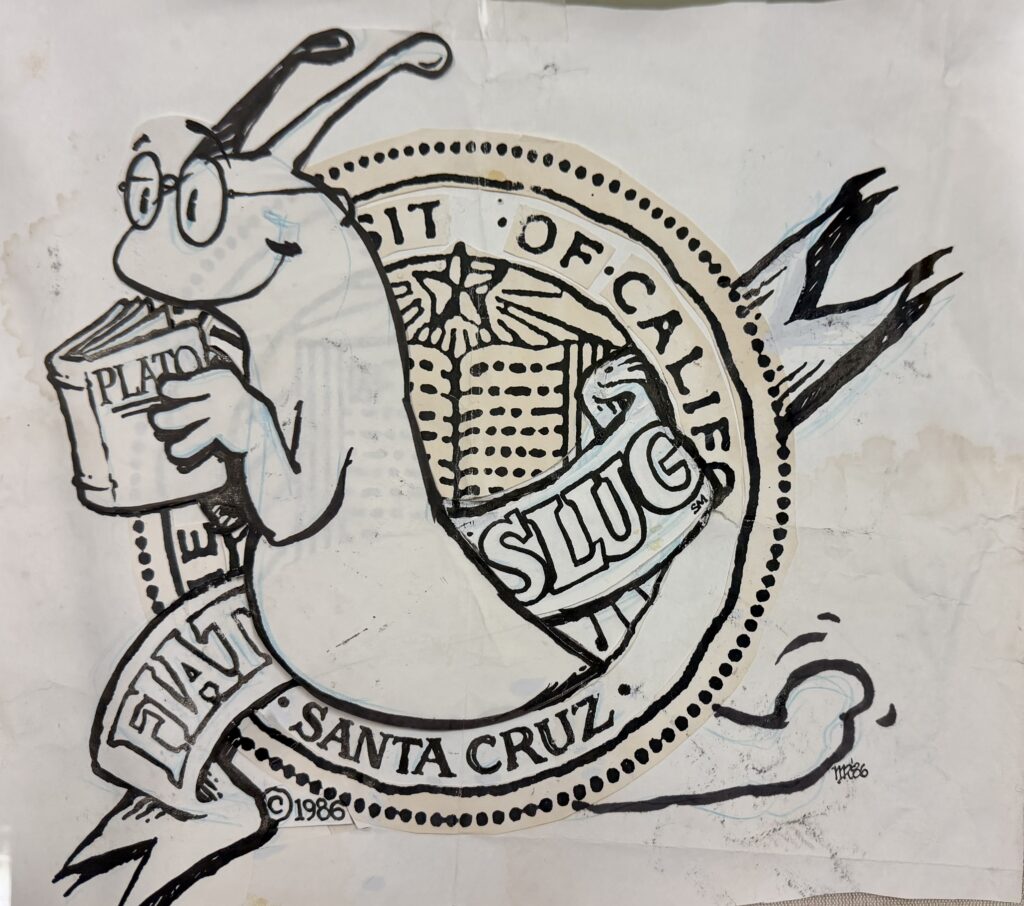
Remarkably, students kept their resistance campaign going, and the Student Union Assembly in 1986 put forward a nonbinding ballot measure to reinstate the banana slug as the official mascot. Leading up to the election, student Marc Ratner (Cowell ’87, linguistics) along with Pete Blackshaw (Cowell ’88) and Bob Byington (Stevenson ’88) developed and marketed the Fiat Slug, a smiling bespeckled slug reading Plato surrounded by a seal with the redwoods in the background (the initial design featured the UC seal).
By spring quarter, the campaign was a full-on campus affair, with Sinsheimer sending letters to the editor of CHP continuing to argue against the slug, disparaging the species as “spineless” and “slimy.”
Professor Todd Newberry responded with his own letter, noting the chancellor was attacking them for being the organisms they couldn’t help being and mounting a case for the slug.
“What would banana slugs bring to our team?” Newberry asked. “What, I mean, besides their splendid name, which rolls off the tongue like a cheer: Ariolimax columbianus! They are snails with the guts to come out of their shells. They are larger than life — truly super slugs. They are hermaphroditically sexy, bright (at least bright yellow), ever alert with those stalked eyes. Very likely they are also witty, imaginative, socially adept, and intellectually courageous.”
Newberry shared his letter directly with the Chancellor’s Office, including a cover note, noting the campus “came within a whisker of a truly inspired mascot, seals. It would have been a fine academic pun. It would have taken on a famous name in California sports.”
He went on to write that he believed the chancellor thought the whole controversy was trivial, though Newberry noted “something oddly serious does keep peeking through.”
“Mascots are symbols, and symbols are like that, like flags,” Newberry wrote. “But of course this … merely shows how too seriously the matter can be taken, and it is not a serious matter.”
Leading up to the election, Sinsheimer stepped in and removed the measure from the ballot, though students still voted on the mascot through their individual college elections. Again, the slug prevailed.
Sinsheimer conceded defeat in a May 13 press release, noting that students are “entitled to a mascot they desire and with which they can empathize.”
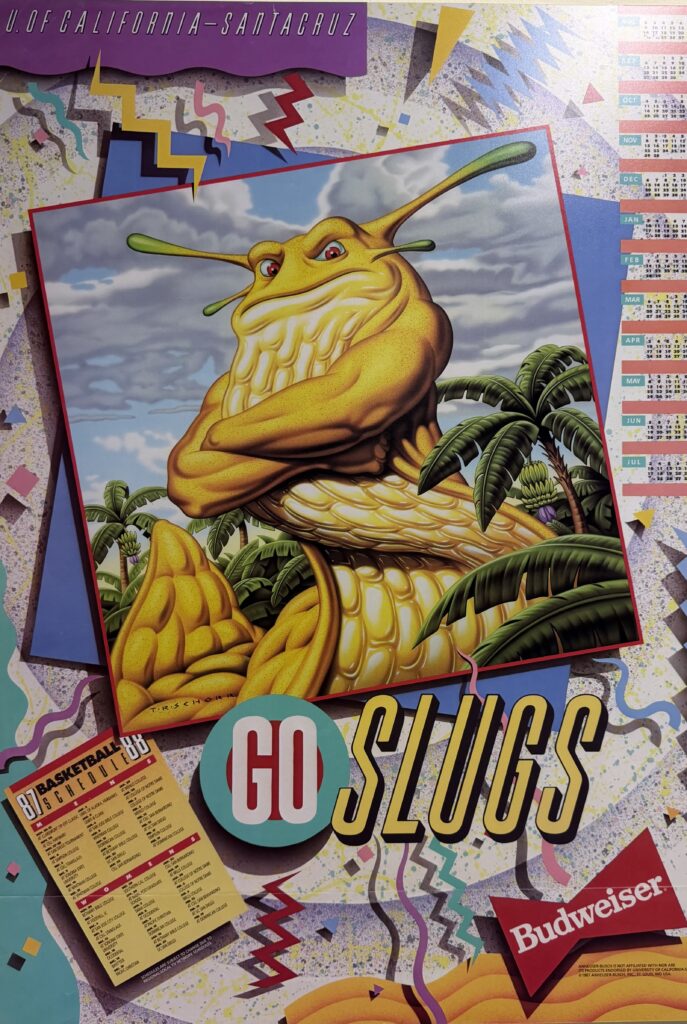
The library exhibit includes some unique and perhaps surprising slug memorabilia from the 1980s—including the original Fiat Slug drawing by Ratner and a Budweiser poster featuring a burly slug. Sammy the Slug—the anthropomorphized version of the mascot—was introduced in 1998 and the exhibit shows its evolution over the years.