Student Experience
NSF awards 20 students and alumni with highly coveted Graduate Research Fellowships
The fellowship program is one of the nation’s most prestigious of its kind. Awardees at or from UC Santa Cruz represent fields ranging from engineering to the physical, biological, and social sciences.
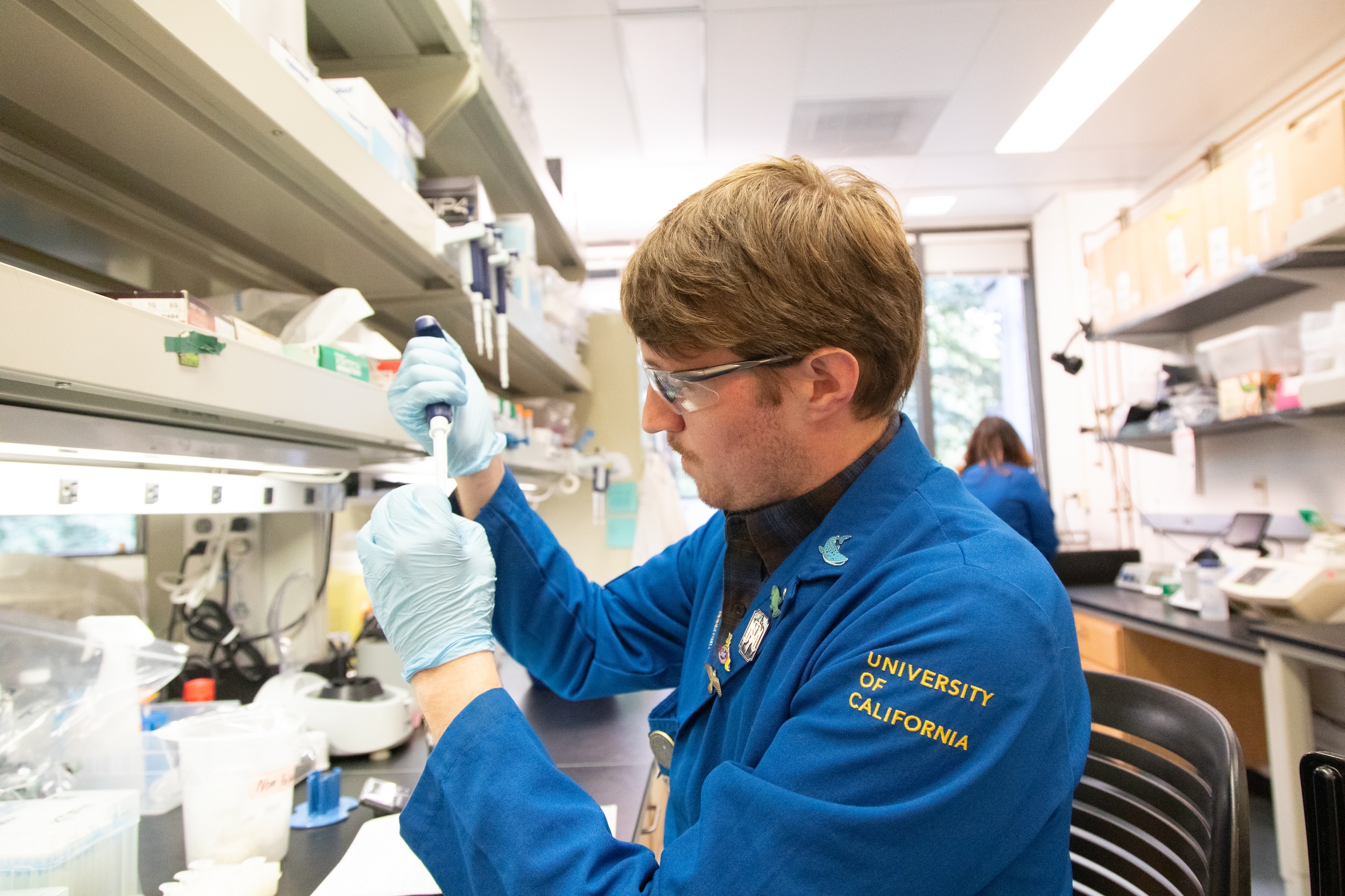
Photo by Carolyn Lagattuta
The National Science Foundation (NSF) has announced that 20 students currently or formerly studying at the University of California, Santa Cruz, will receive prestigious Graduate Research Fellowships for the 2026-27 academic year.
On April 13, the NSF announced that 2,500 students around the country will receive Graduate Research Fellowships, selected from an applicant pool of nearly 14,000 students representing all 50 states, the District of Columbia, and Puerto Rico. Winners were based on their intellectual merit and broader impacts, including their potential to contribute to scientific innovation.
The fellowship program is one of the nation’s most prestigious of its kind, and for more than 75 years, has played a critical role in developing the talent pipeline required for sustaining U.S. leadership in science. The award provides three years of financial support, over five years, to outstanding graduate students across the country who are pursuing research-based degrees in science, technology, engineering, and mathematics.
Fellowship recipients can be undergraduates who are about to pursue graduate degrees, or graduate students continuing their research. The awardees from UC Santa Cruz are either currently enrolled students or alumni now enrolled at another university. Here are the winners affiliated with our campus, listed alphabetically and with their current field of study:
- Isabelle “Izzy” Connor (astronomy and astrophysics)
- Charles Ferguson (bioengineering)
- Aarna Garg (astronomy and astrophysics)
- Elena Halsted (robotics, control, automation)
- Aidan Lewandowski (geodynamics)
- Joshua Lieberstein (linguistics)
- Siobhan Light (paleoclimate)
- Samuel Lindquist (economics)
- Piper Mahn (bioengineering)
- Avery Maltz (organismal biology)
- Liam Murphy (astronomy and astrophysics)
- Scarlett Passer (hydrology)
- Jessica Prakash (biomedical engineering)
- Naomi Rehman (computer architecture)
- Halena Soto (biological anthropology)
- Alison Weber (astronomy and astrophysics)
- Noah Williams (bioengineering)
- Savanna Wright (ecology)
- Fan “Sarah” Xia (genomics)
- Allison Yan (marine ecology)
The 2026-2027 cohort represents a wide range of disciplines, including fields such as engineering; computer and information science and engineering; mathematical and physical sciences; geosciences; biological sciences; social, behavioral and economic sciences; and STEM education and learning research. According to the NSF, their research interests include critical areas that align with national priorities and workforce demands, such as artificial intelligence, quantum information science, biotechnology and nuclear technology.
Since its inception in 1952, the NSF program has supported over 70,000 graduate research fellows, many of whom have gone on to become leaders in research and innovation—with more than 40 former fellows having received Nobel Prizes.
The full list of students who received fellowship offers and honorable mentions this year can be found on the NSF website.