Arts & Culture
A Deep Read interview with Merlin Sheldrake, author of Entangled Life
The British biologist Merlin Sheldrake, this year’s featured author for The Humanities Institute’s (THI) seventh annual Deep Read, spoke with UC Santa Cruz about the strange, generative intelligence of fungi and what it can teach us about connection, creativity, and survival.
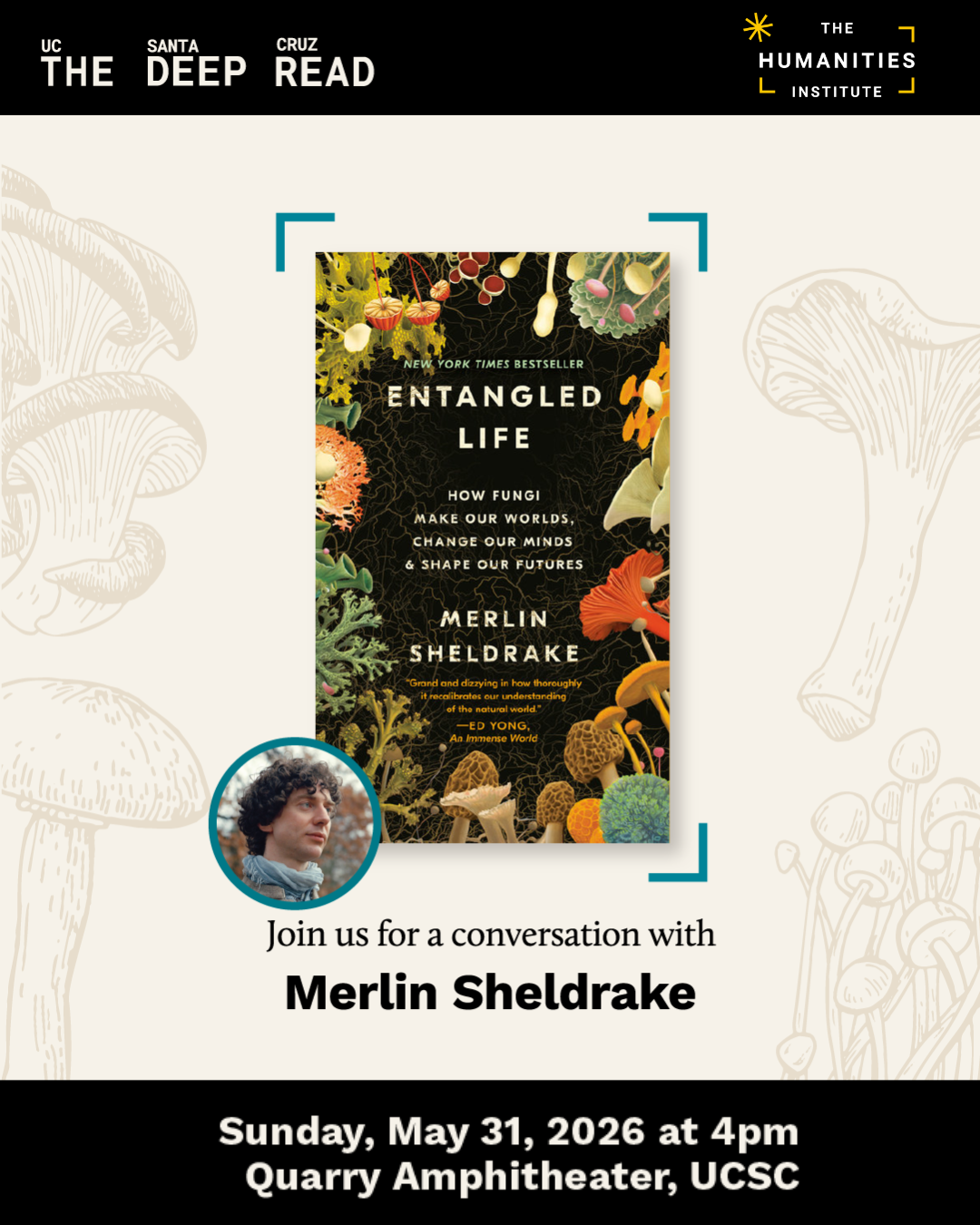
The British biologist Merlin Sheldrake, this year’s featured author for The Humanities Institute’s (THI) seventh annual Deep Read, spoke with UC Santa Cruz about the strange, generative intelligence of fungi and what it can teach us about connection, creativity, and survival.
In this conversation, Sheldrake, author of Entangled Life: How Fungi Make Our Worlds, this year’s Deep Read selection, reflected on the overlooked contributions of amateur scientists, and the ways fungal life challenges our assumptions about individuality and cooperation.
On May 31 at 4pm, Sheldrake will be in conversation with Associate Professor of History Benjamin Breen at the Quarry Amphitheater. The conversation is free and open to the public.
Dan White: Your work moves across disciplines, blending rigorous scientific research with literary and narrative nonfiction techniques. Many scientists aren’t trained to write in this way, and it limits their impact. What drew you to this style of writing, and how did you develop your skills as a nonfiction writer?
Merlin Sheldrake: I’ve found that this style of writing arises by itself if I think and work and write from the perspective of a human being, rather than affecting a disembodied professionalism. Science isn’t an exercise in cold-blooded rationality. Scientists are – and have always been – emotional, creative, intuitive, whole human beings, asking questions about a messy and confusing world. Moreover, scientists have to interpret and communicate their insights, often ambiguous, uncertain, and contradictory, using imaginative language composed of metaphor and analogy.
Dan White: Here in Santa Cruz, we have an active community of mushroom hunters, and while they’re sometimes labeled as outsiders, you’ve described the important role that amateur mycologists have played in fungal science, from historical figures like Charles Darwin to today’s radical mycology movement. In your view, what unique insights or approaches do amateurs bring that professional scientists might overlook?
Merlin Sheldrake: One of the things I love about amateur researchers of any kind is how free they are able to be in their enquiries. Within professional academia, one tends to find less room for free-range play. Even if professional scientists do make time for free-ranging playful enquiries, many fascinating findings get buried because of the demands and constraints of the world of academic publishing. Of course, amateur researchers have their own sets of limitations, but there is a certain inventive, wide-ranging, idiosyncratic, observational style that one often finds among researchers who aren’t bound by the strictures of a formal profession.
Dan White: At the same time, there’s also a long tradition of mycophobia in Western culture. Because fungi are so closely associated with rot, mold, and decomposition, they make some people feel suspicious or even queasy.
Merlin Sheldrake: Fungi are a hugely diverse kingdom of life. Some have the power to heal us, nourish us, or give us visions. Others have the power to kill us, or kill the organisms we depend on, or drive us mad. It makes sense to me that the huge diversity of the fungal kingdom would be reflected in a corresponding diversity of human attitudes towards them. Think of the animal or plant kingdoms, for example. Some people love cats but are terrified of spiders. Others might dedicate their life to growing roses, but kill every plant that isn’t grass to preserve the tidiness of their lawn.
Dan White: The Humanities Institute at UC Santa Cruz is exploring the theme of nourishment this year — not only biological nourishment but also the practices that sustain communities, imagination, and meaning. Fungi literally nourish ecosystems through mycorrhizal networks. How do fungal networks offer a metaphor, or perhaps even a model, for how human communities might sustain one another?
Merlin Sheldrake: It’s a tricky question because fungi are a whole kingdom of life. Mycorrhizal fungi might support the growth of their plant partners, but other fungi grow inside insect bodies, puppet their behavior, and kill them in grisly ways. One could find a model for almost any number of human behaviors in the fungal world, some of which might align with one’s cultural values. This said, I think there are some more general lessons that fungi can point us towards. Fungi are powerful reminders of the intimate relationships that sustain all life. They form resilient, decentralized networks. They remind us that intelligent behaviors can exist in organisms without brains. They show us again and again that by coming together, organisms can achieve things that none of the partners can achieve alone. And they remind us that crisis is so often a crucible for new symbiotic relationships.
Dan White: One consistent theme in Entangled Life is how fungi expand the limits of human thinking, sometimes running up against outright hostility. In the 1860s, the Swiss botanist Simon Schwendener proposed that lichens aren’t single organisms but associations of a fungus and an alga, with the fungus forming most of the structure. Why was it so difficult – or even threatening – for scientists in the 19th century to accept lichens as truly collaborative partnerships rather than hierarchical, single organisms?
Merlin Sheldrake: It was a new idea for modern biology at the time, and new ideas in the sciences are frequently dismissed or ridiculed. The prevailing view of evolution at the time, at least in the anglophone world, was one of unmitigated competition and conflict, and the cooperative sharing of intimate bodily space didn’t fit readily within this view. The entanglement of politics and evolutionary thought is fascinating. In England in the 19th century, the understanding of evolution as a bitter struggle for survival mirrored views of social progress within an industrial capitalist system, best summed up by T.H. Huxley’s view of life as a gladiator show. A number of his Russian contemporaries, by contrast, saw cooperation as a more powerful driving force in evolution, reflecting their different political context.
Dan White: As you talk to audiences here in Santa Cruz, and to students who have taken a class based on your work, what do you hope people take away from your work — whether it’s a new perspective on nature, a sense of wonder, or practical ideas about how we live with the world around us?
Merlin Sheldrake: I hope that we can all leave feeling more like creative participants in a living world.
This year, Deep Readers will have many opportunities to engage with the ideas of Merlin Sheldrake and his book, Entangled Life. Everyone can join THI’s Deep Read program, which is free and open to the public — students, faculty, staff, alumni, parents, friends, community members, and curious readers everywhere can sign up to receive Deep Read emails and participate in upcoming events.
The Deep Read Faculty Salon on Entangled Life will take place on May 19 at the Hay Barn on campus. At this salon-style event participating Deep Read faculty, Professors Benjamin Breen (History), Gregory Gilbert (Environmental Studies), and Donna Haraway (History of Consciousness and Feminist Studies) will give brief presentations and discuss Entangled Life with the Deep Read community in a Q&A moderated by Deep Read Faculty Lead, Laura Martin. Participants can also attend virtually.
Another discussion, The Literature and Poetics of Fungi Faculty Salon, takes place on May 26. The salon will feature Professors Hannah Cole (Assistant Professor of Literature at UC Santa Cruz), Brenda Hillman (Professor Emerita of Poetry at Saint Mary’s College), A. Laurie Palmer (Professor Emerita of Art at UC Santa Cruz), and Jennifer Tseng (Associate Professor of Literature and Creative Writing at UC Santa Cruz) in conversation with moderator Laura Martin and the Deep Read community. Participants can also attend virtually.
And don’t forget to register here for Sheldrake’s on stage discussion with Professor Benjamin Breen on May 31.