Generative AI Center
-
Shaping the future of artificial intelligence
UC Santa Cruz experts are working to guide AI in ethical, sustainable, and socially beneficial directions
-
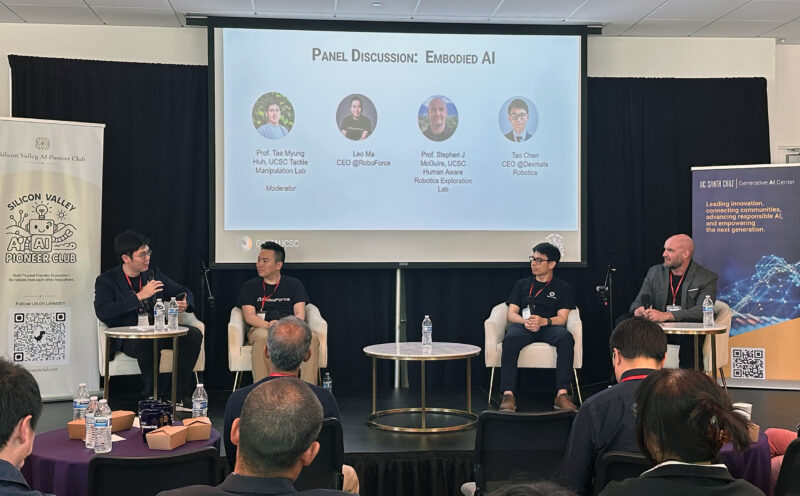
AI leaders gather in Silicon Valley for UC Santa Cruz, SF Tech Week event
More than 200 people gathered for an event called “AI Frontier: Data, Agents & Robots.”
-

Regional ocean dynamics can be better emulated with AI models
Researchers show the success of their technical in a critical region: the Gulf of Mexico.
-

‘Future-guided’ AI improves seizure prediction
Engineers developed a deep learning method that manipulates time to make better predictions.
-

AI is good at weather forecasting. Can it predict freak weather events?
New study tests neural networks’ ability to handle ‘gray swan’ events.
-

AI chatbots perpetuate biases when performing empathy, study finds
A new study explores how GPT-4o, the latest model from OpenAI, evaluates and performs empathy compared to humans, and finds major gaps exist.
-

UC Santa Cruz research will harness advanced AI to better measure, predict climate-change impacts
Two UC Santa Cruz research projects designed to leverage advanced forms of artificial intelligence to improve how scientists measure and predict the effects of climate change have won funding from a $20 million investment by the National Science Foundation.
-

Researchers run high-performing large language model on the energy needed to power a lightbulb
UC Santa Cruz researchers show that it is possible to eliminate the most computationally expensive element of running large language models, called matrix multiplication, while maintaining performance.
-

Brain-inspired AI code library passes major milestone, new paper offers perspective on future of field
UCSC Assistant Professor of Electrical and Computer Engineering Jason Eshraghian’s open source code library for brain-inspired deep learning, called “snnTorch,” has surpassed 100,000 downloads and is used in a wide variety of projects. A new paper details the code and offers a perspective on the future of the field.
-
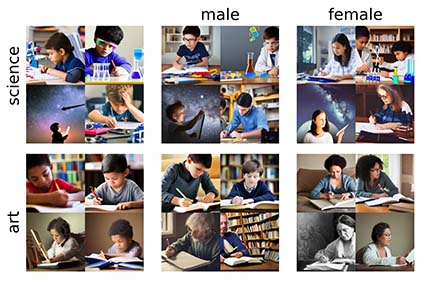
Researchers’ tool finds bias in state-of-the-art generative AI model
UCSC researchers introduce a new tool to measure bias in text-to-image AI generation models, which they have used to quantify bias in the state-of-the-art model Stable Diffusion.
-

UCSC team wins third place in first-ever Amazon SimBot challenge
A team of UC Santa Cruz computer science and engineering (CSE) Ph.D. students won third place in the first-ever Amazon Alexa Prize SimBot Challenge, a university competition focused on advancing virtual assistant technology.
-

SpikeGPT: researcher releases code for largest-ever spiking neural network for language generation
Assistant Professor of Electrical and Computer Engineering Jason Eshraghian and two students recently released the open-sourced code for the largest language-generating spiking neural network ever, named SpikeGPT.