xiz
-

‘Super-Jupiter’ exoplanet is not so Jupiter-like, UCSC study finds
Xi Zhang, a professor of Earth and planetary science at UC Santa Cruz, has discovered that an exoplanet classed as a “super-Jupiter” has substantial differences from our solar system’s largest planet — and in fact, has much in common with Mars. Exoplanet VHS 1256b, located 40 light years away from Earth, was identified in 2015.
-

Why Brown Dwarfs May Explain the Main Differences Between Stars and Planets
The atmospheres of brown dwarfs can be surprisingly similar to those of gas giant planets, too, complete with multi-layered clouds and powerful wind-driven storms. That makes them great windows into the atmospheric processes that shape our own solar system’s giant planets, as well as the super-Jupiter exoplanets discovered outside our stellar neighborhood, according to a…
-
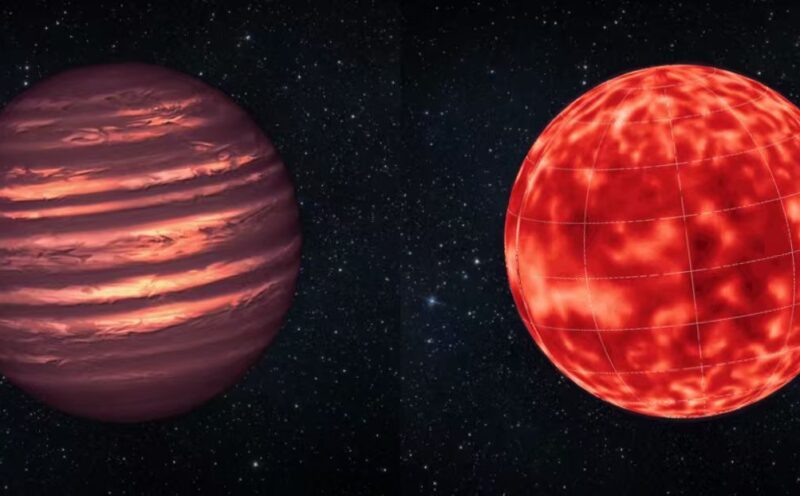
‘Super-Jupiter’ exoplanet has markedly different atmosphere than our gas giant, new study finds
Analysis of early direct images from James Webb telescope show immense dust clouds on brown dwarf that lead to a blurring of atmospheric lines—and scientific consensus
-

Pluto’s hazy skies are making the dwarf planet even colder, James Webb Space Telescope finds
The James Webb Space Telescope (JWST) has discovered that a hazy sky over frozen Pluto is helping to cool the dwarf planet’s atmosphere. The discovery of the haze was predicted back in 2017 by planetary scientist Xi Zhang of the University of California, Santa Cruz, to explain why Pluto’s thin atmosphere is so leaky. Additional…
-

Webb confirms Pluto’s atmosphere cools with haze
After New Horizons’ Pluto flyby, UC Santa Cruz‘s Xi Zhang proposed in 2017 that Pluto’s atmosphere is dominated by haze particles, making it unlike any other in the solar system. He suggested that these particles heat up and cool down, controlling Pluto’s entire energy balance.
-

James Webb telescope confirms cooling effects of Pluto’s haze
New study in Nature Astronomy affirms hypothesis made by UC Santa Cruz’s Xi Zhang in 2017