nocampop
-

Do Nations With the Most Birds Attract the Most Bird Tourists?
Natalia Ocampo-Peñuela, who is an assistant professor of environmental studies at the University of California, Santa Cruz, wanted to understand what drives bird-loving tourists to bring their binoculars—and their wallets—to particular countries and how to encourage more of that.
-

Birdwatchers flock to Colombia and South Africa- so why are Venezuela and DRC being left behind?
“Over the years, we’ve seen Colombia really explode as a birdwatching destination, and we often asked ourselves why more countries aren’t similarly recognized as great places for birdwatching,” said Natalia Ocampo-Peñuela, lead author of the new UC Santa Cruz study.
-

Birdwatching tourism is booming. Some countries are benefiting, while others are left behind
Birding tourism can support sustainable development and habitat conservation across the tropics, but only if countries can successfully attract birders. New research reveals what affects birdwatchers’ choice of destinations.
-

Why thousands of people are traveling to one country to see these birds
Assistant Professor of Environmental Studies Natalia Ocampo-Peñuela is a conservation ecologist who has been studying the explosion of bird-watching tourism in Colombia. Activity on eBird, a platform where birders can record their observations, increased more than 27-fold in Colombia since 2010, according to unpublished research by Ocampo-Peñuela and other authors that’s currently under review.
-

New mapping techniques empower bird conservation in Colombia
Natalia Ocampo-Peñuela, assistant professor of environmental studies, and a team of Colombian researchers have introduced a transformative approach to mapping bird species distribution across Colombia, harnessing community science data and innovative modeling techniques.
-

Association for Tropical Biology and Conservation at 60: A look back and forward
Colombian ecologist Natalia Ocampo-Peñuela, an assistant professor of environmental studies at UC Santa Cruz, discussed the impact of the Association for Tropical Biology and Conservation. “When you bring conservation in—because conservation is a crisis discipline that deals with imperfect and incomplete data sets—there’s a tension,” she said. “But I’ve seen that tension dissolve at ATBC over…
-

TEDxSantaCruz announces speakers for first conference in five years
Economics Professor Galina Hale and Assistant Professor of Environmental Studies Natalia Ocampo-Peñuela are among the selected speakers for an upcoming TEDxSanta Cruz event, which will also feature UCSC alumni and a current graduate student.
-

Worldwide leaders convene to protect, advance global biodiversity
With a focus on sustaining and strengthening global biodiversity in the face of climate change, UC Santa Cruz hosted the Asia-Pacific Economic Cooperation University Leaders’ Forum, bringing together nearly 100 international leaders in education, industry, and government.
-

Farms with natural landscape features provide sanctuary for some Costa Rica rainforest birds
Assistant Professor of Environmental Studies Natalia Ocampo-Peñuela commented on new research featured in The Washington Post that shows how agricultural areas with natural features can help to sustain birds.
-

Here’s How to Use Window Films to Actually Protect Birds
Scientific American interviewed Assistant Professor of Environmental Studies Natalia Ocampo-Peñuela about the challenges of preventing bird strikes on windows.
-
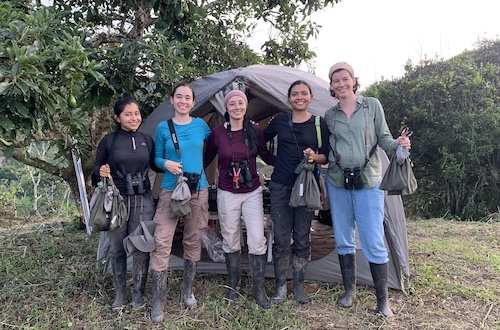
Colombian all-female team uncovers naturalist Elizabeth Kerr’s long-forgotten legacy
Many fields of study have long been dominated by men but a team of eight female Colombian researchers are committed to uncovering the story of naturalist pioneer Elizabeth Kerr, whose legacy had remained invisible despite her vast contributions to ornithology.
-
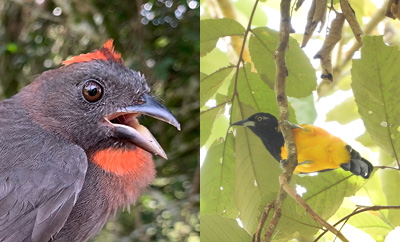
Colombia, a global biodiversity hotspot, faces rising threats to bird species from expanding human footprint
A new study published in the journal Environmental Research Letters used satellite mapping data to analyze how changes in human footprint on the landscape between 1970 and 2018 overlapped with distributions of 1,469 Colombian bird species. The study is the first of its kind to expand focus from forested regions, like the Amazon and Chocó,…