foxtree
-

What psychology research says about virtual communication
As more companies and governments issue often unpopular return-to-office mandates, there’s still very little evidence about how remote work compares to in-person settings, especially when it comes to communication, which is the foundation of collaboration. Psychology researchers at UC Santa Cruz have been working to fill in the gaps by investigating the nuances of virtual…
-

Three UCSC faculty named 2022 AAAS fellows
Three UC Santa Cruz professors received the distinction of 2022 fellows of the American Association for the Advancement of Science (AAAS), the association announced today.
-

These red flags can let you know when you’re in an online echo chamber
Researchers at UC Santa Cruz have identified specific elements of tone and style in online speech that are linked to hyperpartisan echo chambers. These language markers could also prove useful for flagging spaces where disinformation may be likely to emerge.
-

Three soft skills leaders need for hybrid work environments
Fast Company discussed research by Ph.D. student Andrew Guydish and Psychology Professor Jean E. Fox Tree on the importance of understanding "conversation reciprocity" for teams in hybrid and remote work environments.
-

Filler words: From pause fillers to elements of discourse
Psychology Professor Jean E. Fox Tree's research on the importance of filler words was discussed in an article by Die Zeit, one of German's most widely read newspapers.
-

Four Ways To Spark Watercooler Moments For Your Remote Team
Forbes cited research from psychology Ph.D. student Andrew Guydish and Psychology Professor Jean E. Fox Tree in an article about the challenges of remote work. Guydish was also interviewed for a recent article in The Walrus.
-

'Ums' and 'ers' are a hidden code that helped complex language evolve
Psychology professor Jean E. Fox Tree's research on the higher purposes of filler words was featured in the October issue of New Scientist.
-
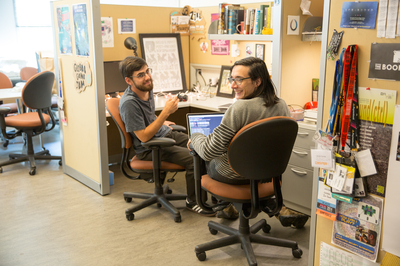
Psychology research shows ‘water cooler talk’ can have big benefits
In settings where people are working together on a task, making time for small talk allows for a newly-described behavior called “reciprocity in conversation,” which is associated with higher levels of task enjoyment.
-

In the Realm of "Ahh"
Psychology Professor Jean Foxtree's work was featured in a Psychology Today article about the ways vocal features, including "filler" words like um and ah, influence communication and comprehension.
-

Teaching computers the nuances of human conversation
Computer scientist Marilyn Walker wants to make spoken dialogue systems more responsive to the user.