News Article
-
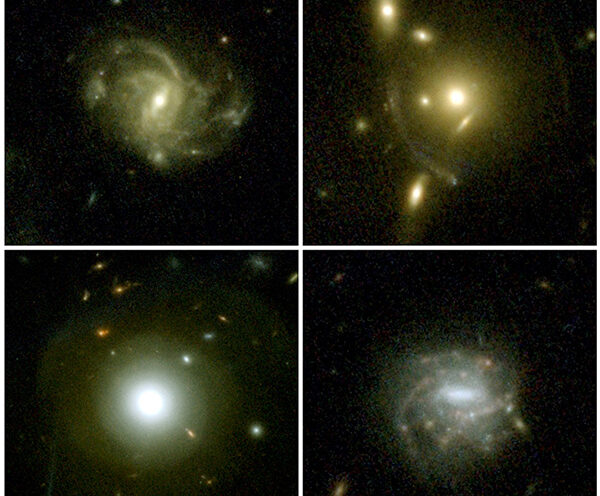
First images released from James Webb Space Telescope’s largest general observer program
Mosaic images from the COSMOS-Web program offer a treasure trove of early galaxies, including dazzling examples of spiral galaxies, gravitational lensing, and evidence of galaxy mergers.
-
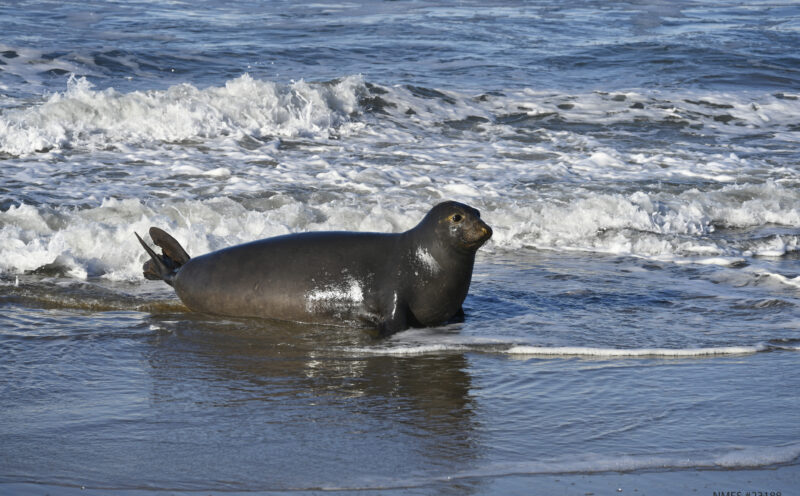
Marine mammal reproduction rests on a precarious tipping point of ocean resources
A study of northern elephant seals reveals a threshold at which a small decrease in the amount of prey females can find during foraging migrations could lead to a sudden drop in reproductive success.
-

Indigenous land management focus of this year’s Conversations on Climate Justice
Wildfires. Flooding. Drought. The nation has faced these climate issues for centuries. Yet, there’s still a lot that can be learned from pre-colonial indigenous food and land management techniques to combat our current climate problems, according to Dr. Lyla June Johnston, the keynote speaker for UC Santa Cruz’s third annual Conversations on Climate Justice event,…
-

SpikeGPT: researcher releases code for largest-ever spiking neural network for language generation
Assistant Professor of Electrical and Computer Engineering Jason Eshraghian and two students recently released the open-sourced code for the largest language-generating spiking neural network ever, named SpikeGPT.
-

Graphene quantum dots show promise as novel magnetic field sensors
Physicists found that speeding electrons trapped in circular loops in graphene quantum dots are highly sensitive to external magnetic fields.
-
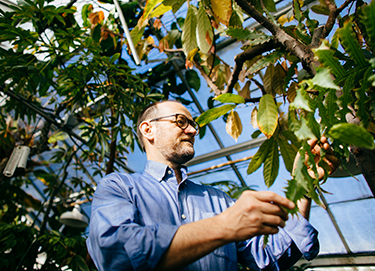
Leaf wetness sensor will enable better plant disease forecasting and management
An interdisciplinary team of researchers created a new type of sensor for more accurately measuring leaf wetness which will enable better plant disease forecasting and management.
-
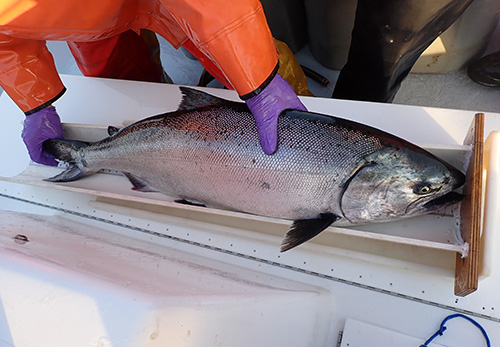
Shrinking age distribution of spawning salmon raises climate resilience concerns
Study suggests changes in hatchery practices could help increase population stability for Sacramento River fall-run Chinook salmon, the backbone of California’s salmon fishery.
-
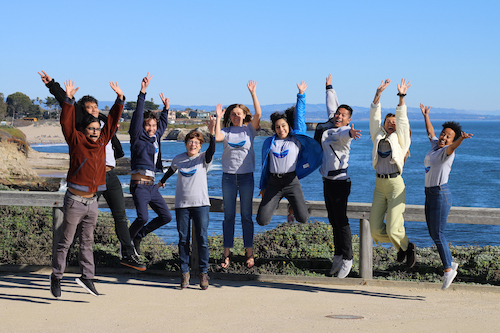
UC Santa Cruz sees record number of first-year applications
The University of California, Santa Cruz has begun the process of building the fall 2023 class of students seeking to learn and thrive at an institution that leads at the intersection of innovation and social justice. The competition to earn a spot at UC Santa Cruz remains strong this year, with a record number of…
-
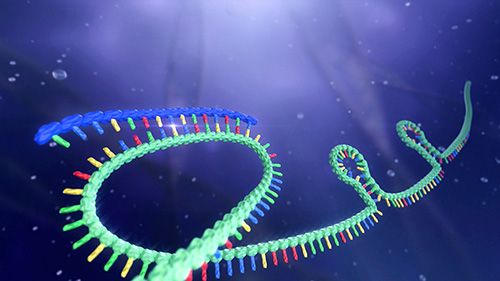
RNA Rescue challenge invites players to solve puzzles and advance RNA therapeutics
Researchers at UC Santa Cruz have developed a new puzzle challenge for the online game Eterna, enlisting players to help design a novel RNA drug to treat hemophilia A.
-

Major expansion of Lick Observatory education programs will benefit Bay Area students
Scientific Teaching through Astronomy Research (STARs), a suite of new outreach and education programs at UC’s Lick Observatory, will reach a diverse population of K-12 and college-age students.
-

Researcher wins inaugural NHGRI award for DEIA Innovation in the Genomics Workforce
Ann Mc Cartney received the National Human Genome Research Institute’s (NHGRI) inaugural Staff Award for DEIA Innovation in the Genomics Workforce.
-

UCSC professor building collaborations to shape future minds through ethnic studies
Many believe we are at a pivotal moment in this country regarding anti-racist reforms, police abolition, and restorative justice. And according to Rekia Jibrin, an assistant professor in critical studies of education within UC Santa Cruz’s Education Department, engaging local communities is vital to bringing about transformative change.