News Article
-

New program advises UCSC Ph.D. students on their path to entrepreneurship and venture capital
Many student-led innovations never make it out of the lab. A new program at UC Santa Cruz aims to change that by mentoring Ph.D. students in the life sciences on alternative career pathways outside academia: entrepreneurship and venture capital.
-
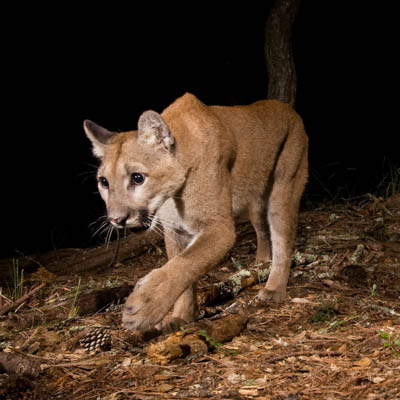
Humans and housing density are the leading cause of death for local pumas
Two new studies involving UC Santa Cruz researchers are shedding light on the challenges facing local pumas where humans are encroaching on their natural habitats.
-

JWST’s first direct spectrum of planetary-mass object reveals dynamic atmosphere
The most detailed spectrum ever for a planetary-mass object outside our solar system covers an unprecedented range of wavelengths, providing a wealth of new insights.
-

Center for Labor and Community opens on UC Santa Cruz campus
Scholars studying the economic and social impacts of a variety of labor and employment issues facing workers in Santa Cruz and the Monterey Bay Area just announced the opening of a new center on campus that will provide timely and policy-relevant labor research, will educate the next generation of labor and community leaders and will…
-

Computer engineering research prompts bug fixes, updates to major GPU frameworks
A new suite of GPU tests developed by Assistant Professor of Computer Science and Engineering Tyler Sorensen and his students led to changes to an important GPU framework for programming web browsers.
-

UCSC names astronomer Bryan Gaensler dean of Physical and Biological Sciences
UC Santa Cruz has appointed internationally recognized astronomer Bryan Gaensler to serve as dean of the Division of Physical and Biological Sciences, effective August 15.
-
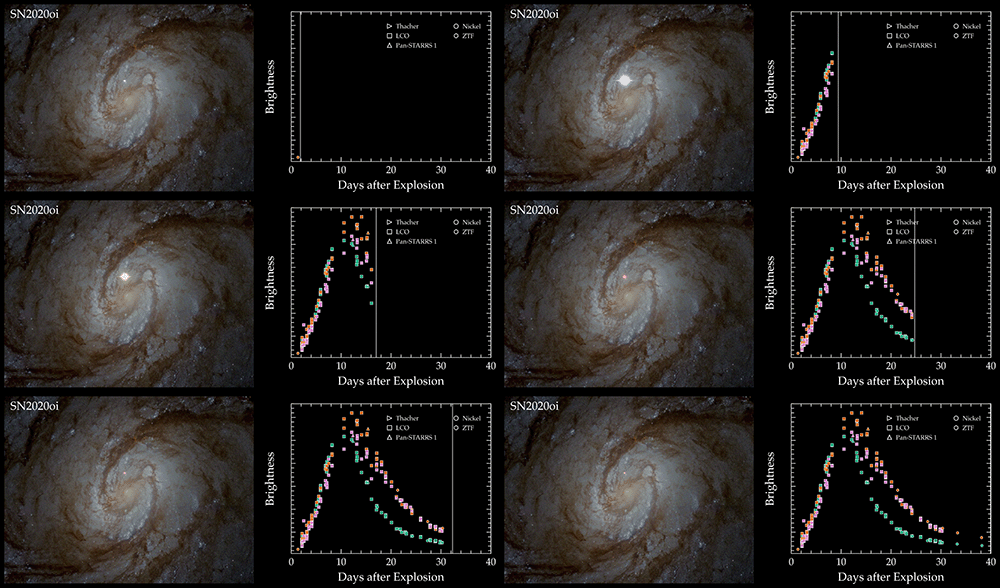
Young Supernova Experiment releases first set of transient survey data
UC Santa Cruz astronomers organized the survey, which has discovered thousands of cosmic explosions and other transient events of interest to astronomers and astrophysicists.
-

Researcher solves nearly 60-year-old game theory dilemma
Dejan Milutinovic has solved a nearly 60-year-old game theory dilemma called the wall pursuit game, with implications for better reasoning about autonomous systems such as driverless vehicles.
-
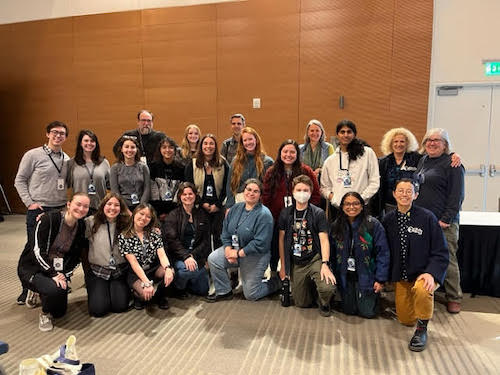
Local educators shared expertise at the first STEM Education Central Coast Conference
The conference, which was organized by California State University Monterey Bay in collaboration with UC Santa Cruz, was designed by and for local educators in science, technology, engineering and math. The goal was to share expertise.
-

Minke whales are as small as a lunge-feeding baleen whale can be
Research on the feeding behavior of Antarctic minke whales found that a smaller whale could not capture enough food to survive using the lunge-feeding strategy of baleen whales.
-

Where is your squid coming from? Most likely unregulated waters, according to a new international study
Scientists and policymakers have voiced growing concerns about the decline of global squid stocks, but little has been done to date to target squid fishing activities that are expanding into unregulated spaces, according to a new international study.
-

New project will develop safer, highly accurate GPS alternative
Ricardo Sanfelice, UCSC professor of electrical and computer engineering, and his team of graduate students and researchers are designing a new and resilient Position, Navigation, and Timing (PNT) system.