Author: Emily Cerf
-
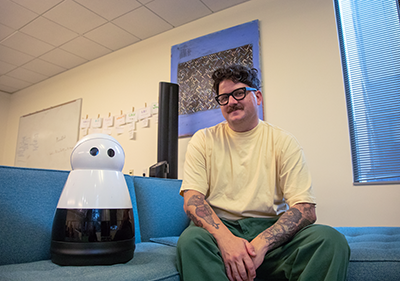
A scholar in his own community: Kevin Weatherwax
Computational Media Ph.D. student Kevin Weatherwax’s research is supported through the Piatt Fellowship, a scholarship for doctoral students from Santa Cruz County.
-
Computer engineering research prompts bug fixes, updates to major GPU frameworks
A new suite of GPU tests developed by Assistant Professor of Computer Science and Engineering Tyler Sorensen and his students led to changes to an important GPU framework for programming web browsers.
-
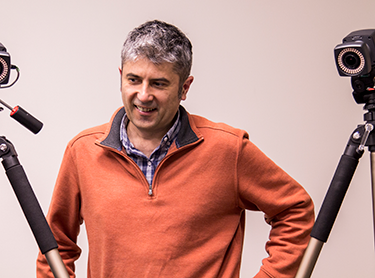
Researcher solves nearly 60-year-old game theory dilemma
Dejan Milutinovic has solved a nearly 60-year-old game theory dilemma called the wall pursuit game, with implications for better reasoning about autonomous systems such as driverless vehicles.
-

New project will develop safer, highly accurate GPS alternative
Ricardo Sanfelice, UCSC professor of electrical and computer engineering, and his team of graduate students and researchers are designing a new and resilient Position, Navigation, and Timing (PNT) system.
-

SpikeGPT: researcher releases code for largest-ever spiking neural network for language generation
Assistant Professor of Electrical and Computer Engineering Jason Eshraghian and two students recently released the open-sourced code for the largest language-generating spiking neural network ever, named SpikeGPT.
-
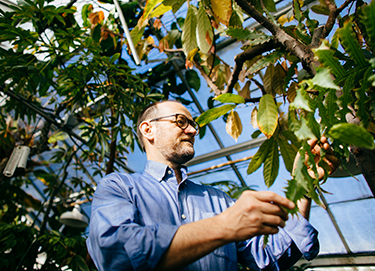
Leaf wetness sensor will enable better plant disease forecasting and management
An interdisciplinary team of researchers created a new type of sensor for more accurately measuring leaf wetness which will enable better plant disease forecasting and management.
-

Researcher wins inaugural NHGRI award for DEIA Innovation in the Genomics Workforce
Ann Mc Cartney received the National Human Genome Research Institute’s (NHGRI) inaugural Staff Award for DEIA Innovation in the Genomics Workforce.
-

UCSC joins FAA/ UAS Collegiate Training Initiative
UC Santa Cruz is now the first UC- or CSU-member of the Federal Aviation Administration (FAA)/ Unmanned Aircraft Systems’ (UAS) Collegiate Training Initiative program.
-
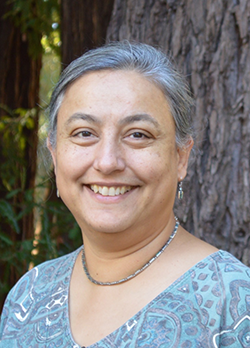
Three UCSC faculty named 2022 AAAS fellows
Three UC Santa Cruz professors received the distinction of 2022 fellows of the American Association for the Advancement of Science (AAAS), the association announced today.
-

Five student teams embark on tech for social good projects
Five student teams will take on tech for social good projects with funding from the UCSC CITRIS and the Banatao Institute and the UCSC Institute for Social Transformation.
-
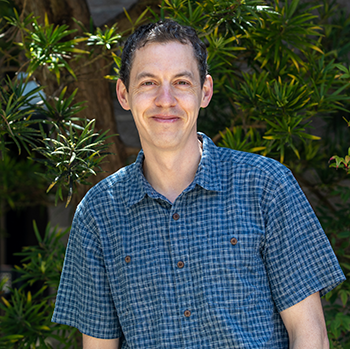
Researchers produce first-ever toolkit for RNA sequencing analysis using a ‘pantranscriptome’
Researchers at UC Santa Cruz introduce the first-ever method for analyzing RNA sequencing data genome-wide using a “pantranscriptome.”
-
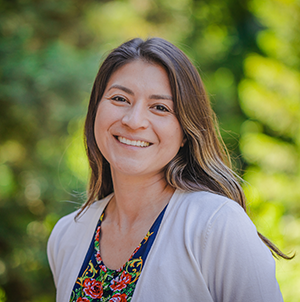
New study presents vision of machine learning leveraged for precision medicine
In a new perspective published in the journal Cell Reports Physical Science, Associate Professor of Applied Mathematics Marcella Gomez details a vision for how the field can move beyond static data to create systems that measure and monitor the real-time responses of the body to a variety of factors and use a machine learning algorithm…