Office of Research
-
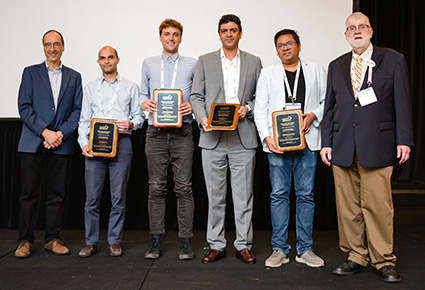
Researchers win best paper award for introducing new AI method for minimum-effort materials engineering
UC Santa Cruz researchers devised a new method for materials engineering that incorporates novel mathematical and deep learning techniques which won them the prestigious 2024 O. Hugo Schuck Best Application Paper Award from the American Automatic Control Council.
-
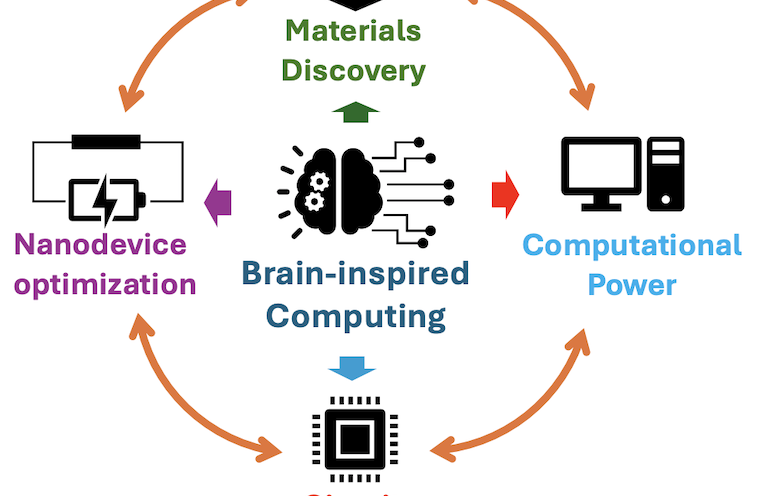
Students across the region invited to help shape the future of semiconductors
As AI weaves itself into more areas of life, scientists and engineers at UC Santa Cruz have come together to develop a better component that serves as the “neuron” in brain-inspired computing. The imperative to make such processing much more energy efficient, and faster, means that those who can design and build these next-generation devices…
-
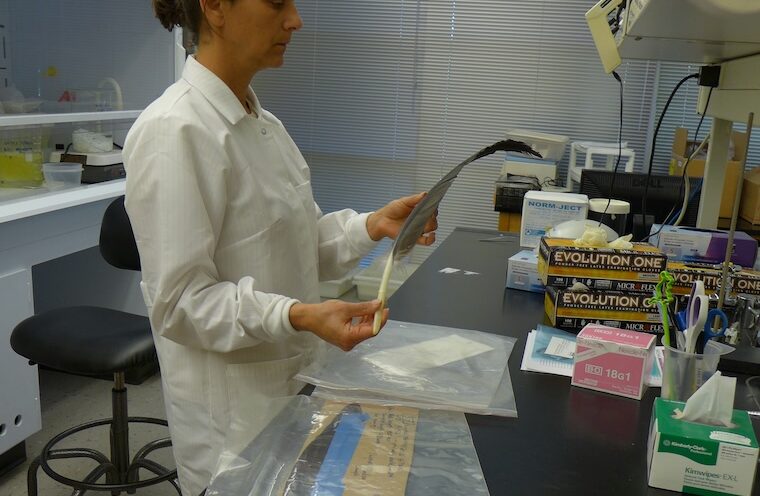
Environmental toxicologist wins funding to use feathers to test for lead exposure in birds
Myra Finkelstein, adjunct professor in microbiology and environmental toxicology, was one of nine researchers nationwide honored on July 8 by the Animal Welfare Institute (AWI) for developing humane solutions to human-wildlife conflicts. Each researcher will receive a grant of up to $15,000 as part of the Christine Stevens Wildlife Award, which honors AWI’s late founder…
-

UC Santa Cruz astrophysicists honored for advancing research on the mysterious FRB
Fast radio bursts are sudden flashes of radio waves coming from random parts of the sky. Each one is on only for a few milliseconds, but they are extraordinarily bright: In those few milliseconds, some can put out more energy than our sun does in an entire year.
-

Hydrothermal vents on seafloors of ‘ocean worlds’ could support life, new study says
Many lines of research suggest that some ocean worlds release enough heat internally to drive hydrothermal circulation under their seafloors. This heat is generated by radioactive decay, as occurs deep in the Earth, with additional heat possibly generated by tides.
-

Researchers run high-performing large language model on the energy needed to power a lightbulb
UC Santa Cruz researchers show that it is possible to eliminate the most computationally expensive element of running large language models, called matrix multiplication, while maintaining performance.
-

UC Santa Cruz’s Center for Coastal Climate Resilience partners with BIMS to incorporate perspectives from Black marine scientists
Today, UC Santa Cruz’s Center for Coastal Climate Resilience (CCCR) and Black in Marine Science (BIMS) announce a formal partnership to meet shared aims to expand opportunities for Black scholars, particularly for understanding risks to coastal communities from climate change and identifying solutions that reduce these risks.
-

Ph.D. student leads effort to open Kosovo’s first observatory
Earth’s newest observatory will open to the public on June 20, 2024, coinciding with the summer solstice, thanks in large part to a UC Santa Cruz student from Kosovo who discovered her love of astronomy as a child amidst the chaos of the country’s brutal war for independence over 20 years ago.
-

Study offers guidance on state-of-the-art long-read RNA sequencing techniques
A new study evaluates the strengths and weaknesses of the two leading long-read RNA sequencing platforms and offers guidance for the field.
-

Earliest, most distant galaxy discovered with James Webb Space Telescope
An international team of astronomers today announced the discovery using NASA’s James Webb Space Telescope (JWST) of the two earliest and most distant galaxies yet confirmed, dating back to only 300 million years after the Big Bang.
-

Researchers explain social media’s role in rapidly shifting social norms on gender and sexuality
A new paper by UC Santa Cruz psychologists describes how social media has supported an explosion of diversity in gender and sexuality in America by empowering authentic self-expression. However, these technologies have also equally enabled a cultural backlash.
-
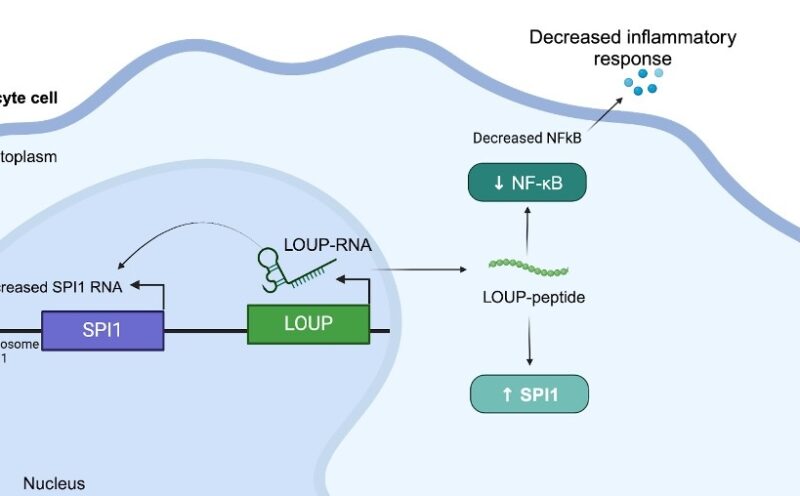
New study discovers tiny target on RNA to short-circuit inflammation
UC Santa Cruz researchers have discovered a peptide in human RNA that regulates inflammation and may provide a new path for treating diseases such as arthritis and lupus. The team used a screening process based on the powerful gene-editing tool CRISPR to shed light on one of the biggest mysteries about our RNA.