Office of Research
-

UCSC expands COVID-19 testing during surge to support community needs
A gift from Bud and Rebecca Colligan will expand testing capacity and help fund a new, dedicated laboratory space to house the diagnostic lab in the Genomics Institute’s facilities at the Westside Research Park.
-

New cryo-electron microscopy facility a boon for UCSC structural biologists
With major funding from NIH, researchers at UC Santa Cruz have acquired powerful imaging tools for studying the structures of biomolecules and their roles in disease.
-
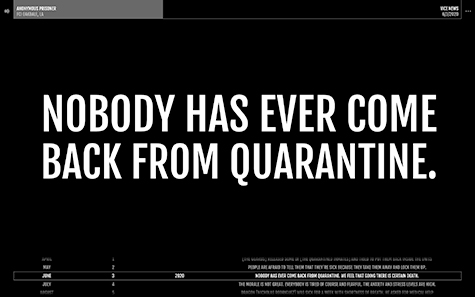
UCSC arts professor documents spread of COVID-19 inside prisons, jails, and detention centers
A new Interactive web project by film and digital media professor Sharon Daniel creates a cumulative public record and evolving history of the pandemic’s impact on those incarcerated
-
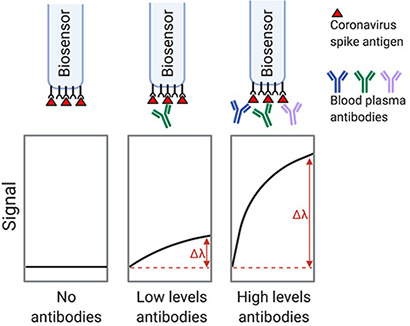
New serological assay provides rapid, accurate testing for SARS-CoV-2 antibodies
Using optical biosensor technology, the test provides quantitative measurements of antibodies in blood plasma in less than 20 minutes.
-

Surge in online grocery shopping brings a quantity-over-quality jobs shift
The coronavirus pandemic has accelerated emerging labor market trends associated with e-commerce in the grocery industry, creating mixed implications for jobs, according to a new report led by UCSC professor Chris Benner.
-
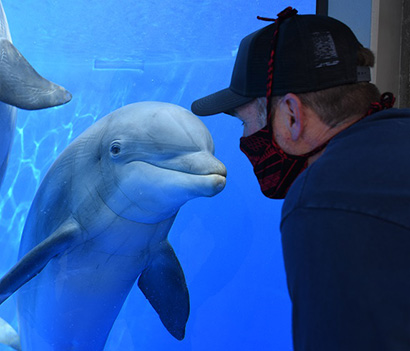
Marine mammals’ adaptations to low oxygen offer new perspective on COVID-19
Humans are poorly adapted for oxygen deprivation, making us vulnerable to long-term effects from a disease that disrupts the body’s oxygen supply pathway.
-

AXA Chair at UC Santa Cruz funds efforts to build coastal resilience naturally
Marine scientist Michael Beck was awarded the chair to support his work on natural defenses to enhance coastal resilience to flooding, erosion, and sea level rise.
-

Direct visualization of quantum dots reveals shape of quantum wave function
UCSC researchers used a scanning tunneling microscope to visualize quantum dots in bilayer graphene, an important step toward quantum information technologies.
-

Materials theorist Yuan Ping wins grant from Air Force Young Investigator Program
Ping’s research on spin dynamics in two-dimensional materials has applications for spintronics and quantum information technologies.
-

Approval of Proposition 14 boosts funding for stem cell agency
The California Institute for Regenerative Medicine (CIRM) has provided major funding for research and training at UC Santa Cruz since its creation in 2004.
-

UC Santa Cruz leads interdisciplinary consortium for astrobiology research
With funding from NASA, the UCSC-led team will lay the foundation for detecting the signatures of life in the atmospheres of other planets.
-
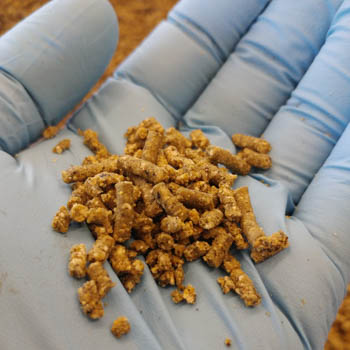
Research breakthrough achieves fish-free aquaculture feed that raises key standards
A new aquaculture feed formula eliminates conventional fish meal and fish oil ingredients by combining ingredients derived from two species of marine microalgae.