Office of Research
-

Materials theorist Yuan Ping wins grant from Air Force Young Investigator Program
Ping’s research on spin dynamics in two-dimensional materials has applications for spintronics and quantum information technologies.
-

Approval of Proposition 14 boosts funding for stem cell agency
The California Institute for Regenerative Medicine (CIRM) has provided major funding for research and training at UC Santa Cruz since its creation in 2004.
-
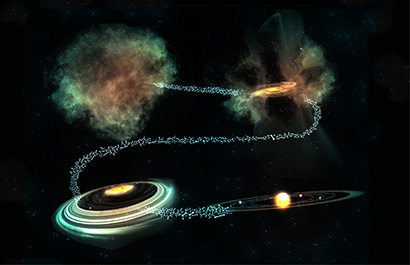
UC Santa Cruz leads interdisciplinary consortium for astrobiology research
With funding from NASA, the UCSC-led team will lay the foundation for detecting the signatures of life in the atmospheres of other planets.
-
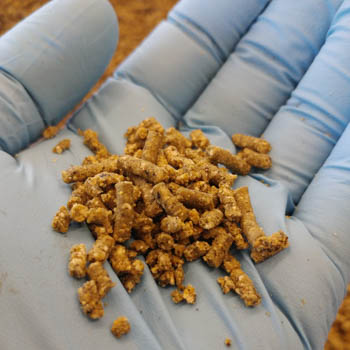
Research breakthrough achieves fish-free aquaculture feed that raises key standards
A new aquaculture feed formula eliminates conventional fish meal and fish oil ingredients by combining ingredients derived from two species of marine microalgae.
-

Computer scientist Lise Getoor receives research funding from Google
A new project on recommender dialogue systems led by Getoor and her collaborators at UC Santa Barbara and USC will receive $1 million in funding over three years.
-
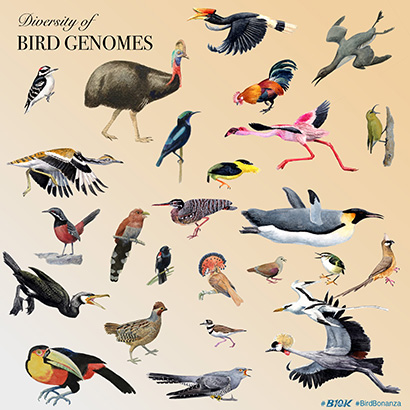
New genome alignment tool empowers large-scale studies of vertebrate evolution
Important new studies of the evolution of birds and mammals relied on Progressive Cactus, a genome alignment tool developed at the UC Santa Cruz Genomics Institute.
-

Radioactive elements may be crucial to the habitability of rocky planets
Earth-size planets can have varying amounts of radioactive elements, which generate internal heat that drives a planet’s geological activity and magnetism.
-
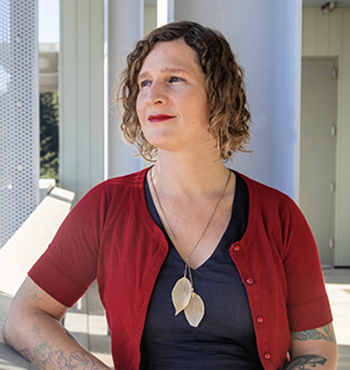
Arts professor micha cárdenas wins IndieCade Award for climate art game
Sin Sol (No Sun), an art game by UCSC assistant professor of Art & Design: Games and Playable Media, micha cárdenas, has won the Impact Award at the 2020 IndieCade International Festival of Independent Games.
-

Novel technique spotlights neuronal uptake of amyloid beta in Alzheimer’s disease
Study finds a short section of the amyloid beta protein is recognized by the cellular prion protein, which mediates its uptake into neurons and subsequent toxicity.
-

Wildfire brings destruction and opportunity to researcher’s field site
Hydrologist Margaret Zimmer has received NSF funding to study the impact of wildfire on the site where she has been studying how water moves through the landscape.
-
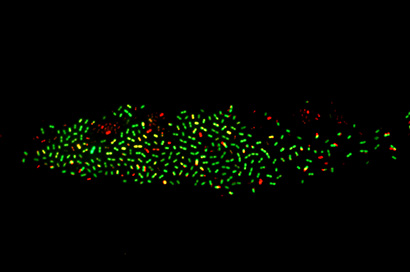
Genetic analysis system yields new insights into bacterial pneumonia
Using a CRISPR interference system to study virulence genes in a mouse model of pneumonia, scientists observed surprising variability in how the disease progresses.
-
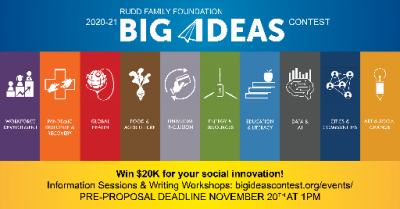
Big Ideas contest offers up to $20,000 for big ideas in social innovation
Big Ideas contest, open to all UC students, seeks student-led, early-stage projects or ideas with a social impact focus.