Office of Research
-

Hollow gold nanospheres show promise for biomedical and other applications
A new metal nanostructure has already shown promise in cancer therapy studies and could be used for chemical and biological sensors and other applications as well.
-

Universities, NASA unveil plans to build new campus at Ames
UCSC and Foothill-De Anza Community College District today announced a new partnership with NASA Ames Research Center to establish a sustainable community for education and research at the NASA Research Park.
-

Exhibition by Elliot Anderson at Gallery 16 in San Francisco through March 27
Equivalents, a new body of work by assistant professor of art and electronic media Elliot Anderson, will be on display at Gallery 16 in San Francisco through March 27.
-
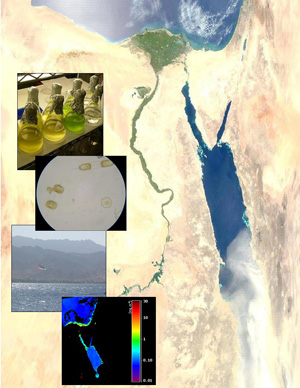
Dust deposited in oceans may carry elements toxic to marine algae
New findings show that some sources of dust deposited in the oceans carry toxic elements that can kill marine phytoplankton.
-
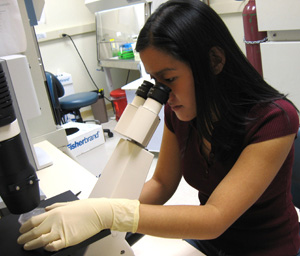
Stem cell symposium showcases new facilities and research
The UCSC Stem Cell Symposium showcased a variety of stem cell research projects now underway on campus and celebrated the opening last year of the Shared Stem Cell Facility.
-

Study links seabird deaths to soap-like foam produced by red-tide algae
A “red tide” bloom of marine algae in 2007 produced a soap-like substance that stripped the natural waterproofing from birds’ feathers.
-
Four arrested for threats and violence against UC researchers
The FBI announced on February 20 that law-enforcement officers have arrested four people who are suspected of terrorizing University of California researchers.
-

Sloan Research Fellowships awarded to two UCSC profs
The Alfred P. Sloan Foundation has awarded Sloan Research Fellowships to Samit Dasgupta, assistant professor of mathematics, and Mark Krumholz, assistant professor of astronomy and astrophysics.
-
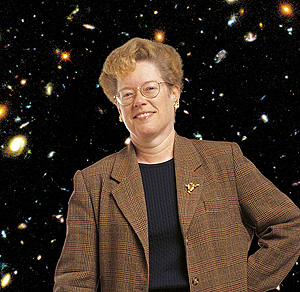
Astronomer Sandra Faber to receive Franklin Institute’s prestigious Bower Award
Astronomer Sandra Faber has been chosen to receive the 2009 Bower Award and Prize for Achievement in Science from the historic Franklin Institute in Philadelphia.
-
New data suggest “jumping genes” play a significant role in gene regulatory networks
Research suggests that mobile repetitive elements affect the evolution of gene regulatory networks.
-
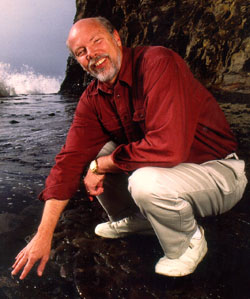
Synthetic biology yields clues to evolution and the origin of life
The efforts of researchers in the field of synthetic biology are yielding clues to the mystery of how life began on Earth.
-
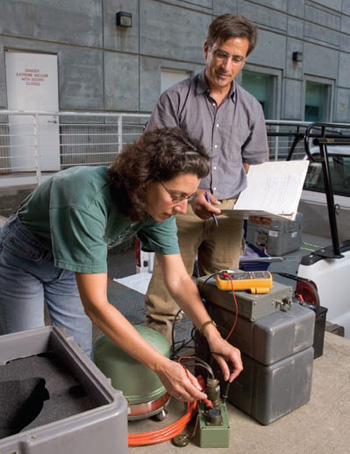
New monitoring stations detect “silent earthquakes” in Costa Rica
After installing a network of monitoring stations in Costa Rica, researchers have detected slow slip events (“silent earthquakes”) along a major fault zone beneath the Nicoya Peninsula.