Science
-
Genome sequencing aids investigation of an ancient and mysterious life-form
Researchers at the University of California, Santa Cruz, are using the latest in genetic technology to investigate an ancient form of life–the poorly understood microorganisms known as Archaea. Many Archaea live in hostile environments, from salt lakes to acidic hot springs, but they can be very difficult to grow and study in the laboratory. So…
-
Rapidly accelerating glaciers may increase how fast the sea level rises
Satellite images show that, after decades of stability, a major glacier draining the Greenland ice sheet has dramatically increased its speed and retreated nearly five miles in recent years. These changes could contribute to rapid melting of the Greenland ice sheet and cause the global sea level to rise faster than expected, according to researchers…
-
UCSC physicists deliver detector for NASA’s GLAST telescope
After more than a decade of work, a team led by physicists at the University of California, Santa Cruz, has completed a major detector subsystem for NASA’s Gamma-ray Large Area Space Telescope (GLAST). Completion of the tracking detector is a significant milestone for the telescope project, scheduled for launch in 2007. GLAST will give astronomers…
-
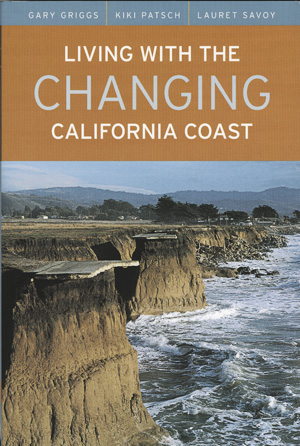
Living with the Changing California Coast: Essential reading for coast dwellers from UCSC geologists
The famously beautiful California coast is a powerful attractor, drawing people to live and build in the coastal zone despite ongoing erosion, periodic storm damage, and regulatory hurdles. For those determined to live next to this dynamic shoreline, the new book Living with the Changing California Coast should be required reading. Written by Gary Griggs,…
-
California’s oak woodlands face a new threat: climate change
California’s iconic oak woodlands have endured many assaults over the years–they’ve been cut for fuel, cleared for vineyards and housing developments, and their seedlings face intense grazing pressure and competition from invasive grasses. But the future will bring a new threat–climate change–which could drastically reduce the areas in which oaks can grow. Researchers at the…
-
A birdwatcher considers his craft in The Ardent Birder, a new book by UCSC’s Todd Newberry
In The Ardent Birder, published this month by Ten Speed Press, Todd Newberry shares the wisdom of a lifelong birder, an accomplished scientist, and an extraordinary teacher. The book is packed with valuable tips on how to become a better birder, as well as interesting stories and information about birds, but its real subject is…
-
Fisheries management study focuses on small-scale fishing cooperatives in the Gulf of California
The David and Lucile Packard Foundation has awarded a major grant to researchers at the University of California, Santa Cruz, and other institutions to study fisheries in the northern Gulf of California. The $1.3 million grant funds a collaborative project to help local Mexican fishers and government officials understand and manage marine resources using cutting-edge…
-
Joseph Miller steps down as director of UC Observatories/Lick Observatory after 14 years at the helm
Joseph S. Miller has resigned as director of the University of California Observatories/Lick Observatory (UCO/Lick), a position he held for 14 years. Miller will return to full-time teaching and research at UC Santa Cruz, where he is a professor of astronomy and astrophysics. Michael Bolte, also a professor of astronomy and astrophysics at UCSC, will…
-
ARCS Foundation scholarships support nine outstanding graduate students at UCSC
Nine UC Santa Cruz graduate students have received scholarships worth a total of $100,000 from the Achievement Rewards for College Scientists (ARCS) Foundation for the 2005-06 academic year. The Northern California chapter of the ARCS Foundation is the most generous provider of annual private awards to the UCSC campus and has provided more than $1…
-
New analysis puts dark matter back into elliptical galaxies
According to the prevailing “cold dark matter” theory of the evolution of the universe, every galaxy is surrounded by a halo of dark matter that can only be detected indirectly by observing its gravitational effects. This theory faced a challenge in 2003, when a team of astronomers reported a surprising absence of dark matter in…
-
Fall Plant Sale at the UC Santa Cruz Arboretum on Saturday, October 8, features Australian fuchsias and South African featherheads
The UC Santa Cruz Arboretum will hold its annual Fall Plant Sale on Saturday, October 8, from noon to 4 p.m. The sale will take place at the Arboretum’s Eucalyptus Grove on High Street near the intersection with Western Drive. For gardeners on the Central Coast, fall is always a good time to get new…
-
Fall lecture series at the Seymour Center will focus on sustainable fisheries
The Fall Lecture Series at UC Santa Cruz’s Seymour Marine Discovery Center will focus on sustainable fisheries, with six speakers providing a range of perspectives on the serious challenges facing important fisheries on the West Coast and around the world. Lecture topics will include the future of seafood, the politics of fish and the oceans,…