Science
-
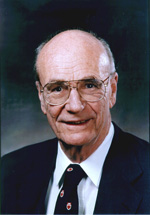
Donald Osterbrock, eminent astronomer and former director of Lick Observatory, dies at age 82
Donald Osterbrock, an eminent astronomer, a leading authority on the history of astronomy, and former director of UC’s Lick Observatory, died suddenly on Thursday, January 11. He was 82.
-

Astronomers find the most distant star clusters hidden behind a nearby cluster
Astronomers have discovered the most distant population of star clusters ever seen, hidden behind one of the nearest such clusters to Earth.
-
American Mathematical Society honors Harold Widom, professor emeritus of mathematics
Harold Widom, professor emeritus of mathematics at the University of California, Santa Cruz, will share the 2007 Norbert Wiener Prize in Applied Mathematics with UC Davis professor of mathematics Craig Tracy.
-
Astronomers discover an enormous halo of red giant stars around Andromeda
Astronomers have found an enormous halo of stars bound to the Andromeda galaxy and extending far beyond the swirling disk seen in images of the famous galaxy, our nearest large galactic neighbor.
-
UCSC biologist Harry Noller honored by Paul Ehrlich Foundation
The Paul Ehrlich Foundation of Germany has announced that it will award the 2007 Paul Ehrlich and Ludwig Darmstaedter Prize to Harry Noller, Sinsheimer Professor of Molecular Biology at the University of California, Santa Cruz, and Ada Yonath of the Weizm
-
New instrument reveals raindrop formation in warm clouds
How do raindrops form? It’s a simple question, but the answer is far from elementary. Tiny water droplets somehow merge to become full-sized raindrops, but the details remain a mystery. Now, scientists at the University of California, Santa Cruz, are closing in on an explanation with a new instrument they developed that measures the sizes…
-
UCSC biochemist Olof Einarsdottir honored by American Association for the Advancement of Science
Olof Einarsdottir, professor and chair of chemistry and biochemistry at the University of California, Santa Cruz, has been awarded the distinction of AAAS Fellow by the American Association for the Advancement of Science (AAAS). Election as a fellow is an honor bestowed upon members of AAAS by their peers. Einarsdottir is among 449 fellows elected…
-
Jingle Shells Art and Book Festival at the Seymour Center on Saturday, December 9
The 87-foot blue whale skeleton at UC Santa Cruz’s Long Marine Laboratory will again brighten the holiday season. Fondly known as Ms. Blue, the world’s largest mounted whale skeleton will glow each evening starting December 9 at the lab’s Seymour Marine Discovery Center. To celebrate the holidays, the Seymour Center will host the Jingle Shells…
-
Seismologists measure heat flow from Earth’s molten core into the lower mantle
For the first time, scientists have directly measured the amount of heat flowing from the molten metal of Earth’s core into a region at the base of the mantle, a process that helps drive both the movement of tectonic plates at the surface and the geodynamo in the core that generates Earth’s magnetic field. Seismologists…
-
Supercomputer study shows Milky Way’s halo of dark matter in unprecedented detail
Researchers at the University of California, Santa Cruz, have used NASA’s most powerful supercomputer to run the largest simulation to date of the formation and evolution of the dark matter halo that envelops the Milky Way galaxy. Their results show substructures within the halo in unprecedented detail, providing a valuable tool for understanding the evolutionary…
-
Scientists helped shape policy in proposed plan for California marine reserves
Mark Carr’s office looks out on a stretch of pounding surf, kelp beds, and tide pools that represents not only his research interest in marine coastal ecology, but also his involvement at the intersection of science and policy. Carr, an associate professor of ecology and evolutionary biology at the University of California, Santa Cruz, serves…
-
Scientists investigate unusual ocean conditions along the U.S. West Coast
For two years in a row, ocean life along the U.S. West Coast has suffered from the delayed appearance of conditions that normally support a highly productive marine environment. Instead of the usual upwelling of cold, nutrient-rich waters along the coast during spring and summer, ocean conditions early in the year have been similar to…