Science
-

Unusual supernovae may reveal intermediate-mass black holes in globular clusters
A strange and violent fate awaits a white dwarf star that wanders too close to a moderately massive black hole.
-
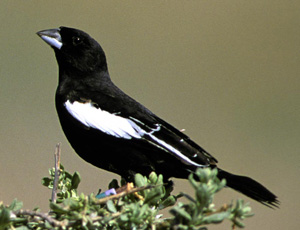
Changing fashions govern mating success in lark buntings, study finds
A study of how female lark buntings choose their mates, published this week in Science, adds a surprising new twist to the evolutionary theory of sexual selection.
-

Sea otter study reveals striking variability in diets and feeding strategies
Scientists studying southern sea otters at different sites in California’s coastal waters were not surprised to find that the dietary diversity of the population is higher where food is limited. But this diversity was not reflected in the diets of individ
-
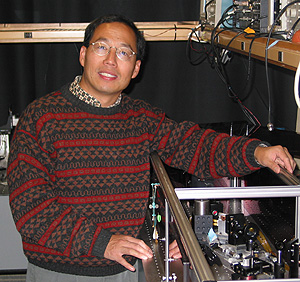
New nanostructured thin film shows promise for efficient solar energy conversion
Combining two nanotech methods for engineering solar cell materials appears to yield better results than either one alone does, according to UCSC chemist Jin Zhang.
-

Geophysicist Robert Coe honored by American Geophysical Union
Robert Coe, professor of Earth and planetary sciences, was selected by the American Geophysical Union’s (AGU) Geomagnetism and Paleomagnetism section to receive the 2007 William Gilbert Award.
-

Undergraduate wins biomedical research award for minority students
Milana PeBenito, an undergraduate senior at UC Santa Cruz, received a presentation award at the Annual Biomedical Research Conference for Minority Students.
-
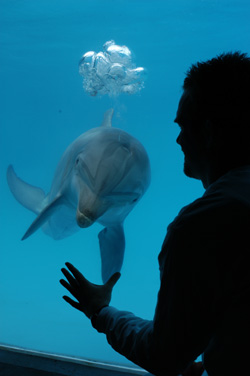
Why diving marine mammals resist brain damage from low oxygen
Certain animals–including dolphins, whales, and sea otters–appear to be protected from low oxygen by elevated levels of oxygen-carrying proteins in their brains, according to a new study by UCSC researchers.
-
California Coastal Commission approves UC Santa Cruz’s Coastal LRDP
At a hearing today in San Francisco, the California Coastal Commission approved UC Santa Cruz’s Coastal Long Range Development Plan (CLRDP), a land-use blueprint for possible future development at the site of UCSC’s Long Marine Laboratory.
-

UCSC faculty receive $4.5 million in new grants for stem cell research
Two UCSC faculty members have received major grants totalling $4.5 million for stem cell research from the California Insitute for Regenerative Medicine (CIRM).
-
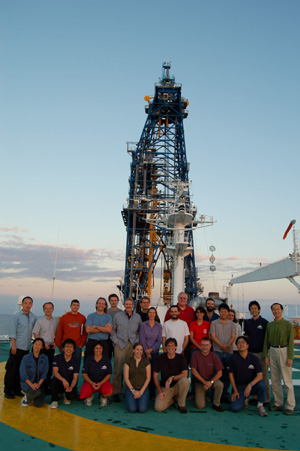
UCSC geologist probes undersea seismic zone as part of new deep-drilling experiment
The first effort to drill into an undersea zone where massive earthquakes and tsunamis are generated has yielded new data on the stresses that build up there, according to UCSC geologist Casey Moore.
-

UCSC selected to join new Science Education Alliance
UCSC has been selected as one of 12 inaugural members of the Science Education Alliance (SEA), a new program developed and funded by the Howard Hughes Medical Institute (HHMI) that aims to enhance the teaching of science and inspire new generations of res
-
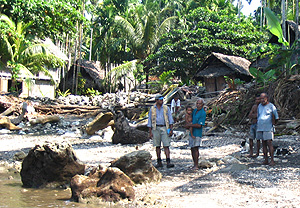
Study finds oral traditions effectively warn people about tsunamis and reduce mortality
Oral traditions are a very efficient means of tsunami education, according to a new study that researchers say shows the power of education to reduce mortality from tsunamis.