Science
-
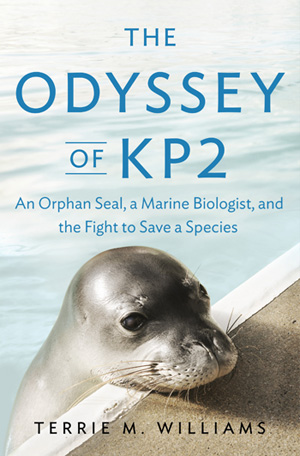
New book by UCSC biologist highlights efforts to save Hawaiian monk seals
Marine biologist Terrie Williams recounts how an abandoned pup named KP2 is helping efforts to save the most endangered marine mammal in U.S. waters.
-

Search for Higgs boson reveals new particle
Physicists involved in experiments at the Large Hadron Collider (LHC) have presented evidence of a new particle that may prove to be the long-sought Higgs boson.
-

Michael Bolte to step down as director of UC Observatories
Michael Bolte has announced his decision to resign as director of UC Observatories at the end of July and will return to full-time teaching and research at UC Santa Cruz.
-
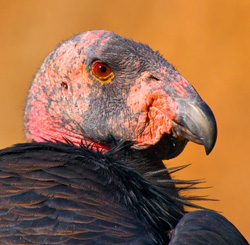
Lead poisoning blocks recovery of California condor population
Study confirms lead-based ammunition as primary source of lead in condors and shows population cannot recover as long as lead contamination persists.
-
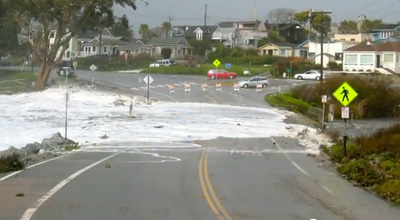
California sea level projected to rise at higher rate than global average
The sea level off most of California is expected to rise about 36 inches over the next century, an amount slightly higher than projected for global sea levels, according to a new report.
-

Physicist Alexander Sher named Pew Scholar in the Biomedical Sciences
Alexander Sher, assistant professor of physics, will receive $240,000 to support his research on how the retina heals itself after laser surgery.
-
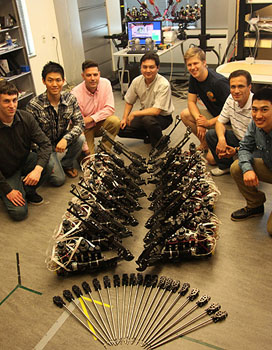
Year of the Slug: Great UCSC moments in 2011-12
From the Rock ‘n Roll Hall of Fame to cancer research to its ranking as one of the top “young” universities in the world, UCSC stood in the spotlight this year.
-
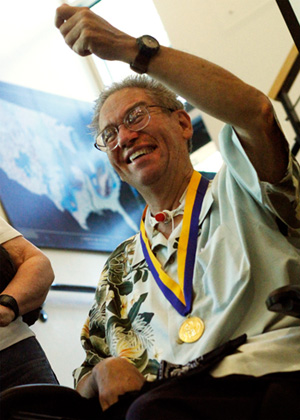
Astronomer Jerry Nelson receives Franklin Medal in campus ceremony
Astronomer Jerry Nelson was awarded the Franklin Institute’s 2012 Benjamin Franklin Medal in Electrical Engineering on Friday, June 8.
-

Spotlight on outstanding work: Student Achievement Week recognizes accomplishment
Computer programmers, actors, robotics students, apprentice astronomers and fine artists showed off their skills during this year’s Student Achievement Week celebration.
-

Surf industry grant benefits Seymour Center
The Seymour Center at Long Marine Laboratory is among the 20 ocean-environmental organizations named as beneficiaries of the 23rd Annual Waterman’s Weekend.
-
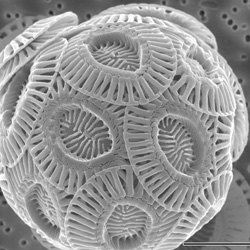
Climate more sensitive to carbon dioxide now than in past epochs
New evidence from the geologic record contrasts with today’s close coupling of climate and atmospheric carbon dioxide
-
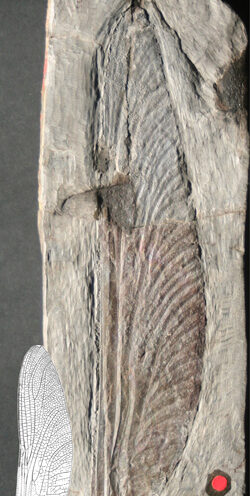
Reign of the giant insects ended with the evolution of birds
Giant insects once ruled the prehistoric skies, but the evolution of birds ended their reign.