Science
-

Genomics Institute faculty and staff help create non-profit to center Indigenous Knowledge while accelerating conservation genomics research
Several current and former UC Santa Cruz faculty and staff have joined with leading experts in the field of conservation genomics to launch Wise Ancestors, a non-profit centering Indigenous Peoples and Local Communities as co-creators of biodiversity conservation projects
-
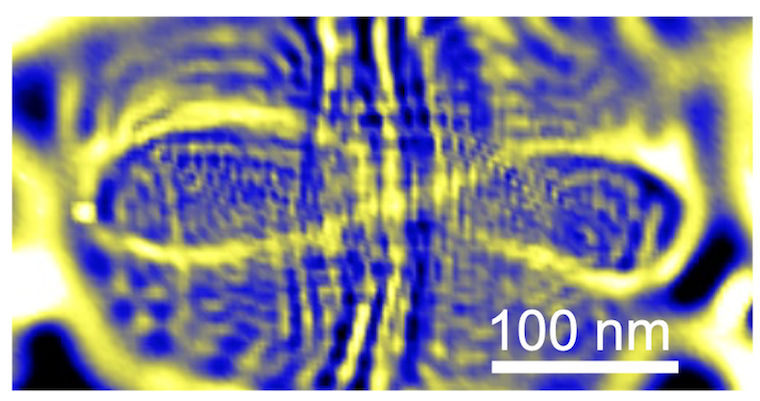
Physics experiment proves patterns in chaos in peculiar quantum realm
Where do you see patterns in chaos? It has been proven, in the incredibly tiny quantum realm, by an international team co-led by UC Santa Cruz physicist Jairo Velasco, Jr. In the journal Nature, the researchers detail an experiment that confirms a theory first put forth 40 years ago stating that electrons confined in quantum…
-

Magnetic tornadoes create Earth-size spots discovered at Jupiter’s poles
While Jupiter’s Great Red Spot has been a constant feature of the planet for centuries, a team of astronomers have discovered equally large spots at the planet’s north and south poles that appear and disappear seemingly at random.
-

UC Santa Cruz, Monterey Bay Aquarium lead collaboration on kelp conservation
In May 2024, UC Santa Cruz and the Monterey Bay Aquarium convened a workshop aimed at bridging the gap between scientific research and the practical application of evolutionary resilience concepts for kelp.
-
Professor J. Xavier Prochaska to deliver December 4 Kraw Lecture
The Kraw Lecture Series aims to help audiences better understand the big picture behind scientific research at UC Santa Cruz and the broader trends at play. This tradition continues with the December 4 talk on how artificial intelligence (AI) is accelerating the scientific pursuit.
-

24 in 2024: list of most highly cited researchers includes UC Santa Cruz scientists and engineers
In a notable recognition of scholarly achievement, 24 scientists and engineers from UC Santa Cruz have earned a spot on the 2024 Highly Cited Researchers list, recently unveiled by Clarivate.
-

2024 iGEM team’s foundational science project tackles infant formula affordability
The 2024 UC Santa Cruz iGEM team won a silver medal at the international Jamboree for a project focused on addressing the high cost of infant formula through a foundational synthetic biology approach.
-
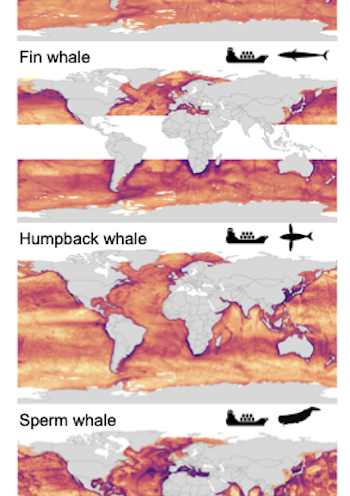
Fewer than 7% of global hotspots for whale-ship collisions have protection measures in place
A UC Santa Cruz scientist who specializes in research at the intersection of big data and marine-life conservation has contributed to a new study that shows the vast majority of “hotspots” where ships collide with whales in the world’s oceans lack protections for the majestic giants.
-

$7.5 million awarded to UC Santa Cruz to support leadership in salmon-recovery science
UC Santa Cruz has received nearly $7.5 million from the National Oceanic and Atmospheric Association (NOAA) to vault scientific research on imperiled Pacific salmon populations into one of the nation’s most powerful collaborations between the agency and academia to save the vital species.
-

Team discovers ultra-massive galaxies in early Universe that challenge standard cosmology
An international team of astronomers has identified three ultra-massive galaxies—each nearly as massive as the Milky Way—already in place within the first billion years after the Big Bang. The discovery is surprising because it indicates that the formation of stars in the early Universe was far more efficient than previously thought, challenging current models of…
-

Physics Department improves undergraduate experience for non-majors
Fundamental teaching strategies—making room for failure, and being explicit and transparent about how students’ knowledge will be assessed—combine to create an atmosphere that is more conducive to learning than traditional forms of physics instruction.
-

New chemical process makes biodiesel production easier, less energy intensive
UC Santa Cruz chemists have discovered a new way to produce biodiesel from waste oil that both simplifies the process and requires relatively mild heat. This discovery has the potential to make the alternative fuel source much more appealing to the massive industrial sectors that are the backbone of the nation’s economy.