Earth & Planetary Sciences
-

Seismologists discover complex structure in Tonga mantle wedge
The subduction zones where oceanic plates sink beneath the continents produce volcanic arcs such as those that make up the “rim of fire” around the Pacific Ocean. A new study finds that the structure of the mantle wedge above the subducting plate may be f
-
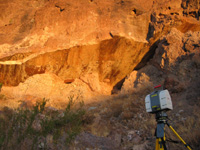
New technology shows old faults are smoother than young ones
A new study by UCSC geologists finds old earthquake faults are smoother than young ones, worn smooth over time by friction like the brake pads of an old car.
-
New instrument reveals raindrop formation in warm clouds
How do raindrops form? It’s a simple question, but the answer is far from elementary. Tiny water droplets somehow merge to become full-sized raindrops, but the details remain a mystery. Now, scientists at the University of California, Santa Cruz, are closing in on an explanation with a new instrument they developed that measures the sizes…
-
Seismologists measure heat flow from Earth’s molten core into the lower mantle
For the first time, scientists have directly measured the amount of heat flowing from the molten metal of Earth’s core into a region at the base of the mantle, a process that helps drive both the movement of tectonic plates at the surface and the geodynamo in the core that generates Earth’s magnetic field. Seismologists…
-
Fall lecture series at the Seymour Center will focus on global climate change
The Fall Lecture Series at UC Santa Cruz’s Seymour Marine Discovery Center will focus on climate change and global warming, with six speakers providing a range of perspectives on climate science, the effects of global warming, and policy options. Lisa Sloan, professor of Earth and Planetary Sciences, will give the first lecture in the series.…
-

New book looks at Santa Cruz coast ‘then and now’
A new book by Gary Griggs, professor of Earth and planetary sciences at UC Santa Cruz, and local architect Deepika Shrestha Ross offers a unique look at the Santa Cruz coastline. The book juxtaposes historic photographs with photographs taken from the same locations today, showing how the coastline has evolved and changed, sometimes dramatically, over…
-
Increased flow of groundwater after earthquakes suggests oil extraction applications
The most obvious manifestation of an earthquake is the shaking from seismic waves that knocks down buildings and rattles people. Now researchers have established a more subtle effect of this shaking–it increases the permeability of rock to groundwater and other fluids. The enhanced permeability caused by seismic shaking could potentially be harnessed to help extract…
-
Study shows earthquake shaking triggers aftershocks
A new analysis of earthquake data indicates that aftershocks are triggered by the shaking associated with the mainshock, rather than by the added stress on nearby faults resulting from rearrangement of the Earth’s crust. The triggering of aftershocks by shaking may seem obvious, but is in fact a surprising result, said Emily Brodsky, assistant professor…
-
Saturn’s moon Enceladus may have rolled over to put a hot spot at the pole
Enceladus, a small icy moon of Saturn, may have dramatically reoriented relative to its axis of rotation, rolling over to put an area of low density at the moon’s south pole. According to a new study, this reorientation process could explain the polar location of a region where NASA’s Cassini spacecraft recently observed icy jets…
-
Seismologists detect a sunken slab of ocean floor deep in the Earth
Halfway to the center of the Earth, at the boundary between the core and the mantle, lies a massive folded slab of rock that once formed the ocean floor and sank beneath North America some 50 million years ago. A team of seismologists led by scientists at the University of California, Santa Cruz, detected the…
-
New capture scenario explains origin of Neptune’s oddball moon Triton
Neptune’s large moon Triton may have abandoned an earlier partner to arrive in its unusual orbit around Neptune. Triton is unique among all the large moons in the solar system because it orbits Neptune in a direction opposite to the planet’s rotation (a “retrograde” orbit). It is unlikely to have formed in this configuration and…