Engineering
-
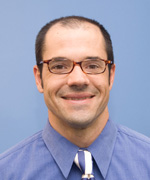
Five faculty members win 2009 NSF CAREER awards
Five UCSC faculty members have won NSF CAREER awards in 2009.
-
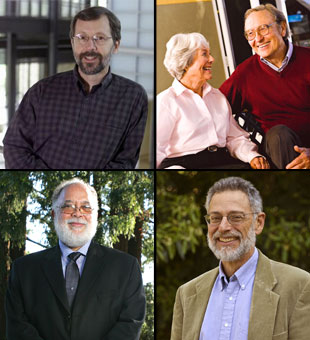
3rd annual UCSC ‘Founders Day’ gala dinner at Cocoanut Grove to honor five exceptional individuals
UCSC will host its third annual Founders Day gala dinner at the Cocoanut Grove on Friday, October 23.
-
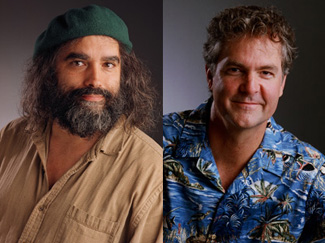
Haussler and Kent honored by American Society of Human Genetics
The American Society of Human Genetics (ASHG) has honored two UCSC researchers with the 2009 Curt Stern Award.
-

AIDS vaccine expert encouraged by promising results from clinical trial
Phillip Berman said he is encouraged by promising results from a large clinical trial of an AIDS vaccine regimen.
-

$3.5 million NIH grant supports AIDS vaccine research
The National Institute on Drug Abuse (NIDA) has awarded a $3.5 million grant for AIDS vaccine research at UCSC.
-
Genome Sequencing Center offers state-of-the-art sequencing services
The UCSC Genome Sequencing Center is now available to accept samples from investigators at other academic institutions as well as regional biotechnology companies.
-

Computer scientist Michael Mateas named to MacArthur Foundation Chair
Computer scientist Michael Mateas, named to the MacArthur Foundation Chair at UCSC, aims to radically expand the expressive power of computer games.
-

Summer programs focus on renewable energy research and education
The Bio-Info-Nano Research and Development Institute is sponsoring four programs in renewable energy through the summer of 2009.
-
Bio-Info-Nano Research and Development Institute holds workshops on local electric microgrids
Experts discussed the critical issues in using renewable energy sources to generate reliable, stable electric power at the first in a series of BIN-RDI workshops.
-
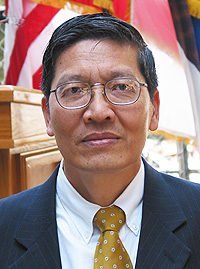
Artificial retina project wins R&D 100 Award
R&D magazine has awarded an R&D 100 Award to the Artificial Retina Project, recognizing it as one of the most innovative ideas of the year.
-
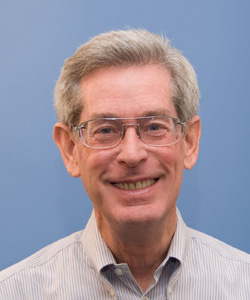
Don Chamberlin to receive 2009 Fellow Award from Computer History Museum
Computer scientist Don Chamberlin has been chosen to receive a 2009 Fellow Award from the Computer History Museum.
-
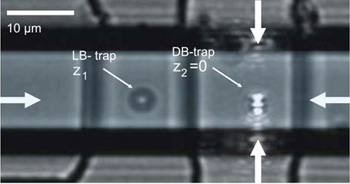
Integrated optical trap holds particles for on-chip analysis
A new type of optical particle trap can be used to manipulate bacteria, viruses and other particles on a chip as part of an integrated optofluidic platform.