Technology
Protecting cloud data the moment encryption stops
CAREER-award supported research will lay the foundation for stronger data privacy in fields like healthcare, finance and blockchain, and AI.

Getty Images/ Prae_Studio
Press Contact
These days, much of your data lives and moves around in the cloud: financial information when you make a transaction, health data when you receive a test result, even your own thoughts when you send a DM to a friend.
Cloud systems rely on encryption to protect private data while it’s stored and in transit. But data has to be used, too—searched, queried, analyzed—and that’s where today’s approaches fall short. Even when the content of data stays encrypted, the pattern of which records are accessed, and when, leaks information that attackers can exploit.
Oblivious computation addresses this gap. It’s a technique for processing encrypted data so that the access pattern itself reveals nothing. Imagine sending a package in the mail, but the delivery person can’t tell how heavy it is, where it’s going, or how often you send it.
University of California, Santa Cruz Assistant Professor of Computer Science and Engineering Ioannis Demertzis will develop and scale oblivious computation to handle real-world workloads with the support of a $630,000 National Science Foundation CAREER award. The work will lay the foundation for stronger data privacy in fields like healthcare, finance and blockchain, AI, and more. It comes at a moment when many fields are recognizing a growing need for better cybersecurity and more security professionals.
“Because of AI, there are many problems that create the need for security practitioners,” Demertzis said. “We need to modernize and step up to new problems as people give AI access to their healthcare and financial information. This creates a plethora of demand for security work and security jobs.”
The need for zero-leakage computation
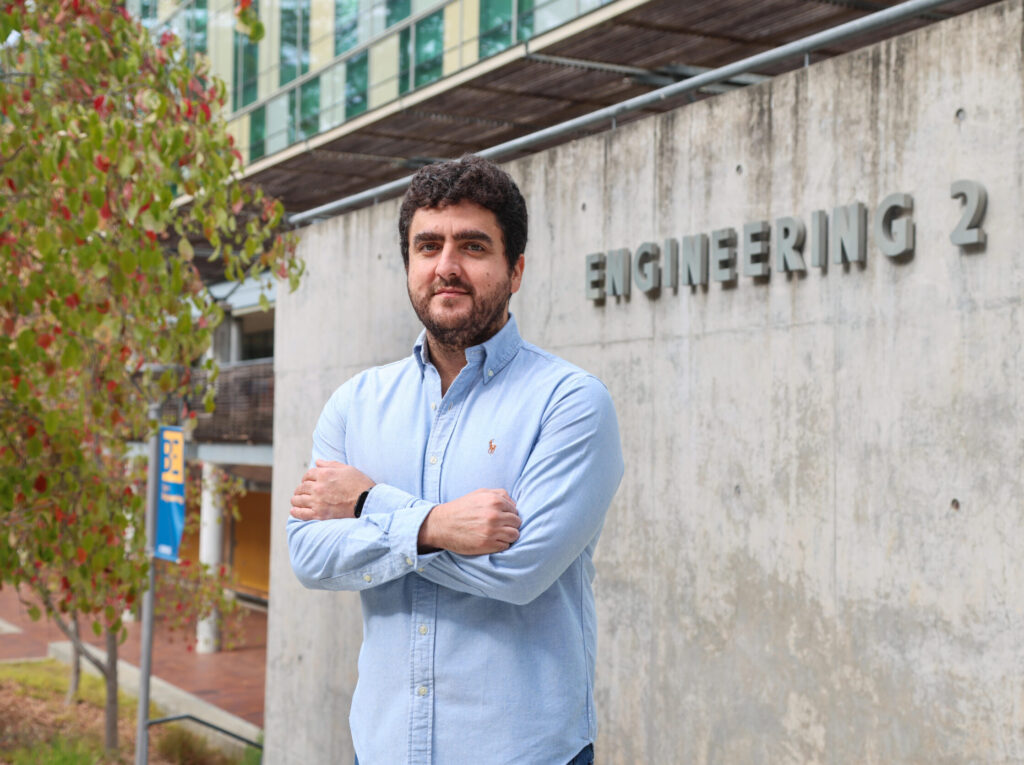
Demertzis is a cybersecurity researcher at the Baskin School of Engineering whose work spans cryptography, security, systems, databases, and AI systems. With this project, he will focus on expanding the scale and performance of oblivious computation, a technique that hides not only the data but the pattern of how it is accessed.
Many common encryption approaches still leak information in metadata and access patterns. This can lead to cyberattacks called side-channel attacks and leakage-abuse attacks, which allow bad actors to steal information by observing patterns rather than breaking the encryption directly. Oblivious computation eliminates the leakage these attacks depend on.
“In general, what obliviousness gives you is zero-leakage private computation,” Demertzis said. “The data are always encrypted, and the way that we access the data doesn’t leave any trace.”
Demertzis says many companies have begun to recognize the need for the most rigorous levels of security that can protect against metadata, access-pattern, and side-channel attacks, including in AI and highly regulated industries that work with proprietary and sensitive data. At the Confidential Computing Summit in June, Apple laid out a four-level framework for trustworthy cloud AI whose highest tier explicitly requires defending against side-channel attacks, and Microsoft and OpenAI researchers recently issued reports of attacks on encrypted agentic frameworks and protected hardware. In each case, the missing piece is the same.
“Encryption protects the data. Hardware enclaves protect where it’s processed. What’s still exposed is how it’s accessed, and that’s where the attacks are happening now,” Demertzis said. “Oblivious computation closes that gap, and the goal of this project is to make it fast enough, and big enough, that companies can actually deploy it.”
It has already been done once at scale. In 2021, the encrypted messaging app Signal deployed Demertzis’ scalable oblivious computation to power its private contact discovery, protecting the contact lists of tens of millions of users, marking the first large-scale production use of oblivious computation.
Blockchain finance is the next candidate. Despite its decentralized design, most wallets read the blockchain through a handful of centralized providers that can see which accounts a person controls—enough to deanonymize users and reconstruct their portfolios, which provide the raw material for targeted scams, extortion, and attacks on crypto holders that rose 75 percent in 2025.
The CAREER project aims to take oblivious computation to the scale of the hundreds of terabytes and petabytes of data that modern systems routinely handle, making it practical for healthcare data processing, private AI, including techniques such as retrieval-augmented generation (RAG), and more. Getting there means bringing down the cost of the low-level primitives oblivious computation is built on, and tailoring them to what each application actually needs.
“When we started, oblivious computation could handle hundreds of megabytes,” Demertzis said. “Now we’ve reached the terabyte scale, and what we’re trying to do with this proposal is to go above and beyond—the petabyte scale.”
Advanced cryptography education and industry connections
A major component of the NSF’s CAREER Award is integrating research with education. Since joining Baskin Engineering in 2020, Demertzis has made major contributions to UC Santa Cruz’s security curriculum, creating four new graduate and three new undergraduate courses in cryptography, private computation on encrypted data, and secure AI and systems.
With the CAREER Award, he will focus on introducing class projects that can span across different courses to enable students to do more hands-on and sophisticated work. He aims for this to result in more student publications and put students on the path to careers as security practitioners, especially as emerging issues in the AI industry create more jobs in cybersecurity.
Along these lines, Demertzis plans to host workshops and gatherings for academics and industry, particularly at UC Santa Cruz’s Silicon Valley Campus, that could help students connect to career pathways and provide opportunities for academic researchers and industry to give feedback on their evolving needs. Demertzis organized the NorCalDB Day at UC Santa Cruz on October 16, which brought together Northern California’s database leaders from academia and industry, and plans to host additional events in the future.
“We need feedback from industry,” Demertzis said. “We do the research and the science, but many times we can adjust the science in a way that now we are solving the problems that they need addressed so that we serve a real world need.”