Earth & Space
Land-based origins of life explored in UCSC-led special issue of ‘Astrobiology’
The scientists hypothesize that an entire landscape might be implicated in life’s beginning
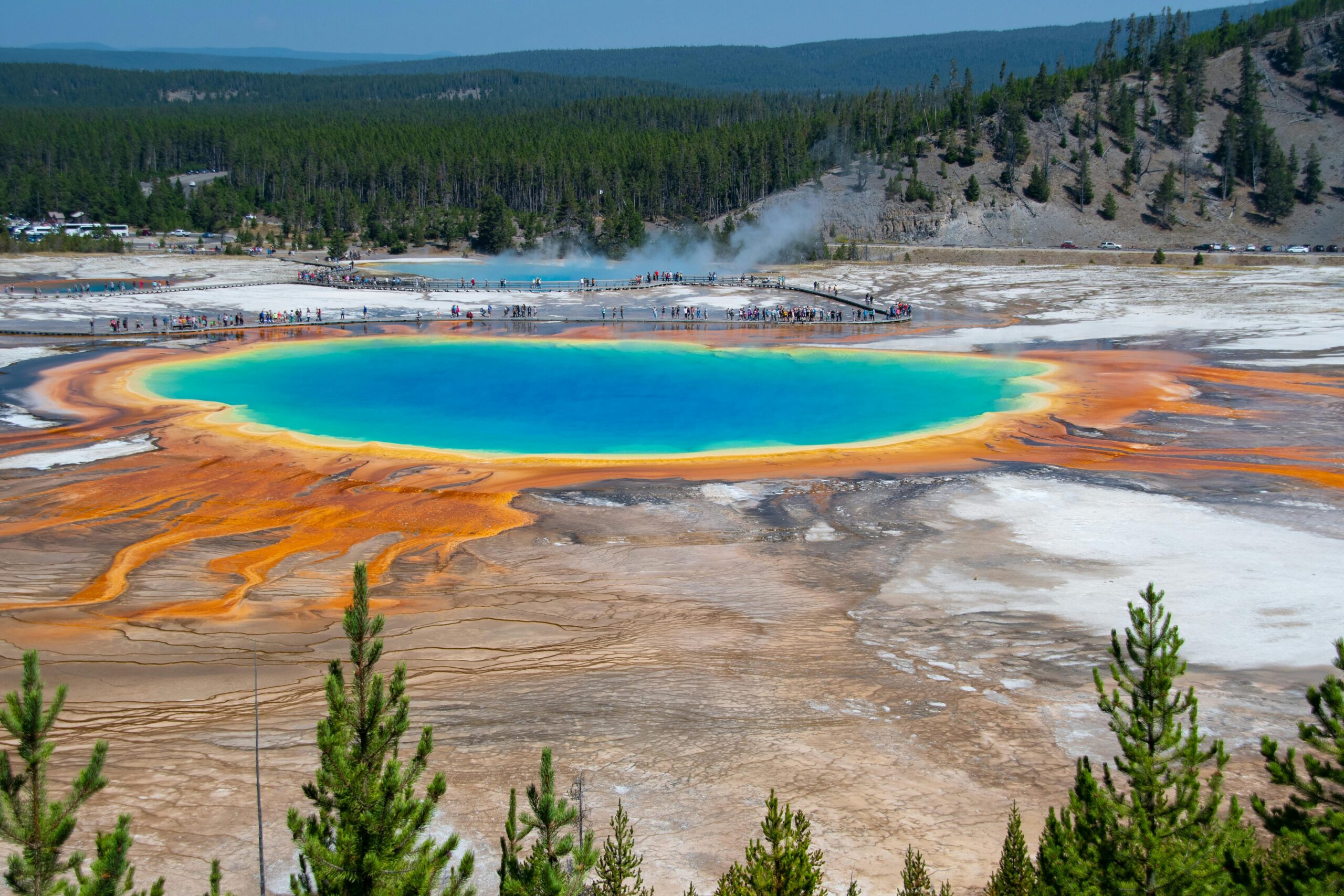
The special issue of Astrobiology explores how life may have begun in chemically dynamic environments on land, perhaps similar to the hot springs that can be seen in Yellowstone National Park.
Siegfried Poepperl / Pexel
Press Contact
For scientists seeking to understand the origins of life on Earth, a central debate is land versus sea: whether life began in hot springs or other chemically dynamic environments on land, or in deep-sea hydrothermal vents.
A new special issue of the journal Astrobiology, titled “An Origin of Life on Land” and guest edited by University of California, Santa Cruz, professor emeritus of biomolecular engineering (BME) David Deamer and BME research associate Bruce Damer, examines growing evidence that life may have emerged within networks of terrestrial environments on early Earth, billions of years ago.
“In this new view, perhaps an entire landscape might be implicated in life’s beginning,” Damer said.
The collection explores how the origins of life may have come about in volcanic landscapes, freshwater hydrothermal systems like geyser-fed hot springs, evaporative environments, crater and soda lakes, and other concentrating freshwater environments. These systems may have collectively provided the chemical complexity and environmental cycling necessary for non-living organic chemical mixtures to assemble into the protocell populations, which then evolved into the first microbial communities.
The issue does not argue for a single exclusive setting for life’s origins, but advances an emerging systems-level view in which life may have arisen through interactions among diverse environments that support fluctuating chemical conditions across volcanic landmasses.
The implications extend far beyond Earth. This work informs whether life might have emerged on planets such as Mars or moons such as Saturn’s Enceladus, as well as on potentially habitable exoplanets. It also helps refine one of science’s most consequential questions: under what conditions can life begin, and how common might living worlds be in the universe?
Damer and Deamer contributed the issue’s introductory article, titled “Revisiting Darwin’s Warm Little Pond in the 21st Century: Land-Based Scenarios for Life’s Origins,” which synthesizes evidence that suggests fluctuating terrestrial environments may have been especially favorable for the emergence of increasingly complex chemical systems.

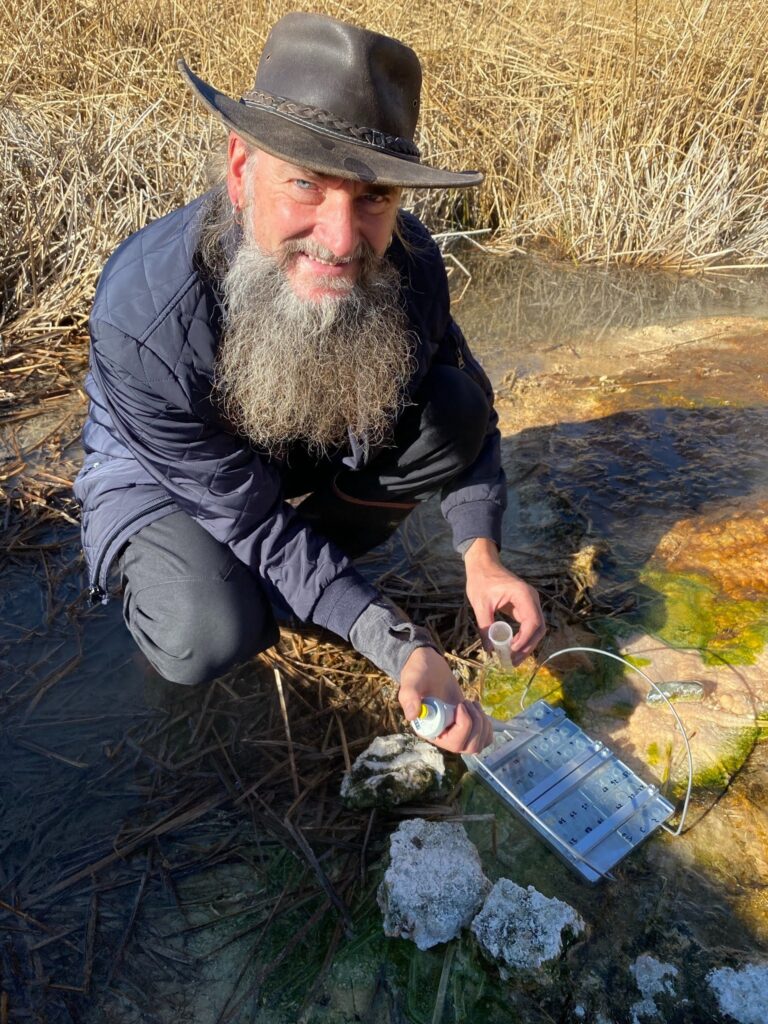
At left, David Deamer in the lab. At right, Bruce Damer carries out experiments in hydrothermal environments in Fly Geyser, Nevada.
The two UC Santa Cruz researchers are co-authors on two other manuscripts in the collection. Damer led the proposal of a new hypothesis that layered systems in the drying state of wet-dry cycles in hot springs can act as a “progenitor for life” by providing a medium for polymers to form functional complexes. Deamer authored “Nanopore Sequencing: A Way to Explore Life’s Origins,” a guide to research on nucleic acids using the technology for DNA and RNA sequencing that he co-invented.
A central concept threading through the collection is “urability,” a new scientific term proposed by Deamer, Damer, and colleagues in 2022 to describe the broader set of environmental conditions required for life to emerge on a planet or moon.
“Liquid water alone is probably insufficient for life to originate, so water worlds like Enceladus could sustain life as we know it, but perhaps not start it,” Deamer said.
The issue includes studies on:
- Geochemical complexity in terrestrial hot spring system
- Stability of nucleic acids during wet-dry cycling in Icelandic hot springs
- Micrometeorites as prebiotic chemical processors in the atmosphere
- Wet-dry cycling systems promoting the assembly of key polymers for life
- Protocell assembly and the emergence of primitive metabolism
- A 3D-printed experimental hot spring platform for prebiotic chemistry
- Nanopore sequencing approaches for studying how life’s first polymers assembled
- Historical debates surrounding pre-cellular evolution leading to today’s hypotheses
The special collection arrives during renewed momentum in origin-of-life research driven by sample-return missions from asteroids such as Bennu, which confirm extraterrestrial delivery of key organic compounds to landscapes on the early Earth, along with accumulating evidence for ancient hot springs on Earth and Mars, increasing rates of discovery of potentially habitable exoplanets, and advances in synthetic protocell and systems chemistry research.