Earth & Space
Collaborating ecology professors earn national honors and discuss their work together
Professors of ecology and evolutionary biology Roxanne Beltran and Erika Zavaleta have been recognized individually by the Ecological Society of America. But they also partner on research that bridges ecology, inclusive education, and field-based learning
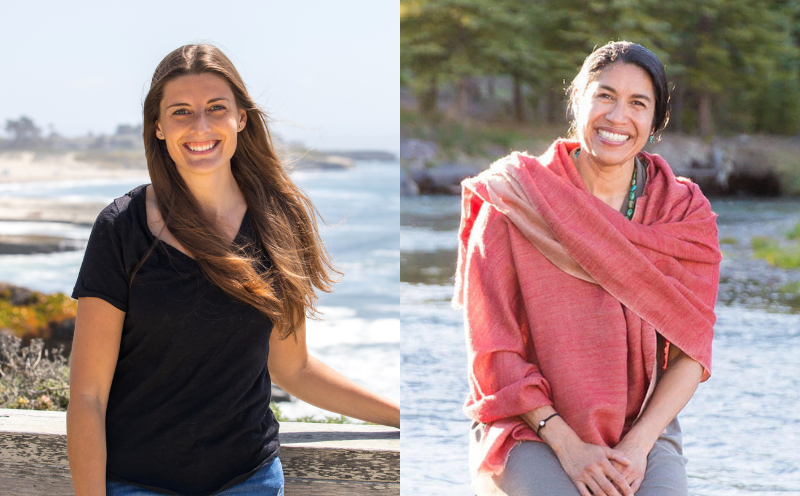
Professors Roxanne Beltran (left) and Erika Zavaleta
Just weeks apart, the Ecological Society of America (ESA) has honored two professors of ecology and evolutionary biology at the University of California, Santa Cruz, for their impactful contributions to the field. On April 15, ESA announced Assistant Professor Roxanne Beltran as a 2026 Early Career Fellow; and this morning, the organization announced Professor Erika Zavaleta as the inaugural recipient of an award recognizing mentorship towards diversity, inclusion, and belonging.
Beltran was cited for her intrepid, interdisciplinary work that integrates animal behavior, physiology, and environmental change to understand how and why animals survive and die in rapidly changing ecosystems. Her research combines long-term field studies, biologging, and demographic data to uncover how individual traits and environmental conditions interact to shape life history strategies in long-lived marine vertebrates, particularly northern elephant seals.
The current monitoring of highly pathogenic avian influenza’s impact on the seal colony at Año Nuevo Reserve demonstrates her commitment to understanding this complex interplay—even as alarming conditions emerge in real time.
Zavaleta, who was named an ESA Fellow in 2018, is now the recipient of the new Fakhri A. Bazzaz and Steward T.A. Pickett Award, which honors excellence in mentoring future generations of ecologists. A leader of groundbreaking research on biodiversity’s importance to people and nature, Zavaleta has also established multiple programs at UC Santa Cruz that are designed to lift up students who have faced adversity and help students of all backgrounds succeed.
In 2018, she founded the Center to Advance Mentored, Inquiry-based Opportunities (CAMINO), which removes barriers to research by providing accepted undergraduates with training and a paid summer research position in ecology. In 2015, Zavaleta brought the Doris Duke Conservation Scholars Program to UC Santa Cruz. Over the course of 10 years, the program prepared 160 undergraduates from diverse backgrounds to be leaders in conservation and transform the field in many ways.
Increased impact through partnership
Beltran and Zavaleta also collaborate on research into inclusive education, field-based learning, and equity in science, technology, engineering, and mathematics (STEM). Their partnership, dating back to 2012, bridges a primary emphasis on ecological research with education research to dismantle barriers that historically excluded marginalized students from field biology.
Their joint work is characterized by “action-oriented” investigation that tests how academic structures impact student success. Key themes include how field courses impact a student’s science identity, sense of belonging, and retention in biology. They have specifically researched how these courses can narrow achievement gaps for underrepresented students.
ESA’s recognition of the individual accomplishments of these two professors serves as an ideal opportunity to ask them how collaboration has amplified the impact they seek to make on the environment and in the lives of students.
What do you find most valuable in each other’s perspectives?
“We deeply value the complementarity of how we approach science. Roxanne brings exceptional strength with data and quantitative approaches, paired with a drive to apply them to important and generalizable questions, from marine mammals to field-based education. Erika has a remarkable ability to reframe research projects toward actionable outcomes and to help mentees refine and elevate their science communication. That combination is rare and powerful, and it reflects a broader focus on people and relationships in science.
“Together, we challenge each other to think more critically, connect ideas across scales and disciplines, and push our work to be both rigorous and meaningful.”
What direction is your work together taking you these days?
“Increasingly, our collaboration reflects a shared interest in how ecological understanding is generated and shared—including how mentoring and training shape the next generation of scientists. Across all of this work, students are not just participants but central contributors, linking research and education in a mutually reinforcing way.”
Are there projects you’re currently collaborating on or planning that you’re particularly excited about?
“We are especially excited about continuing to elevate the role of field-based science in ecology. At a time when field research and field teaching can be difficult to sustain and scale because it is resource-intensive, we see it as essential for grounding ecological insight in real-world complexity. We believe that training effective environmental scientists requires putting them directly in the systems they aim to understand and protect.
“Through our research, our training of students at UC Santa Cruz, and our broader efforts to shift policy and practice at our institution and beyond, we aim to keep field skills, natural history, and ecological context central to our disciplines—while also applying the scientific method to improve both ecological stewardship and how we teach ecology.“